


Caricature portraits
Recognition, Wit and the Public Encounter
In caricature, likeness is achieved through reduction and emphasis. A few decisive features—a profile, hairstyle, gesture or posture—are sufficient to preserve identity while transforming observation into wit.


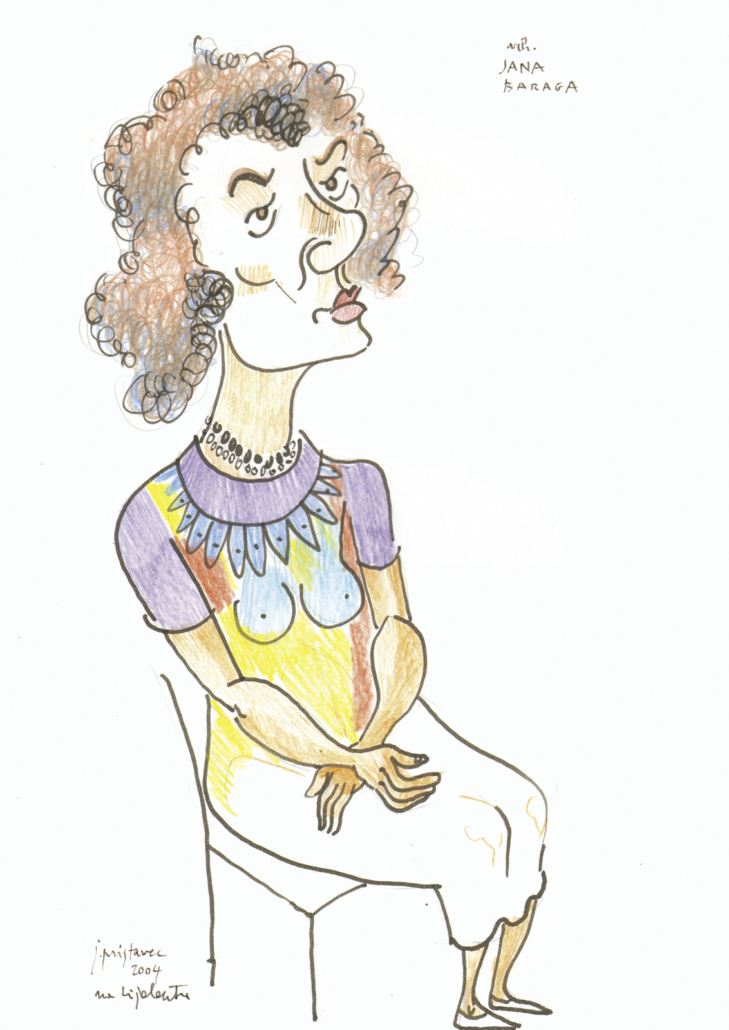


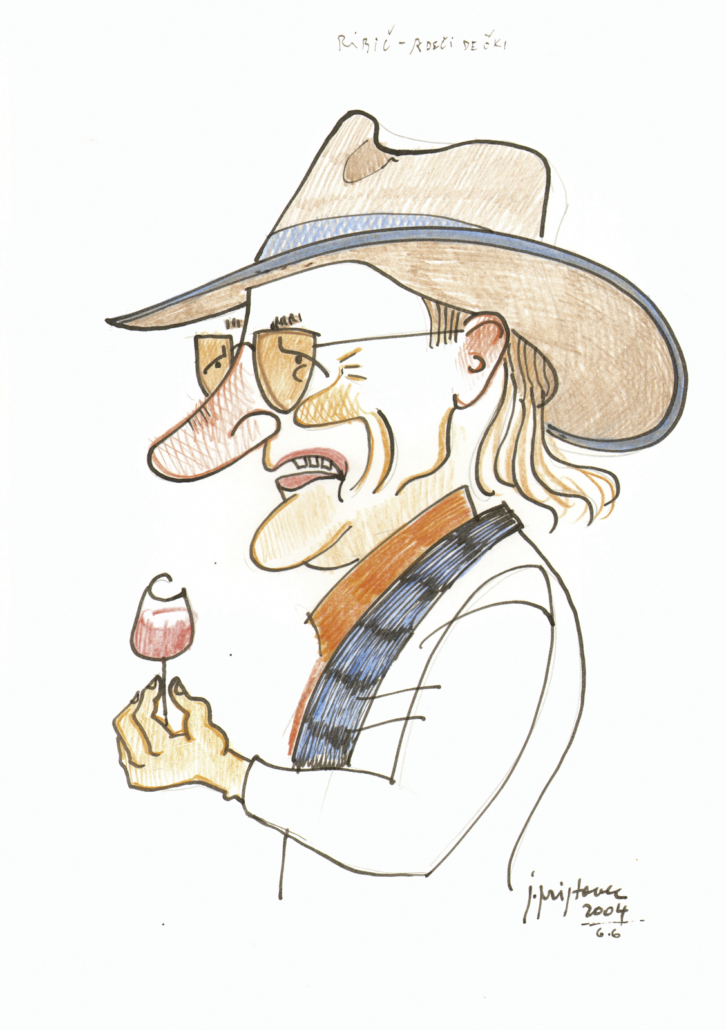


Pristavec’s caricature portraits occupy the border between portraiture, drawing and social performance. The artist does not attempt to reproduce every visible detail. Instead, he selects the features that make a person immediately recognisable and intensifies them through enlargement, abbreviation and rhythmic line. A prominent nose, distinctive glasses, an unusual hairstyle or a characteristic posture may become the structural centre of the entire image. Coloured pencil is applied sparingly but deliberately, directing attention towards the face, clothing or an identifying object. Although many drawings are humorous, their purpose is rarely ridicule. They preserve the individuality of the sitter and transform an encounter into a concise visual memory.
Pristavec’s caricature portraits are not merely humorous variations on conventional portraiture. They represent a distinct method of seeing in which likeness must survive reduction, exaggeration and speed.
Unlike portraits on canvas, which are constructed through chromatic mass and material density, caricature depends upon selection. The artist must decide which features can be omitted and which carry the identity of the entire person. An enlarged forehead, elongated nose, compressed body or emphasised gesture does not necessarily weaken resemblance. In the most successful works, disproportion becomes its principal instrument.
The drawings also preserve the circumstances of their creation. Names, dates, places, dedications and brief comments frequently remain visible on the sheet. Musical events, literary gatherings, exhibitions and encounters in Maribor enter the image through microphones, books, wine glasses, cameras or drawing tools. Portraiture therefore becomes both an artistic act and a record of cultural life.
Many of the works were produced in public, where observation, drawing and recognition occurred almost simultaneously. This performative dimension distinguishes them from the more private portraits on paper. The sitter, artist and audience temporarily shared the same event, while the completed drawing became a material trace of that encounter. The publication Encounters extended this ephemeral practice into a lasting social archive.
Caricature has a particular position within Janez Pristavec’s portrait oeuvre because it reveals the minimum visual information required for a person to remain recognisable. Where the painted portrait gradually constructs presence, caricature must discover it almost immediately.
This demand makes caricature an art of radical selection. The artist cannot describe the entire face with equal attention. He must recognise the physiognomic hierarchy of the sitter: the relation between nose and mouth, the angle of the forehead, the weight of the eyelids, the direction of the hair or the habitual inclination of the head. One feature may be enlarged, another abbreviated and a third almost completely omitted.
Exaggeration is therefore not added to an already completed likeness. It is the means through which likeness is created. The sitter becomes recognisable precisely because the artist abandons anatomical equality and gives greater visual weight to those features that carry the strongest individual significance.
Line performs several tasks at once. It defines the silhouette, indicates movement and establishes the rhythm of the sheet. A single curve may describe the forehead, nose and temperament; a broken contour may suggest age, nervousness or bodily hesitation. The drawings often retain the speed of execution, allowing the viewer to follow the movement of the hand and the sequence of the artist’s decisions.
The surrounding blank paper is equally important. Figures are generally isolated within an open field, without a fully described interior or landscape. This emptiness concentrates attention upon the face, body and gesture. At the same time, it gives the drawing the character of an event rather than a complete illusionistic scene: the person appears as though briefly called into visibility by the line.
Colour is economical but structurally significant. Blue, yellow, violet, red and brown do not model the face naturalistically. They identify clothing, emphasise a hairstyle, separate one figure from another or introduce a visual counterpoint to the linear drawing. Because large parts of the sheet remain uncoloured, even a small chromatic accent can organise the entire composition.
Pristavec does not limit caricature to the enlarged head. In many works the body becomes an equally important carrier of character. A compressed torso, thin legs, oversized hands or a slightly theatrical pose extend physiognomy into gesture. The sitter is recognised not only through the face but through the way they sit, speak, hold a glass, draw, sing or address another person.
Objects function as concise biographical signs. A microphone identifies the musician, a book or sheet of paper suggests the writer, a camera the photographer and drawing materials the artist. These objects do not create a detailed narrative; they provide just enough context to connect physical appearance with occupation, public role or the circumstances of the meeting.
The group caricatures introduce a particularly dynamic form. Two or more heads face one another, while differences in profile, scale and gesture create an abbreviated social scene. Conversation, artistic exchange or a shared public appearance is translated into a compact visual dialogue. Caricature thereby moves beyond the isolated individual and begins to record relationships.
The inscriptions preserved on many sheets are an integral part of their documentary character. Dates, locations, names and occasional remarks situate the drawing within a particular encounter. Word and image coexist without becoming conventional illustration: the inscription anchors the event, while the drawing records its human presence.
The collection brings together artists, writers, musicians, cultural figures, acquaintances, visitors and anonymous participants. Well-known personalities appear beside people identified only by a first name, profession or place of meeting. This mixture is essential. It prevents the series from becoming a formal gallery of celebrities and instead presents culture as a network of individual encounters.
Some works approach affectionate portraiture; others are more openly comic. Yet the humour generally arises from recognition rather than hostility. Pristavec enlarges what is already distinctive instead of imposing an unrelated grotesque mask upon the sitter. The person remains an individual rather than becoming merely an example of a social type.
This balance gives caricature an ethical dimension. Exaggeration always carries the danger of reducing a person to a defect or stereotype. The strongest drawings avoid this by preserving vulnerability, dignity or psychological ambiguity within the comic transformation. Wit and respect are not opposites; they depend upon the artist’s ability to distinguish perceptive emphasis from humiliation.
The inclusion of an artist’s self-portrait is important in this respect. By applying the same principle of distortion to his own face, Pristavec places himself within the community he observes. He is not an invisible judge standing outside the scene, but one of its participants and potential comic figures.
Public drawing further changes the meaning of authorship. The work is produced under temporal pressure and often before spectators. There is little opportunity for extensive correction. The drawing must emerge from confidence, visual memory and the immediate response to the sitter. Its occasional irregularity is therefore not simply a weakness but evidence of risk and directness.
The concentration of works around 2004 suggests an especially intensive period of public and social portrait activity. Taken together, the drawings preserve more than individual physiognomies. They evoke a cultural environment made up of literary gatherings, musical performances, exhibitions, conversations and informal meetings.
The book Encounters gave this practice an additional archival form. Drawings originally connected with temporary occasions could be viewed together as a collective portrait of a city and its cultural community. Publication transformed the momentary exchange between artist and sitter into a more durable form of social memory.
Caricature portraits, portraits on paper and portraits on canvas consequently offer different but complementary truths. Canvas gives the face material and chromatic weight. Paper preserves the immediacy of observation. Caricature reduces the encounter to its most recognisable and communicative signs.
Pristavec’s caricatures are therefore neither secondary sketches nor merely comic diversions. They reveal an artist capable of translating physiognomy, gesture and social context into a highly economical visual language. Each drawing records a person, but the collection as a whole records a community: its faces, professions, relationships and shared cultural occasions.