


Abstract drawings
Asociacije: Line, Colour and Serial Variation, 2000–2001
Through the repeated movement of the hand, line becomes colour, colour becomes structure, and a limited visual rule generates an open field of associations.


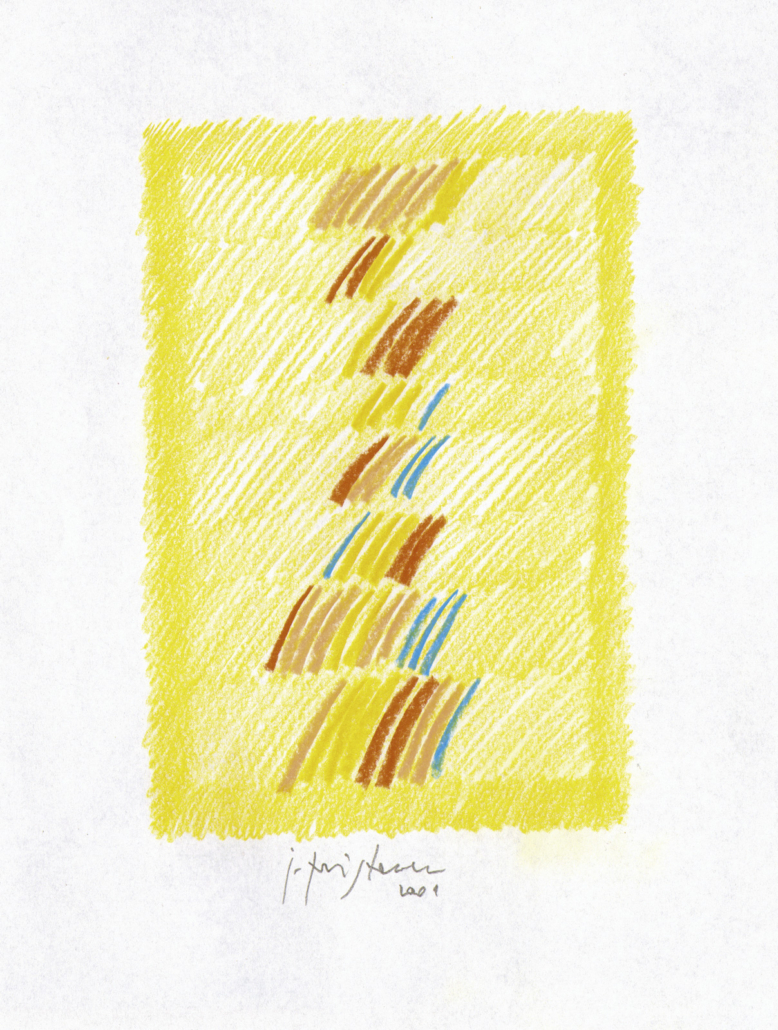

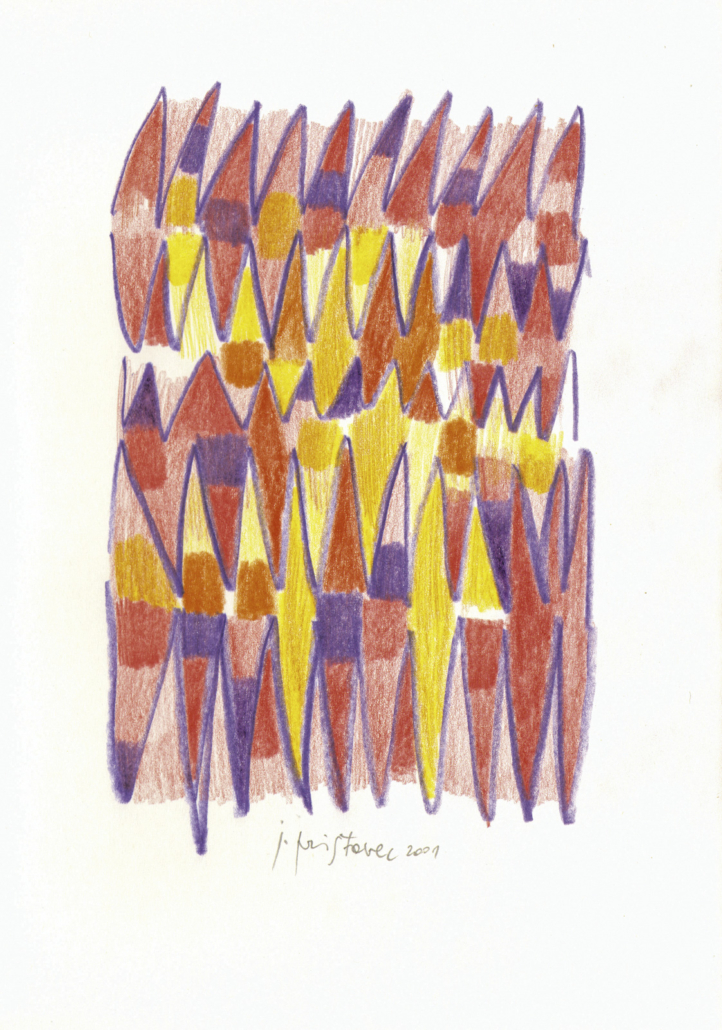


The drawings presented here belong to a concentrated investigation created in 2000 and 2001. In the archive, the group is identified through the titles Abstract Drawings and Asociacije (Associations). The latter also appears in Pristavec’s handwriting on one of the sheets, confirming that the term formed part of his own vocabulary for the cycle.
These works should not be understood as the final stage of a linear development from representation towards abstraction. Pristavec had already explored autonomous colour and non-figurative structure during the 1980s and early 1990s, while portraits, caricatures and figurative drawings remained important around 2000. Asociacije represents a renewed and highly focused return to abstraction within a practice in which different pictorial languages continued to coexist.
Most of the drawings place a concentrated rectangular field within a larger white sheet. The activity of colour remains visibly separated from the physical edges of the paper, while the surrounding margin emphasises the image as a deliberately constructed field. Its boundaries are geometric but never mechanically exact: they are formed by the accumulated beginnings and endings of individual pencil strokes and therefore retain the irregularity of the hand.
The drawing dated 2000 introduces one of the most open and atmospheric approaches in the group. Pale blue, yellow, green and ochre strokes move diagonally through a lightly bounded field. Individual marks remain clearly visible, yet their accumulation produces a continuous chromatic environment. During 2001, this relatively open structure was divided, layered and interrupted through a much broader range of graphic systems.
Several drawings are organised through diagonal hatching. Repeated blue, violet or yellow lines establish a dominant direction, while brighter accents cross or intensify selected areas. Elsewhere, horizontal bands are built from numerous short strokes placed closely beside one another. Seen from a distance, they appear as continuous layers; at close range, their variations in pressure, spacing and orientation become visible.
Another group introduces broken vertical or diagonal axes within comparatively uniform colour fields. Short red, orange, violet, green and blue marks gather into segmented formations that may suggest stems, ladders, spines or fragments of writing. Such resemblances remain provisional. The surrounding field establishes continuity, while the concentrated sequence introduces interruption, asymmetry and visual event.
A substantial part of the cycle is constructed from pointed, leaf-like, triangular or lozenge-shaped units. These forms are repeated in rows, stacked vertically or fitted together into dense chromatic networks. They are related without becoming identical: individual units expand, narrow, tilt and overlap. The drawings consequently occupy an intermediate position between geometric construction and gestural movement.
Several denser sheets depart from the restrained organisation of the colour fields. Dark loops, dashes and rapidly repeated marks interrupt blue, green or violet grounds and produce stronger contrasts between black, colour and exposed paper. The horizontal compositions further expand the cycle by replacing vertical accumulation with lateral movement, diagonal wedges or overlapping circular and fan-like clusters.
Coloured pencil is the principal medium of the series, occasionally supplemented by additional dark drawing media. Pristavec does not use colour merely to fill previously outlined forms. The entire pictorial field is constructed through repeated directional strokes. Light pressure leaves the grain and whiteness of the paper visible, while stronger pressure and overlapping colours produce denser passages of blue, violet, yellow, ochre and green.
The title Asociacije acknowledges the viewer’s tendency to connect abstract forms with remembered visual experiences. Horizontal layers may evoke landscapes, geological strata or textiles; pointed units may recall leaves, flames, feathers or moving bodies; concentrated sequences of colour can suggest growth, notation or fragmented writing. None of these associations provides a fixed subject. The method of construction remains clearly observable, while the possible identity of the resulting forms stays open.
The cycle is connected with earlier parts of Pristavec’s oeuvre without simply repeating them. Horizontal divisions recall structures found in The Hill and Množice, while the autonomy of colour relates the drawings to the abstract works on crumpled paper. Materially, however, Asociacije is distinct. Instead of using folds, relief and shadows as active elements, Pristavec returns to a flat sheet and constructs movement through the pressure, direction and duration of the drawn line.
Serial variation is the principal unifying method of the group. Pristavec repeatedly establishes a limited rule—a horizontal band, diagonal field, broken axis or pointed module—and tests how far it can be transformed. Repetition therefore does not lead to uniformity. It reveals differences in rhythm, density, chromatic balance and the relationship between order and interruption.
Taken together, Asociacije demonstrates how Pristavec developed a remarkably varied abstract vocabulary from modest materials and the repeated movement of the hand. Line is no longer required to describe a body, animal or object, yet it retains its physical origin in gesture and time. Colour does not replace drawing; it is produced through drawing.