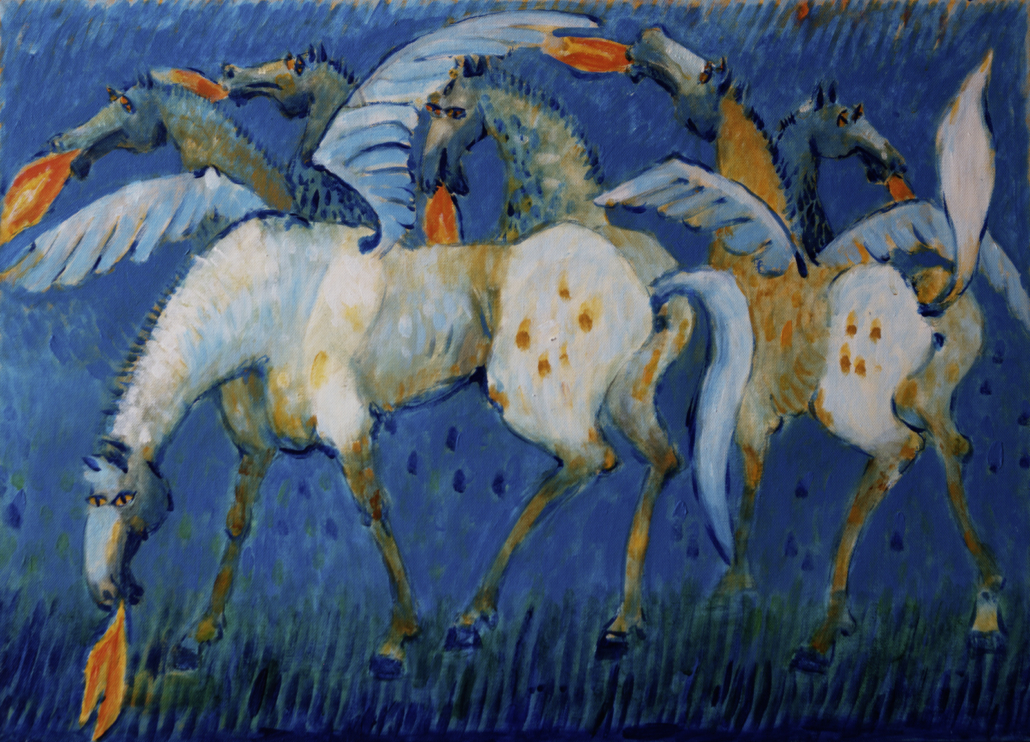
Mythology series

Late Synthesis, Personal Mythography and the Painting of Metamorphosis

In the late Mythology, all of Pristavec’s paths converge: figure, animal, nude, mask, colour surface and personal imagination.

Mythology was created mainly in 2006 and 2007 and represents the final major completed ensemble in Pristavec’s oeuvre. Ancient myths, Christian legends, Slovenian literary tradition and the artist’s personal imagination meet within it. Pegasus, centaur, Minotaur, Nereid or dragon are not iconographically exact reconstructions but carriers of bodily and psychological tension.

The hybrid is the central figure of the cycle. Human and animal parts are joined visibly, often through strong contour, colour change or abrupt bodily turn. Pristavec does not conceal the imperfect junction, because he is interested precisely in the moment of metamorphosis. Pegasus combines the bodily weight of the horse with the possibility of flight, the centaur reason with instinct, while the Minotaur and dragon embody a danger that is both alien and unexpectedly human.

Narrative is not linear. Several actions may be condensed into one field; figures overlap, fall, attack or fly in different directions. Colour functions dramatically: blue opens night, water or transcendent space; red condenses bodily conflict; yellow and orange create impacts of light. Mythology is a late synthesis because drawing discipline, crumpled surface, mask, nude, animal, theatrical space and serial repetition all enter it. The cycle does not merely summarise earlier solutions but translates them into a new personal mythography.

Mythology is not simply the final chapter of Pristavec’s work but an active synthesis of his fundamental pictorial problems. Human and animal body, drawing and colour mass, narrative and ornament merge within it into a personal world of metamorphosis.

Mythology occupies a distinctive position within Janez Pristavec’s oeuvre. Because it was made near the end of his life, it would be easy to describe it as an epilogue, a final retrospective glance or a symbolic farewell. Such a reading is tempting but too narrow. The cycle is not simply a conclusion; it actively transforms everything the artist had developed over previous decades: the discipline of drawing, emancipated colour, deformed figuration, the animal body, theatrical staging, the erotic charge of the nude and the material tension of the pictorial surface.

Lateness here does not mean calm or withdrawal. On the contrary, the paintings are concentrated, restless and often almost combative. Pristavec does not return to myth in order to recover classical order. He turns to it because myth grants him the highest degree of freedom: the freedom to fuse human and animal, narrative and sign, cultural memory and private fantasy, recognisable figure and chromatic eruption.

The first reproduction in the surviving body of work depicts the artist beside a canvas on which winged horses are appearing. Flowers, ceramic vessels and traces of the working environment surround him. The image is more than a studio document. It acts as a programmatic prologue, presenting myth as something that comes into being before the viewer within the concrete space of the painter’s labour.

The scene is governed by a significant duality. The artist is both observer and maker of the beings he paints. Pegasus is not summoned from a remote antiquity but born on the canvas among ordinary studio objects. Mythological and everyday reality are not separate worlds. Vase and painting, model and imagination, work surface and vision occupy the same space.

The title Mythology might suggest a homogeneous classical cycle, yet the surviving body of work reveals a wider and more syncretic repertoire. Alongside Pegasus, centaurs, the Minotaur, Nereids and other classical beings appear Urška and the Water Man, a saint confronting a dragon, and scenes close to apocalyptic or folkloric imagination. The cycle is not bound to a single mythological tradition.

This heterogeneity is not an iconographic inconsistency but a defining feature of personal mythography. The artist treats cultural memory as an open archive in which the ancient, the Christian, the Slovenian and the invented are not rigidly separated. He selects situations that permit conflict, flight, abduction, metamorphosis, heroic action or bodily fusion.

This openness allows the motif to operate on several levels. A centaur is not only a character from a specific tale but a conjunction of instinct and reason; Pegasus is not merely a winged horse but a figure of ascent; the dragon is adversary, bodily danger and chromatic knot; the Minotaur is a carrier of inner division. Meaning emerges not only from the title but from posture, colour field, directional movement and the relation between bodies.

Such space does not represent one isolated second. It is a field of compressed action in which time becomes open and cyclical. The viewer does not follow a story from left to right but enters a network of events, reading the composition much as one reads memory, dream or a mural where different moments coexist.

The hybrid is the fundamental figure of the cycle. The centaur joins human and horse; the Nereid approaches a piscine or serpentine body; the winged horse crosses the boundary between earth and air; the dragon combines parts of several animals. Such bodies are not exceptions within an ordered world. They establish its law.

Pristavec does not conceal hybridity. Junctions are frequently emphasised by contour, a change of colour or a sudden twist in the body. Anatomy is not smoothed into a plausible fantasy creature because plausibility is not the aim. What matters is the visible transition, the point at which one kind of body becomes another.

The cycle is better understood as a late opening than a farewell. Myth allowed Pristavec his greatest freedom, yet it remained anchored in decades of observing body, animal, surface and colour. The entire oeuvre condenses here into one last major pictorial field.

Sacred Tradition as a Pictorial Field

The Body between Sacrifice, Witnessing and Revelation

In Pristavec’s sacred paintings, the inherited Christian image becomes a field in which the vulnerable body, the written word and the painted sign confront the limits of suffering and representation.

Created in 2007 alongside the Mythology series, these works form a concentrated group centred upon the Crucifixion, the Descent from the Cross and the Four Horsemen of the Apocalypse. They do not constitute a conventional religious cycle or a systematic reconstruction of biblical narratives. Pristavec approaches sacred imagery through the same questions that shape his late mythological paintings: bodily transformation, conflict, vulnerability, movement and the unstable boundary between narrative and pictorial sign.

The Crucifixion is the dominant motif of the group. Pristavec returns to it in several markedly different versions, treating repetition as a means of investigation rather than duplication. The cross becomes a heavy geometric structure, while Christ’s body is stretched, twisted or displaced across its rigid axes. The contrast between the immovable construction and the exposed human figure transforms the biblical event into an elemental confrontation between body and structure, mortality and transcendence.

Words, inscriptions and diagrammatic lines enter directly into the painted field. The cry “Eloi, Eloi, lama sabachthani” is not merely quoted but written across the image as an urgent visual trace. The inscription INRI, isolated fragments of language and the recurring eye enclosed within a triangle connect the represented event with a second level of signs. Language does not explain the image; it intensifies its instability and emotional pressure.

The Descent from the Cross and the Four Horsemen of the Apocalypse expand the group beyond the central image of sacrifice. One concentrates upon the bodily weight and human intimacy that follow death; the other transforms biblical revelation into a procession of collective catastrophe. Together, the works move between individual suffering and universal destruction, presenting sacred tradition as a living pictorial language through which Pristavec confronts abandonment, violence, witness and the possibility of meaning.

The sacred and apocalyptic works occupy a significant place within Janez Pristavec’s late oeuvre. Made during the same period as the principal paintings of Mythology, they share their vivid colour, compressed action, exposed drawing and freedom of association. Their presence beside scenes of Pegasus, the Minotaur, Danaë and Saint George reveals that Pristavec did not treat classical mythology, Christian tradition and personal imagination as isolated territories. Each offered situations in which the body is tested by forces greater than itself.

The Christian subjects nevertheless introduce a different emotional gravity. In the mythological paintings, bodies fly, merge, attack or undergo metamorphosis. In the Crucifixions, movement is arrested. The body remains bound to the cross, and the drama develops from the tension between physical immobility and inner intensity. Transformation is no longer embodied by a hybrid creature but concentrated in suffering, death and the unresolved promise of transcendence.

Pristavec’s repeated return to the Crucifixion should therefore not be understood as the production of variations upon a fixed iconographic formula. Each painting reorganises the relationship between cross, body and surrounding figures. Some compositions are dominated by a single monumental figure; others widen into complex scenes containing witnesses, secondary crucified bodies, fragments of animals and signs drawn from neighbouring mythological motifs. The event remains recognisable, but its pictorial structure is continually reopened.

The cross is both an object within the narrative and the principal architecture of the image. Its broad ochre and yellow beams establish an emphatic vertical and horizontal order. Against this rigid construction, Christ’s body appears unstable: arms strain along the crossbeam, the torso bends away from the central axis, the head turns sharply and the hands remain painfully open. The body does not rest upon the geometry but struggles against it.

This conflict recalls Pristavec’s long engagement with the nude figure, yet the meaning of bodily exposure has fundamentally changed. The earlier nude may be intimate, erotic, contemplative or formally self-contained. Here nakedness signifies vulnerability. Flesh is rendered through pink, red, orange and pale yellow, colours that make the body appear simultaneously living and wounded. Anatomical distortion does not diminish its humanity; it makes the experience of suffering more immediate.

Bright blue lines are drawn across several bodies like an irregular grid, a system of coordinates or a provisional scaffold. They may suggest construction, confinement, measurement or an attempt to impose order upon an event that resists rational explanation. Their meaning remains deliberately open. What matters pictorially is the way this cool linear structure cuts across the warm, organic surface of the flesh, placing diagram and body in direct tension.

Writing performs a comparable function. The words are not separated from the painted scene as captions. They bend around bodies, interrupt areas of colour and follow the movement of the artist’s hand. Christ’s cry of abandonment becomes both language and drawing: a statement that can be read and a rhythm that must be seen. The handwritten text introduces the immediacy of a note, invocation or private meditation into a subject burdened by centuries of established representation.

Other signs remain similarly suspended between traditional meaning and personal invention. The INRI panel identifies the biblical scene, while the isolated eye enclosed by a triangle introduces the idea of vision and witnessing. It may recall the conventional Eye of Providence, yet Pristavec does not employ it as a stable doctrinal emblem. Detached from an ordered sacred scheme, it becomes an ambiguous presence: an eye that observes suffering without resolving it.

The surrounding figures are equally important. They do not always correspond precisely to the traditional participants of the Crucifixion. Some approach as mourners, witnesses or bearers of the dead; others appear displaced, fragmented or absorbed into neighbouring scenes. Their uncertain identities shift attention from iconographic identification towards the act of witnessing itself. They establish a human community around the isolated body while simultaneously intensifying its solitude.

In the Descent from the Cross, the drama changes from exposure to contact. The rigid verticality of the crucified body gives way to the diagonal weight of the dead Christ as he is lowered and supported. The composition is quieter and darker, but no less physical. Sacred meaning is carried through the effort of holding another body: through bent postures, extended arms and the precarious transfer of weight from the cross into human hands.

The Four Horsemen of the Apocalypse transforms stillness into relentless movement. Riders and animals advance across the surface in an uneven procession, their colours and bodily types differentiating the forces named within the painting. The pale skeletal rider, the dark horse and the wounded red animal turn the biblical vision into a condensed image of war, famine, plague and death. Rather than illustrating the Book of Revelation in detail, Pristavec constructs an emblem of collective catastrophe in which human bodies have become inseparable from the forces carrying them forward.

One composite canvas brings the Crucifixion into direct proximity with horses, a dragon, Saint George, a reclining nude and other fragments of Pristavec’s late iconographic world. It should not be read as proof that all these figures possess a single fixed meaning. More convincingly, it functions as a pictorial map of the artist’s thought: a surface upon which sacred history, classical mythology and personal imagery coexist while their possible relationships are being tested.

Saint George occupies a particularly important position at this boundary. As a Christian saint embedded in the structure of heroic legend, he connects hagiography with myth. His active confrontation with the dragon contrasts with the immobilised figure of Christ. One body acts, attacks and attempts to overcome evil; the other endures violence without returning it. Pristavec does not resolve this opposition but uses it to explore two fundamentally different images of spiritual strength.

Colour binds the group together. Deep and luminous blues create an indeterminate space that may evoke night, distance or transcendence without becoming a naturalistic sky. Ochre and yellow give the crosses the weight of constructed matter. Warm reds, pinks and oranges retain the corporeal presence of flesh, while white passages introduce sudden areas of exposure and light. Colour does not decorate the sacred narrative; it establishes its emotional temperature.

These paintings are neither conventional devotional images nor detached revisions of religious iconography. Pristavec preserves the recognisability of the inherited subjects while subjecting them to the urgency of his own late pictorial language. Drawing remains visible, colour is allowed to exceed contour, words enter the image, and distinct narrative moments coexist within a single field.

The sacred and apocalyptic works therefore stand beside Mythology as one of Pristavec’s final investigations of the human condition. Their central theme is not religious certainty but the body placed before the irreversible: sacrifice, death, mourning and catastrophe. Within that confrontation, the sacred image remains open—at once ancient and immediate, collective and personal, an inherited narrative and a newly painted question.