

FISHES AND FROGS ON PAPER
Serial Form, Movement and the Collective Body
In Pristavec’s works on paper, the animal is not merely represented: it is repeated, aligned, reversed and multiplied until the living body becomes rhythm, sign and pictorial structure.
The extensive groups of fishes and frogs occupy a distinctive place within Janez Pristavec’s works on paper. Created primarily between 1979 and 1983, with later returns to the fish motif around 1990 and 1991, they reveal an artist moving freely between observation, drawing, painting and printmaking. Watercolour, opaque colour, linear drawing, linocut and monotype effects are combined in works that resist strict separation into conventional technical categories.
Unlike Pristavec’s academic animal studies and bestiary drawings, these works are not primarily concerned with anatomical description. The recognisable animal body becomes the starting point for a broader investigation of movement, repetition and spatial organisation. A fish may appear as an isolated creature, a pair, a measured row or part of a densely concentrated shoal. A frog may leap, hang, crouch or cast a dark double in the form of its own shadow.
Natural habitat is rarely described realistically. Water is transformed into a blue field, a sequence of horizontal bands, a network of lines or an open surface across which bodies are arranged. Pristavec therefore places living creatures within a space that is simultaneously aquatic, graphic and abstract.
The two motifs produce different pictorial energies. Fishes introduce horizontal movement, flow and collective direction; frogs are defined by angular limbs, sudden changes of posture and the tension between stillness and leap. Together, they demonstrate how a familiar animal form can be transformed into an autonomous visual language.
The animal motif as pictorial structure
The fishes and frogs reveal Pristavec’s sustained interest in the boundary between representation and abstraction. He never reduces the animal completely to a neutral geometric sign. An eye, fin, mouth, curved back or extended limb preserves the physical identity of the creature. At the same time, these features are simplified and repeated until they participate in a larger visual system.
This transformation is closely connected with the logic of printmaking. A form that can be printed or reconstructed more than once naturally encourages seriality. Pristavec exploits this potential without pursuing mechanical uniformity. Variations in pressure, colour, drawing and subsequent painterly intervention ensure that every repetition remains distinct. The image develops through the tension between recurrence and difference.
The ruled lines and networks surrounding many of the fishes play an important role. They may evoke fishing nets, water currents, maps, cages or musical notation, but they never settle into a single descriptive meaning. Their principal function is pictorial: they establish direction, divide the field and create a framework against which organic bodies can move.
In several compositions, the line functions both as a means of connection and restraint. It links individual fishes into a group while simultaneously enclosing them. The resulting shoal can suggest coordinated movement, but also containment and vulnerability. Pristavec leaves this ambiguity unresolved.
The frog series develops a related tension through the use of shadows. Dark silhouettes accompany the coloured bodies, sometimes directly beneath them and sometimes displaced across the surface. A shadow may anchor a frog to the ground, record a previous position or anticipate its next movement. The repeated figure thus introduces an experience of time into an otherwise static image.
Colour further separates the works from zoological illustration. Warm orange and yellow bodies stand out against cool blue and violet fields, while acidic greens and sudden red grounds produce deliberately heightened contrasts. Colour identifies the animal, but it also organises the surface independently of the represented subject.
The serial arrangement of the animals anticipates a method that would remain important throughout Pristavec’s later work: the repeated examination of a single motif through changing colour, scale, orientation and material treatment. Seen in this broader context, the fishes and frogs are not an isolated episode. They form an early and unusually concentrated exploration of repetition as a creative principle.
These works also introduce the question of the collective body. A single animal possesses a clear outline and direction; within a shoal or row, that individuality becomes part of a larger organism. Pristavec repeatedly shifts between these two levels of perception. The viewer first sees the group, then discovers deviations, encounters and opposing movements within it.
The artistic importance of the series lies precisely in this passage between creature and sign, observation and invention, individual presence and collective rhythm. Pristavec’s fishes and frogs remain vividly alive, yet the spaces they inhabit are constructed by the laws of painting and graphic art. Nature provides the motif; repetition transforms it into thought.
Fishes
From the Individual Creature to the Shoal
The fish moves through Pristavec’s images as both a living body and a repeated sign—sometimes solitary, sometimes absorbed into the rhythm of a group.
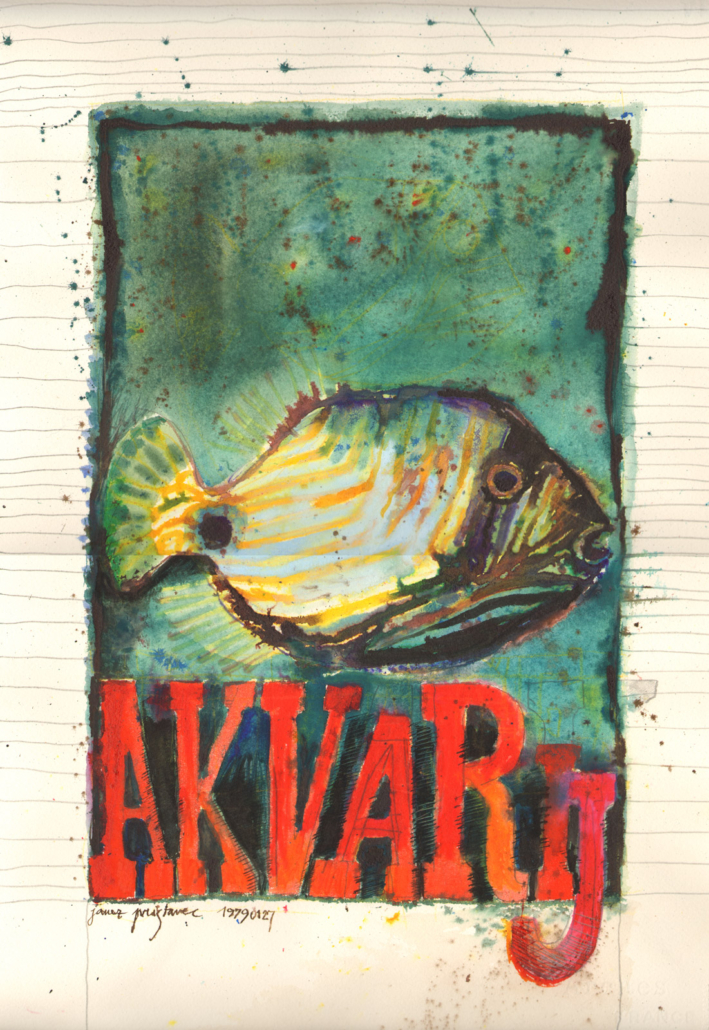
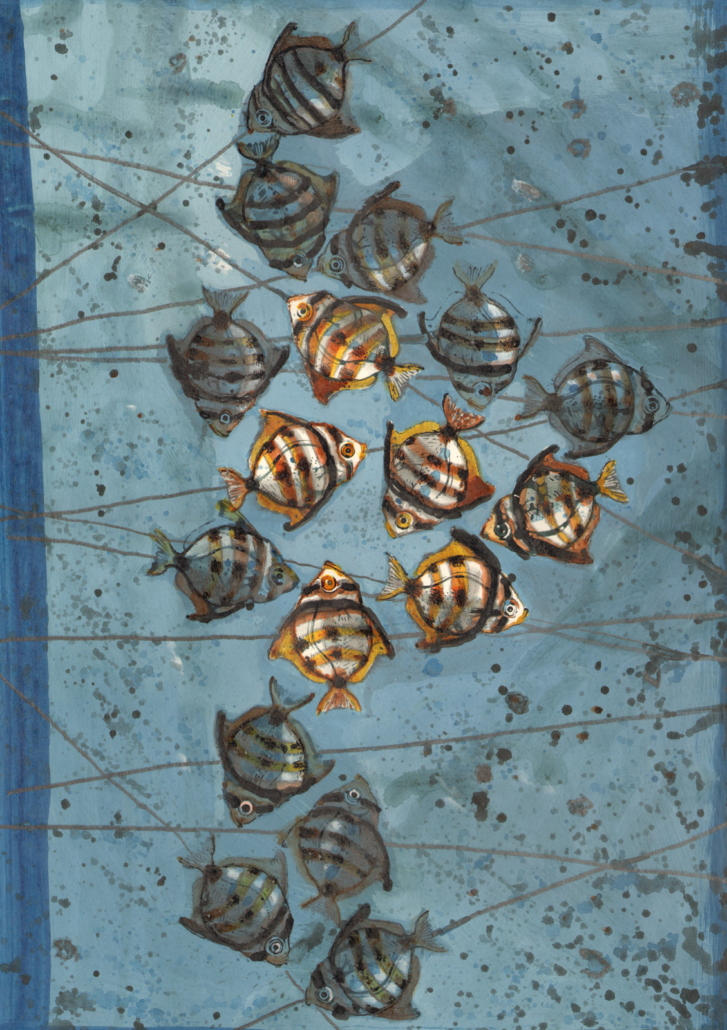
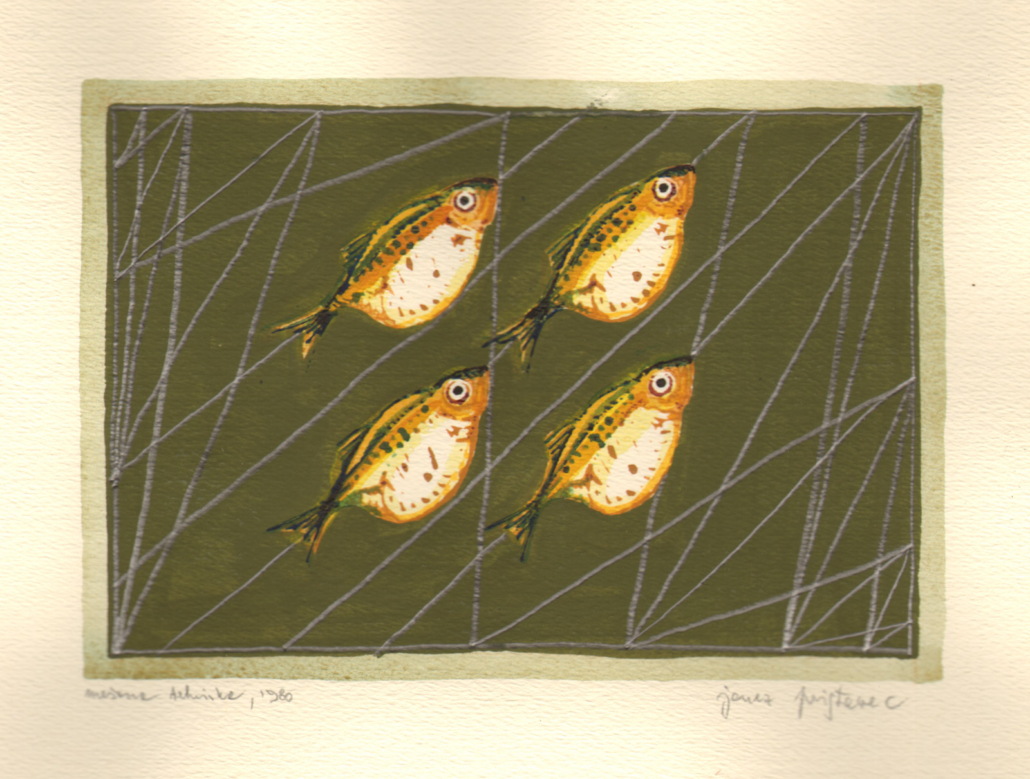
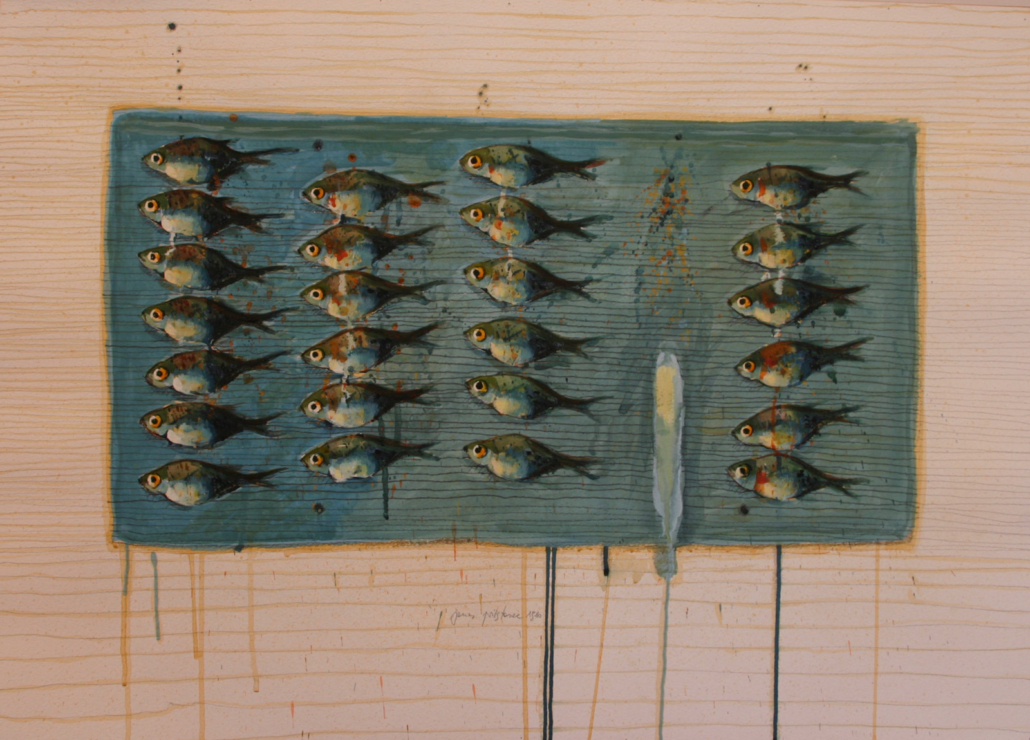
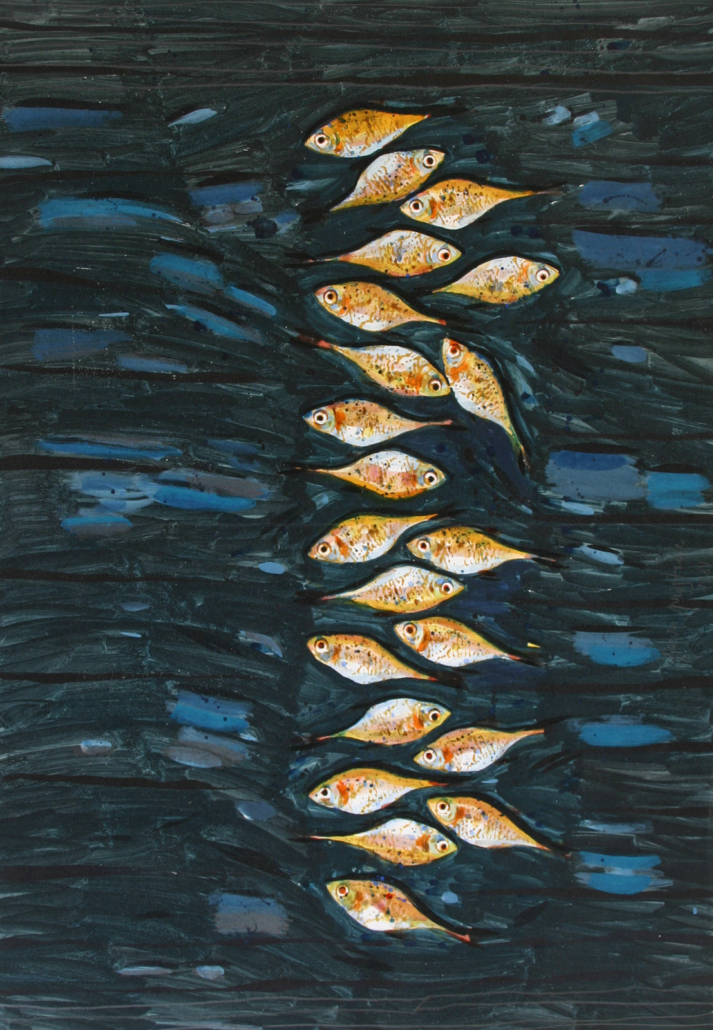
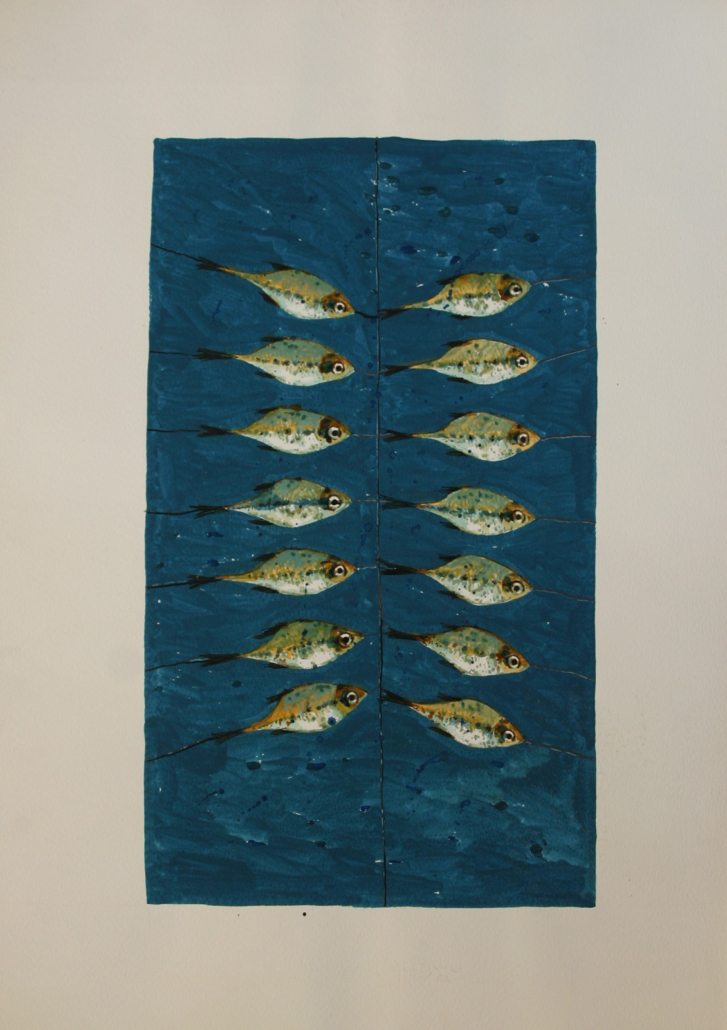
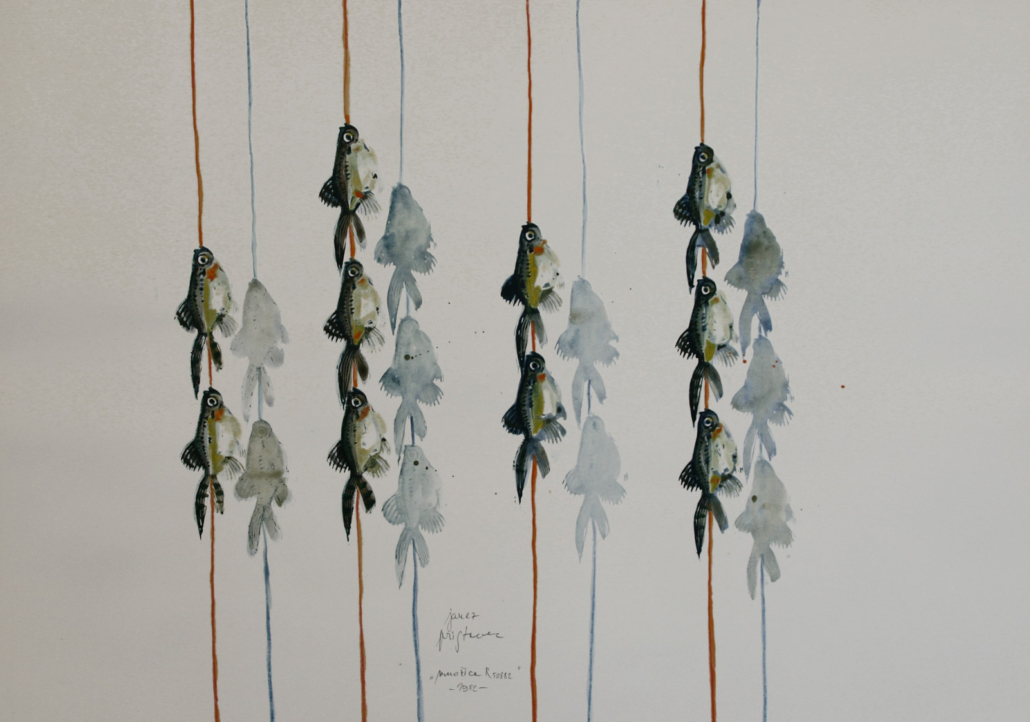
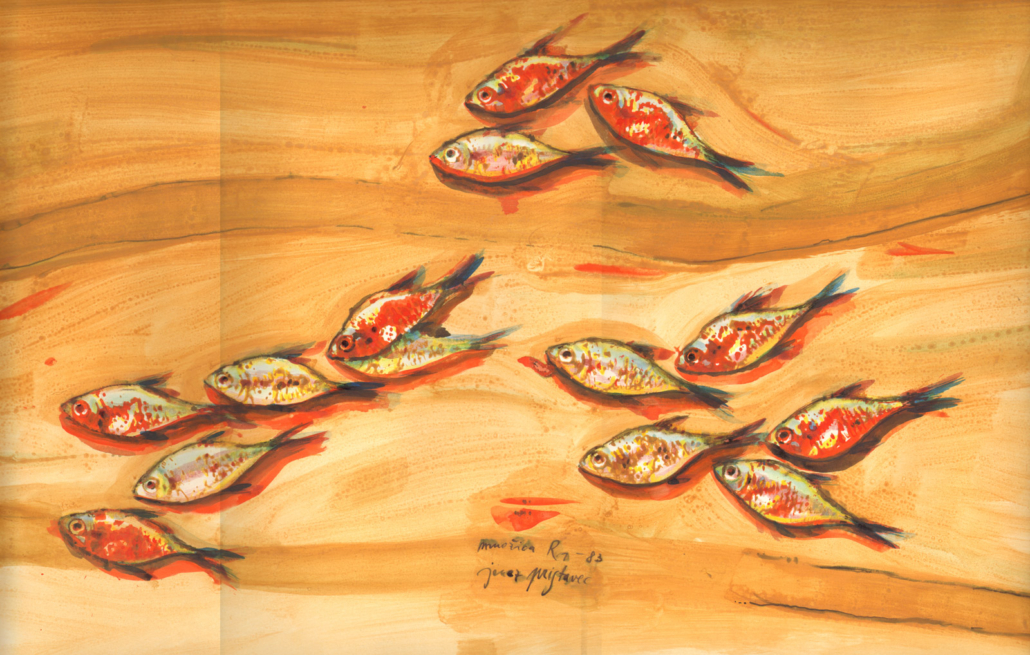
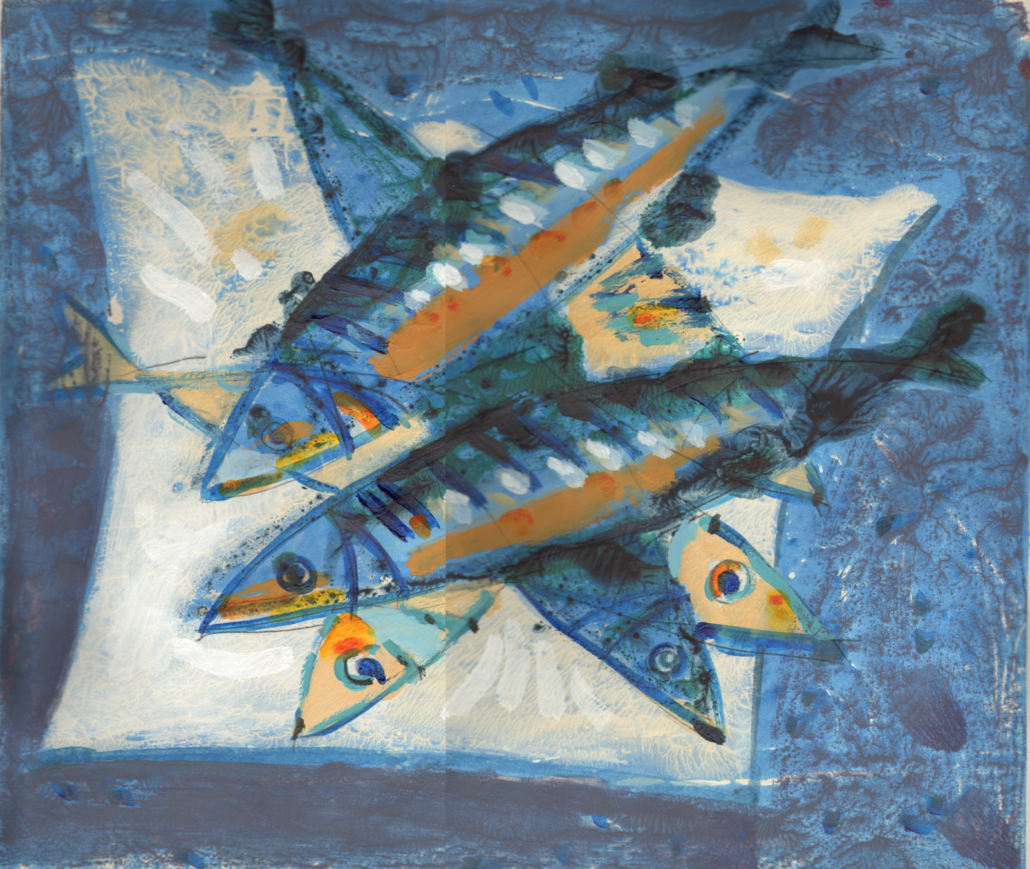
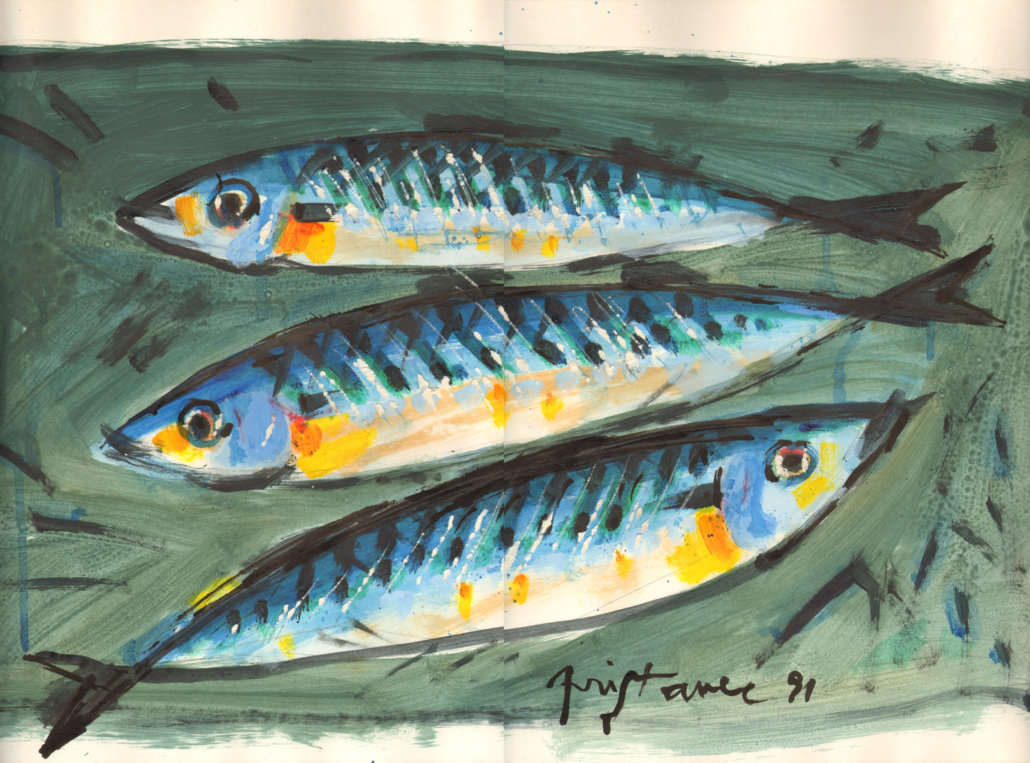
The earliest works from 1979 and 1980 often concentrate upon a clearly outlined individual fish or a small group set against a strongly constructed background. The body retains its anatomical identity, yet colour immediately separates it from naturalistic representation. Orange, yellow, green and white fishes appear against fields of blue, violet, red or ochre, their contours intensified by dark drawing and touches of graphic detail.
In the smaller works from 1980, repetition becomes the principal compositional method. Fishes are arranged in pairs, rows and compact groups. Fine lines divide the surface into rectangles, diagonals and irregular networks, creating spaces that may suggest currents, nets, cages or systems of measurement without illustrating any of them literally. The animal form becomes a module, but no two repetitions are entirely identical.
The larger groups from 1980 and 1981 intensify the contrast between individual body and collective movement. Some shoals are arranged with almost ceremonial order; others gather, scatter or change direction across the page. The viewer can perceive the group as a single shape and simultaneously follow the movements of its individual members. Order is constantly disturbed by variation.
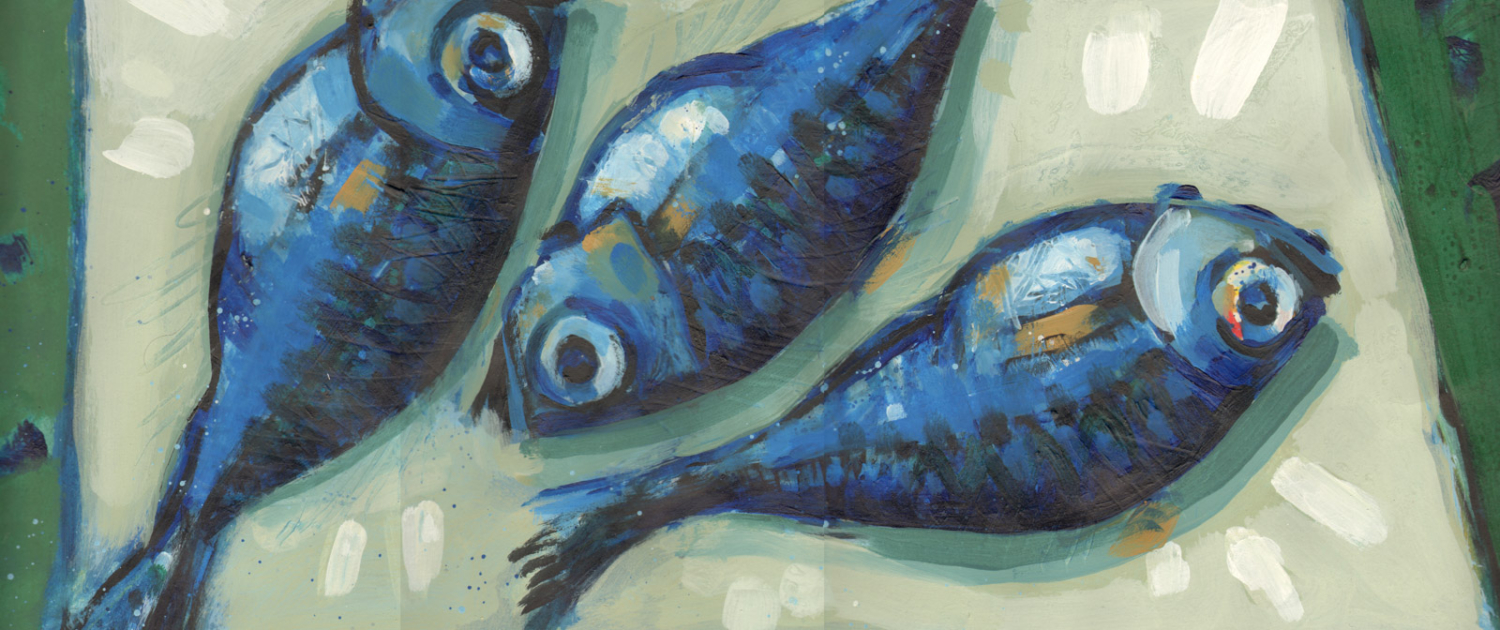
During 1982 and 1983, the compositions become more open and gestural. Printed forms, brushwork and areas of transparent colour overlap, while shoals emerge from energetic accumulations of blue, yellow, red and black marks. Around 1990 and 1991, Pristavec returns to a smaller number of more monumental fishes. Their bodies are heavier, more sharply defined and embedded within dense, painterly surfaces. The motif remains recognisable, but the surrounding space has become increasingly material and expressive.
Frogs
Repetition, Leap and Shadow
Where the fish creates flow, the frog interrupts it: its bent limbs divide the surface into a succession of pauses, leaps and abrupt changes of direction.
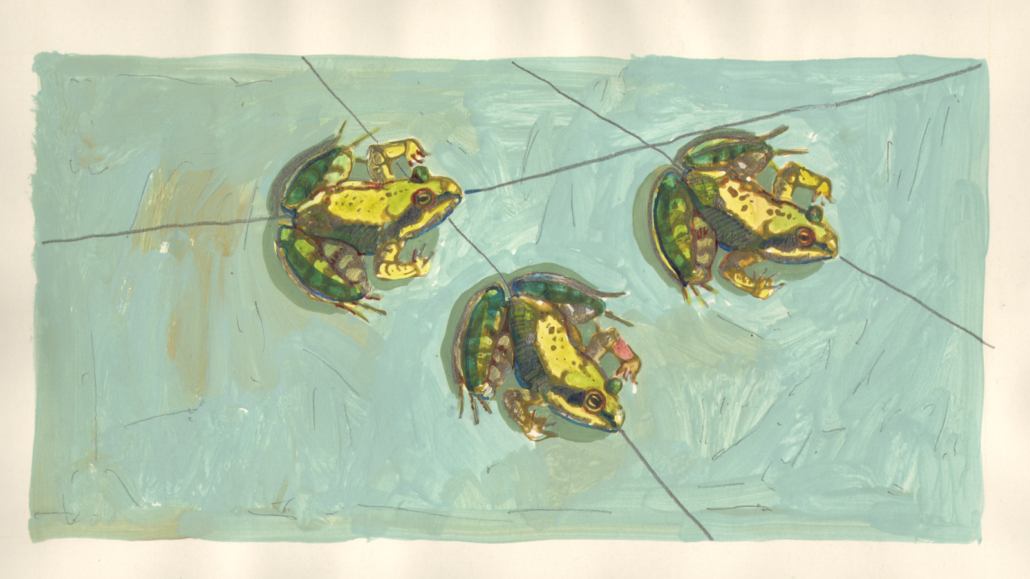
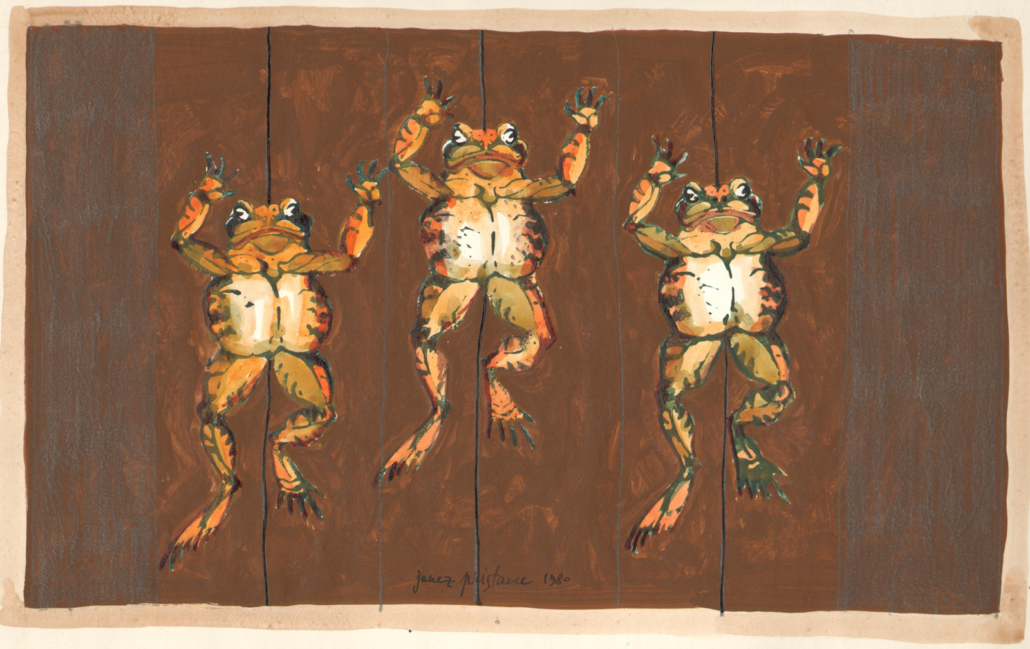
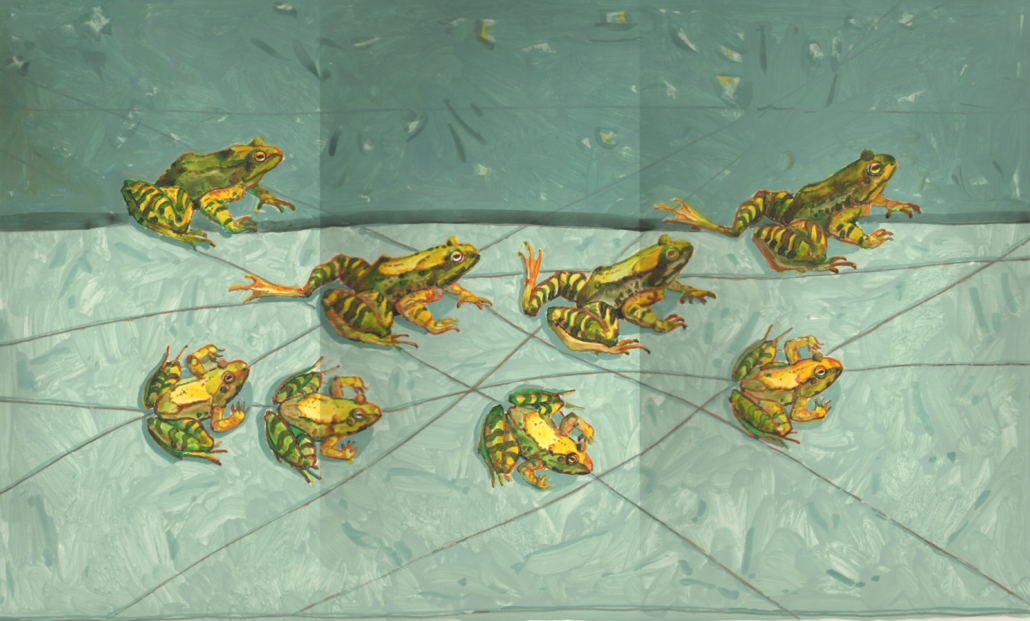
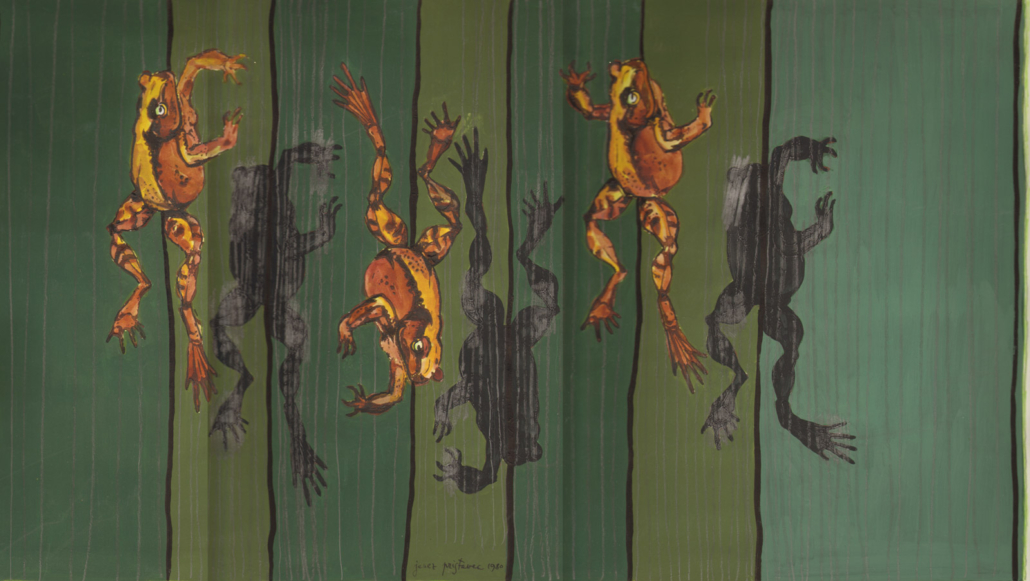
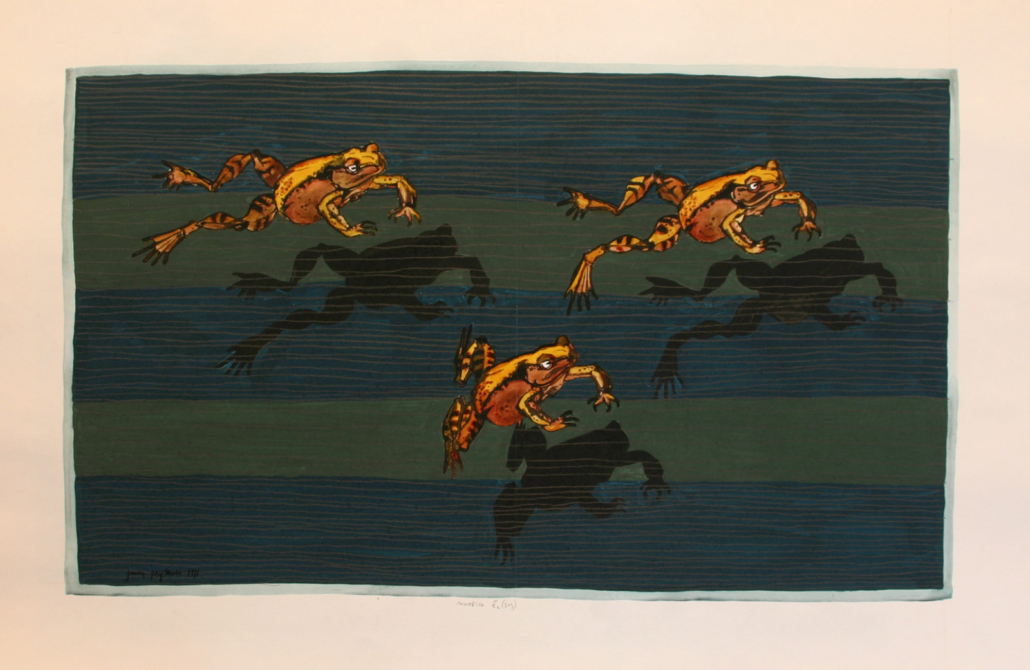
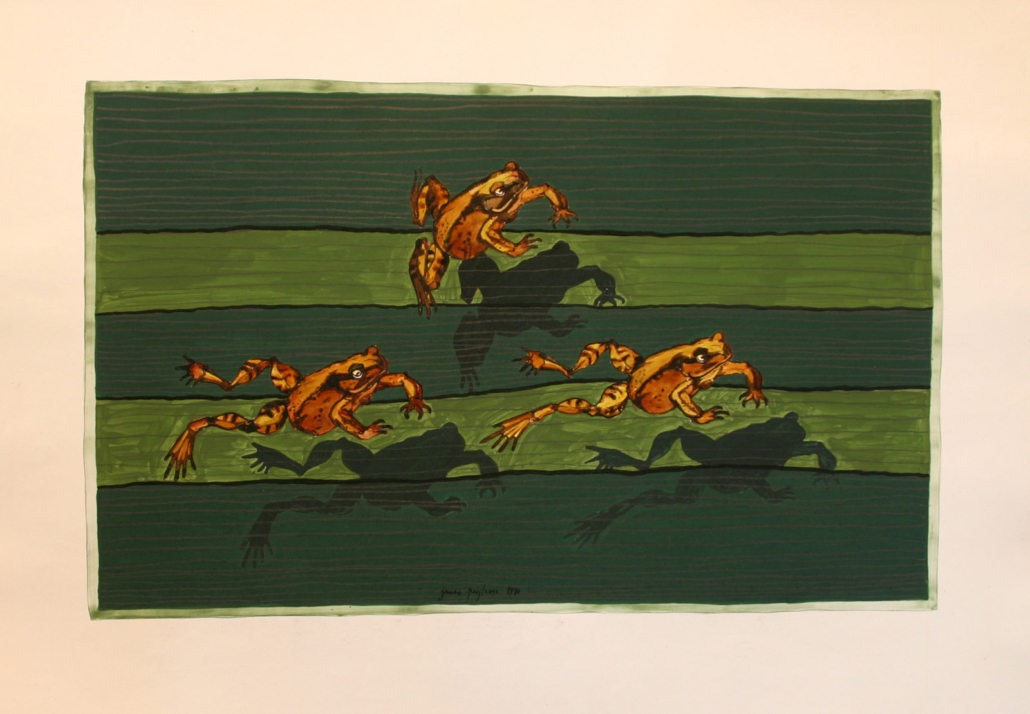
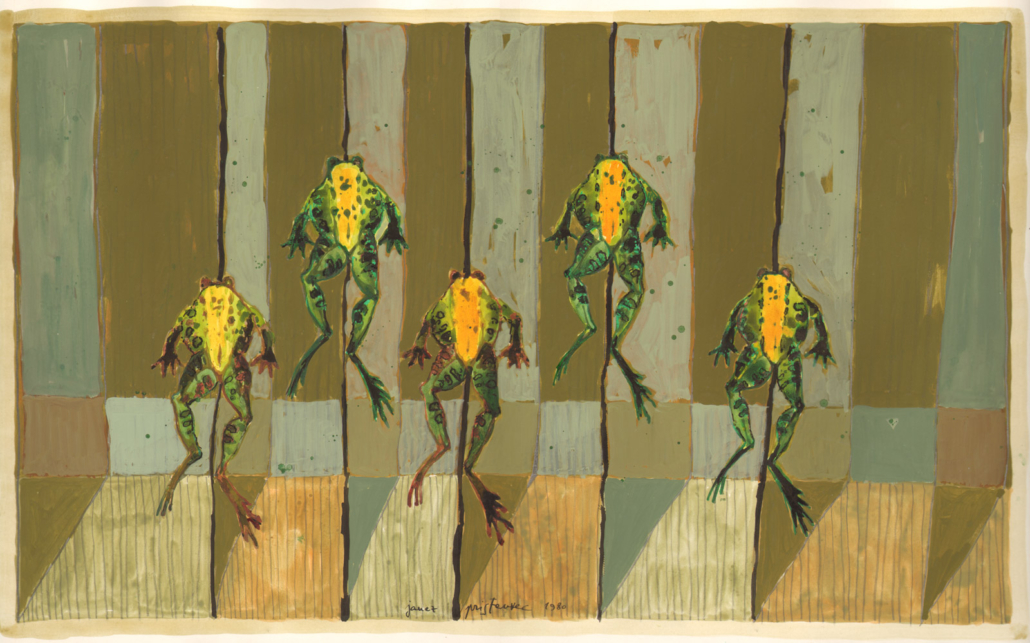
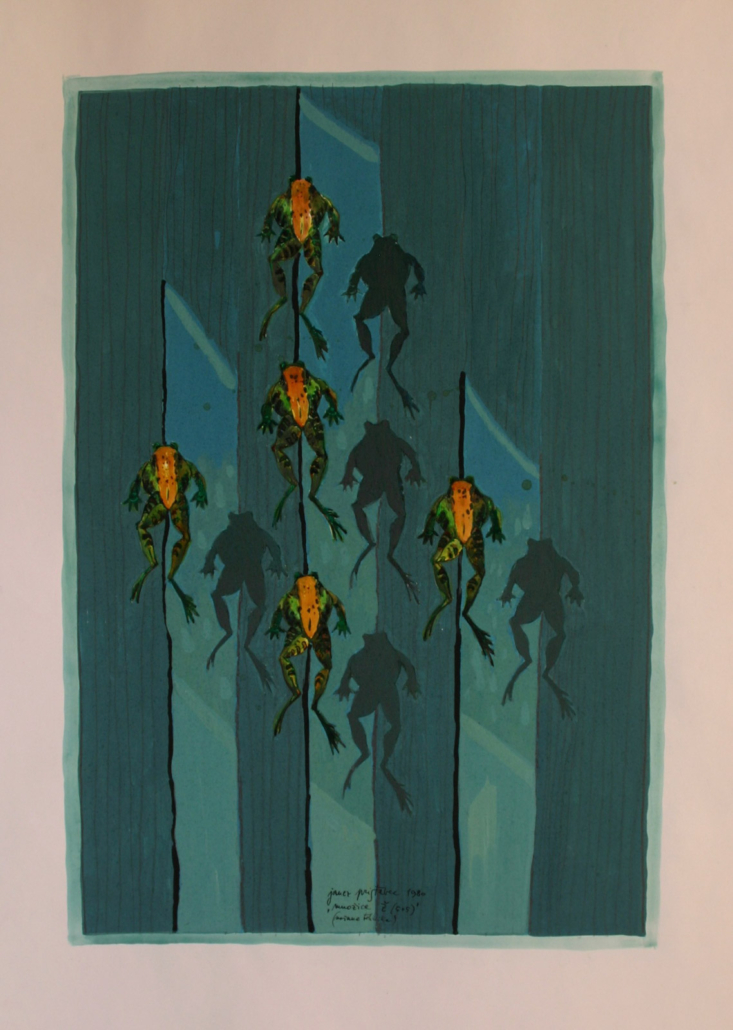
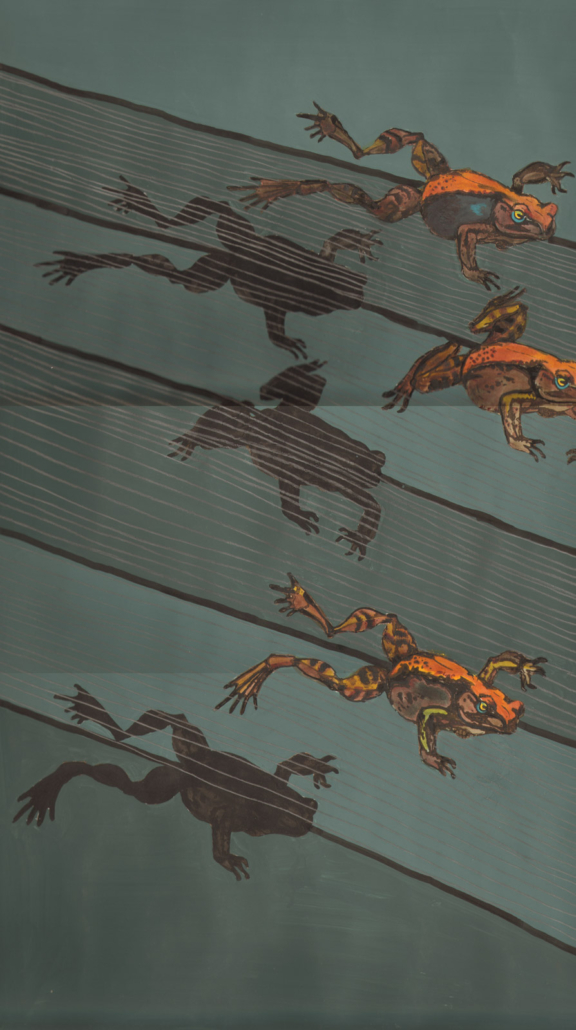
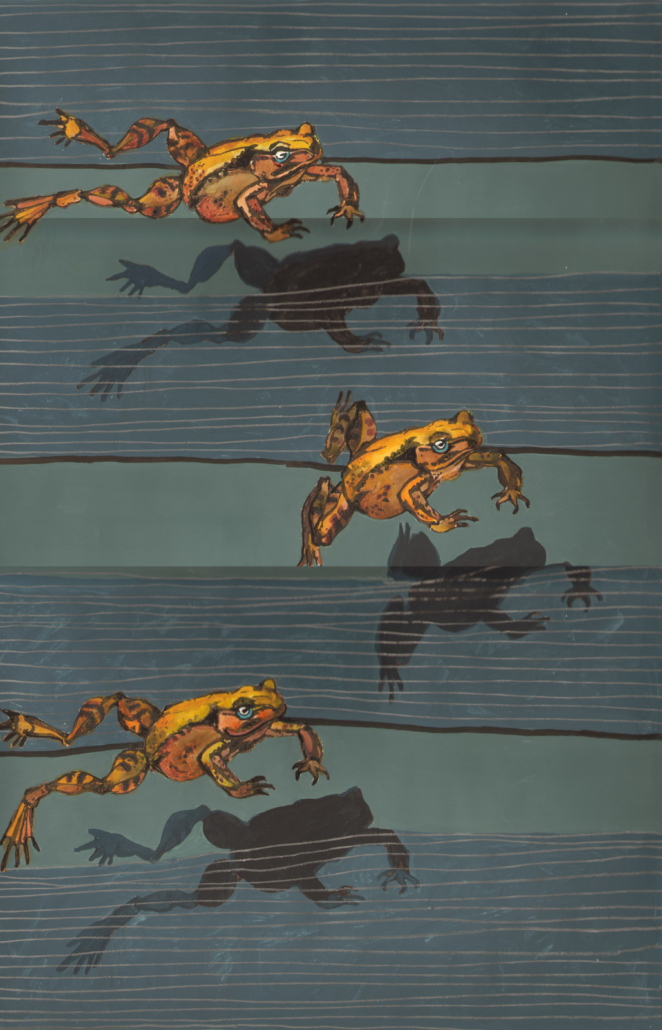
The frog works form a concentrated group from 1980. Pristavec repeatedly places the animal against horizontal bands, vertical divisions and fields of muted blue, green, brown and violet. The frog’s compact body and extended limbs provide a more angular pictorial unit than the streamlined fish. Each change of posture alters the rhythm of the entire composition.
Some works arrange frogs in orderly rows, almost like specimens, signs or performers upon a stage. In others, the figures leap across dark horizontal fields, descend along vertical lines or hang with their bodies inverted. Their elongated shadows create a second population of forms, turning a simple motif into a complex interaction between body, reflection and trace.
Although the series contains an element of visual wit, the frogs are not treated as caricatures. Their repetition becomes a study of bodily articulation and movement. Small differences in the position of a leg, the direction of a head or the distance between two figures generate a sequence that can be read almost cinematically—as consecutive stages of an action preserved within a single image.