


Academy Studies
Anatomy, Movement and the Construction of Form, c. 1972–1977
Through shells, reptiles, amphibians, primate skeletons and the human pelvis, drawing becomes a method of looking beneath visible appearance and discovering the structures that govern form and movement.


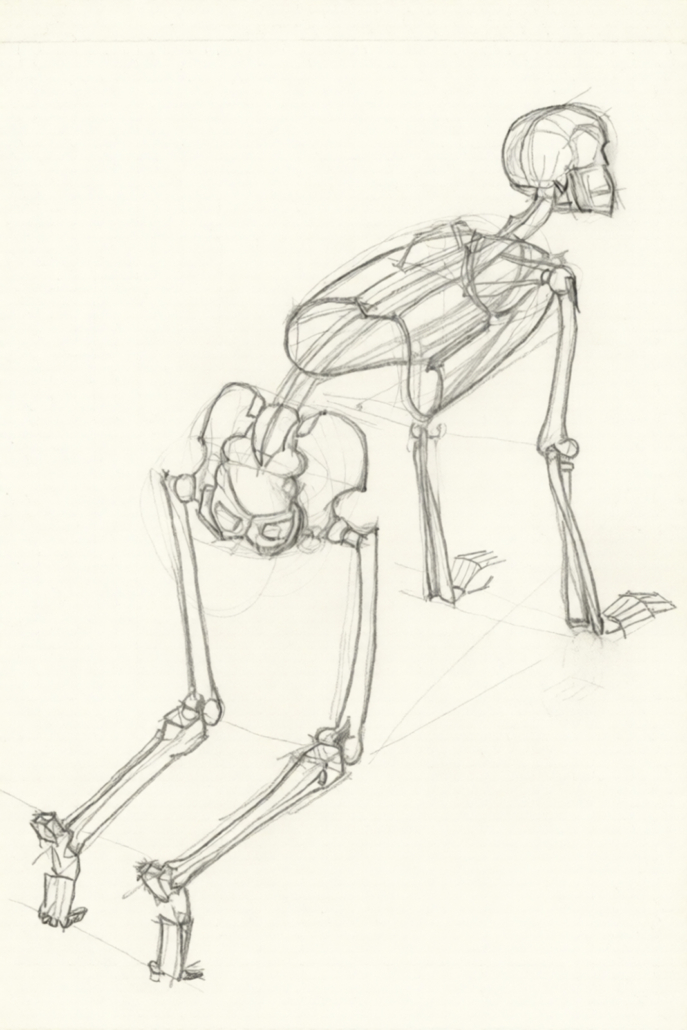


These drawings belong to Janez Pristavec’s period of study at the Academy of Fine Arts in Ljubljana, which he entered in 1972, and to the years immediately following his graduation in 1977. Unlike his later autonomous drawing cycles, the sheets were created primarily as analytical studies. They record the process through which observation was joined with anatomical knowledge, descriptive geometry and the investigation of movement.
The paper functions as an active field of thought. Carefully modelled bodies appear beside skeletal diagrams, isolated bones, geometric constructions and handwritten annotations. A single subject may be represented simultaneously as an observed organism, an internal anatomical system and a simplified arrangement of axes, joints, planes and volumes. The unfinished character of many sheets preserves the successive stages through which visible form was examined and reconstructed.
The shell studies introduce the relationship between organic growth and geometric order. Pristavec follows the outer contour and spiral movement of the shell while also examining openings, sections and internal directions. Graphite establishes volume, whereas coloured lines distinguish selected contours, axes and stages of construction. Geometry does not replace the natural form but provides a means of understanding its spatial organisation.
The largest group is devoted to reptiles and amphibians. Iguanas, lizards and frogs are studied through their external appearance, skeletal structure and changing positions. Pristavec repeatedly isolates limbs and joints, compares phases of movement and traces the transfer of weight through the body. The elongated bodies and tails of reptiles establish strong directional rhythms, while the compact body and extended hind legs of the frog reveal the anatomical relationship between stored energy and sudden motion.
The studies of primate skeletons bring this investigation closer to the construction of the human figure. Seated, crouching and reclining skeletons are not treated as static classroom specimens. The inclination of the spine, the position of the pelvis and the angles of the limbs retain a convincing sense of weight, support and bodily presence. Even when reduced to an armature, the body continues to communicate through posture.
The human pelvis forms the most systematic analytical section of the group. Pristavec examines it from several viewpoints and translates its complex anatomy into cylinders, truncated cones, geometric containers and intersecting planes. This stereometric reduction is not an attempt at Cubist stylisation. It is a method of testing orientation, rotation and the relationship between the pelvic basin, spine and femurs before anatomical contours are reintroduced.
Small additions in red, blue, yellow and ochre clarify particular articulations, sections or spatial directions. Colour remains subordinate to analysis, yet it already demonstrates Pristavec’s awareness that visual relationships can be made legible through chromatic contrast as well as through line. Observation and construction are therefore not separate activities but complementary ways of understanding the same form.
These drawings provide an essential foundation for Pristavec’s later treatment of human, animal and hybrid bodies. The connection should not be understood as a direct progression from an anatomical diagram to a later motif. What persists is a method: observing a form, dividing it into constituent parts and reconstructing it through another pictorial language.
In later cycles such as Množice, the bestiary drawings and the Minotaur compositions, anatomical structure would be compressed, enlarged, deformed or combined with invented forms. Such transformations remain physically convincing precisely because they are supported by an understanding of bodily weight, articulation and movement. Academic discipline was not abandoned; it became concealed within expressive freedom.
Taken together, these studies reveal a decisive stage in Pristavec’s formation. Drawing becomes more than the reproduction of appearance: it exposes internal relationships, compares viewpoints, tests movement and transforms the visible body into a structure that can be analysed, remembered and reinvented.