

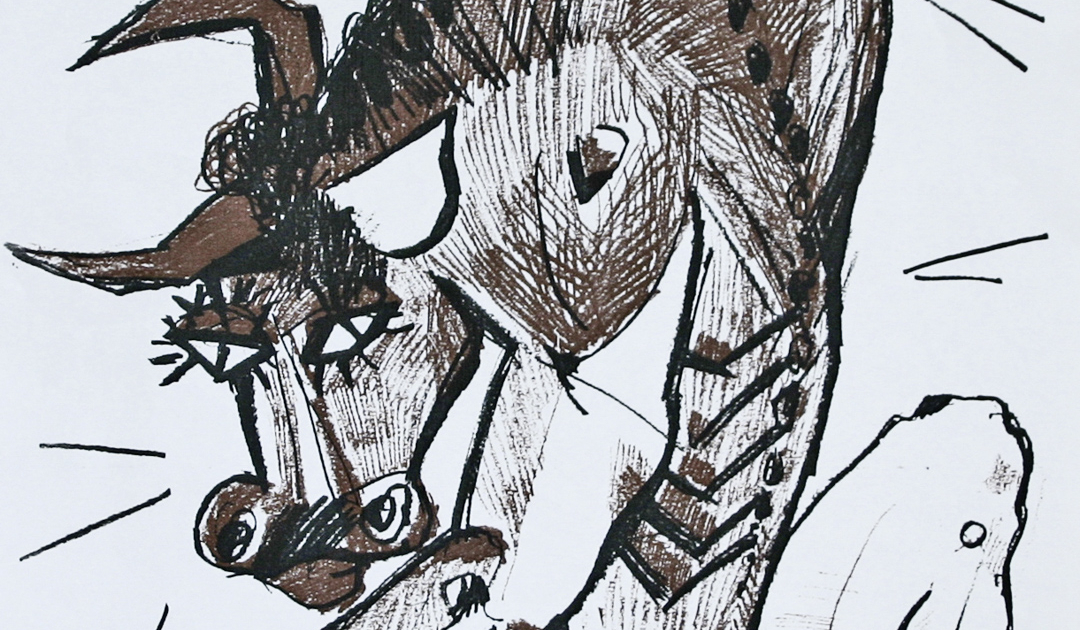
The Minotaur Cycle
Vulnerability and the Hybrid Body, c. 1992
In place of heroic combat, Pristavec presents the Minotaur as a body exposed to injury, exhaustion, sleep and death.


The seven drawings gathered here form a compact cycle associated with 1992. Several carry Pristavec’s handwritten titles, including Wounded Minotaur, Resting Minotaur, Sleeping Minotaur and Dead Minotaur. These inscriptions do not establish a continuous illustrated narrative. Instead, they identify a series of related physical states through which the mythological creature is repeatedly reconsidered.
Pristavec omits almost all the familiar elements of the ancient story. The Labyrinth and Ariadne are absent, while Theseus cannot be securely identified even in the most dramatic composition, where the Minotaur comes into contact with another body. The artist isolates the hybrid creature and concentrates upon its corporeal existence: its weight, tension, injury, fatigue and eventual immobility.
This shift in emphasis transforms the traditional relationship between hero and monster. The Minotaur remains physically powerful, but it is no longer presented primarily as an aggressor awaiting defeat. It becomes the principal bearer of vulnerability. Strength and helplessness coexist within the same massive body, complicating any simple opposition between the human and the monstrous.
The creature is recognisable through its horns, muzzle, animal ears, curly hair and occasional tail, yet the division between human and animal is never entirely stable. The bull’s head is joined to a muscular human torso whose anatomy is enlarged, compressed and rearranged. Especially prominent hands and feet anchor the distorted body to the ground and preserve a convincing sense of weight.
In the vertical drawings, the figure crouches, bends or appears to collapse under its own mass. Knees are drawn towards the torso, shoulders rise and the head is forced downwards. In the horizontal compositions, action gradually gives way to gravity. The body extends across the sheet, but its bent limbs and awkward orientation prevent the repose from becoming calm or idealised.
The body often appears almost too large for the available pictorial field. Horns, hands and feet approach the edges of the paper, while overlapping limbs become difficult to separate. Although Pristavec does not depict the Labyrinth, the sheet itself begins to function as a place of confinement. Containment is created through composition rather than architectural description.
Line records the process through which these unstable bodies were constructed. Preliminary contours, corrections and alternative positions remain visible, allowing the final figure to emerge from accumulated attempts to locate its balance and movement. Firm outlines define horns, limbs and joints, while repeated hatching, loops and radiating marks give density to the body or intensify a point of pain and pressure.
The surrounding emptiness is equally important. In the more active drawings, graphic marks extend outward from the body and charge the paper with tension. Around the reclining figures, broad areas of untouched surface isolate the Minotaur and make its stillness increasingly conspicuous. The difference between rest, sleep, collapse and death is conveyed less through narrative detail than through the degree to which the body still appears capable of movement.
The two versions titled Dead Minotaur demonstrate that bodily stillness is not represented through a single formula. In one, dense graphic marks surround and partially absorb the head and torso; in the other, the body remains more openly exposed against the pale paper. Repetition allows Pristavec to test how contour, density and empty space can alter the emotional character of the same condition.
The cycle connects several areas of Pristavec’s oeuvre. Its anatomical credibility recalls his Academy studies, while the compression and overlapping of bodies relate it to Množice. The unstable boundary between human and animal develops concerns already present in his animal drawings and bestiary. More than a decade later, the mythological paintings of 2006–2008 would again use hybrid bodies and physical conflict to explore fundamental human experience.
The Minotaur drawings are therefore neither straightforward illustrations of an ancient story nor preparatory studies for the later paintings. They form an autonomous investigation of the body at the boundary between resistance and surrender. Their power lies in transforming a familiar monster into a vulnerable physical presence—wounded, resting, sleeping and finally still.