


Množice – The transformed body
Repetition, Shadow and Collective Form
As the single figure becomes a pair, a sequence and finally a crowd, the human body is transformed into a rhythm of weight, gesture and recurring form.


The drawings belonging to the Množice (Crowds) cycle were created principally between 1981 and 1983. Rather than presenting conventional studies of individual figures, Pristavec investigates what happens when a bodily type is enlarged, altered and multiplied. The figure remains recognisably human, yet its anatomy is gradually reorganised until human, animal and invented forms begin to overlap.
Several sheets carry Pristavec’s handwritten titles and serial designations, including Ena, Dve and Tri (One, Two and Three), the letters G and S, and the later sequence K1–K4. Their precise meanings cannot be reconstructed without further archival evidence, but they clearly demonstrate that repetition and variation were fundamental to the artist’s working method.
Pristavec concentrates bodily weight in the pelvis, thighs and lower torso. Heads are reduced, elongated or transformed into beak-like and muzzle-like structures, while hands and feet may become pointed extremities, dark clusters or claws. Anatomical knowledge is not abandoned; it provides the foundation from which the body can be reconstructed as a new, hybrid formation.
Repetition never produces identical copies. Each figure changes slightly in posture, proportion and tonal treatment. An isolated body becomes a pair, a row or a densely organised group in which individual contours participate in a larger collective rhythm. The crowd is therefore created not simply by the number of figures but by their formal and spatial interdependence.
Horizontal bands, diagonals and cast shadows organise the surrounding space. They suggest a platform, stage or indeterminate terrain without establishing a recognisable setting. The shadows frequently extend beyond the bodies that produce them, creating dark secondary figures that introduce movement and complicate the relationship between body and pictorial field.
In the K sequence of 1982 and 1983, the figures become more entangled and increasingly animal-like. Enlarged eyes, crouching postures and claw-shaped hands connect the cycle with Pristavec’s later bestiary and mythological imagery. Množice thus occupies an important position in his oeuvre: between anatomical observation and invention, the individual body and collective form, human identity and hybrid transformation.
Množica N
Suspension, Gravity and the Fragmented Figure
Bodies enter the image from beyond its edges, suspended between descent and collapse while their shadows extend their presence across the pictorial field.
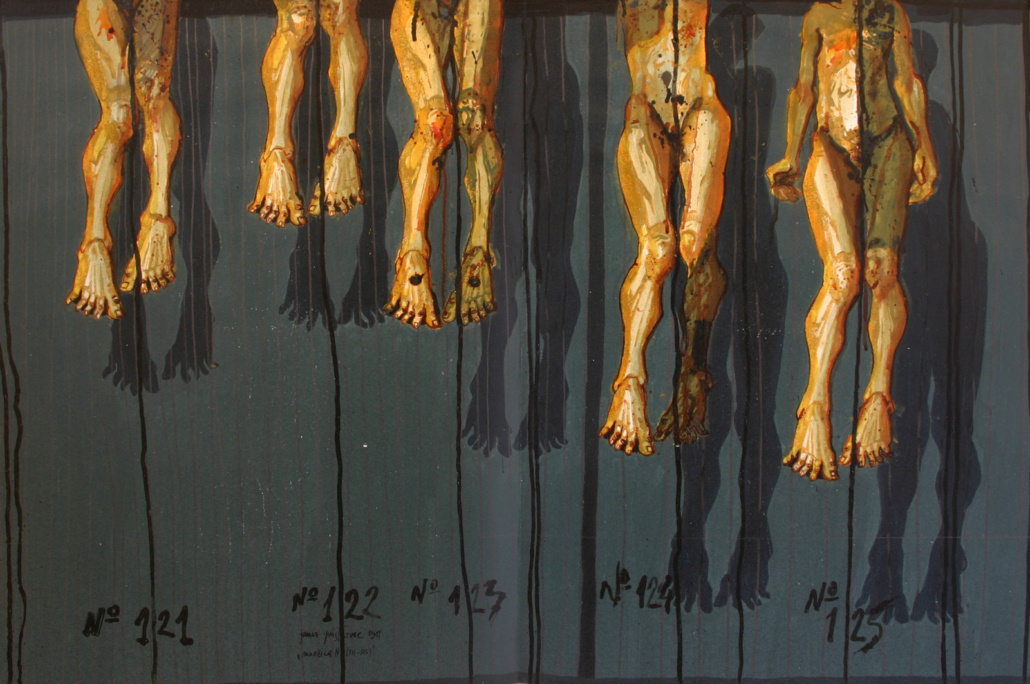
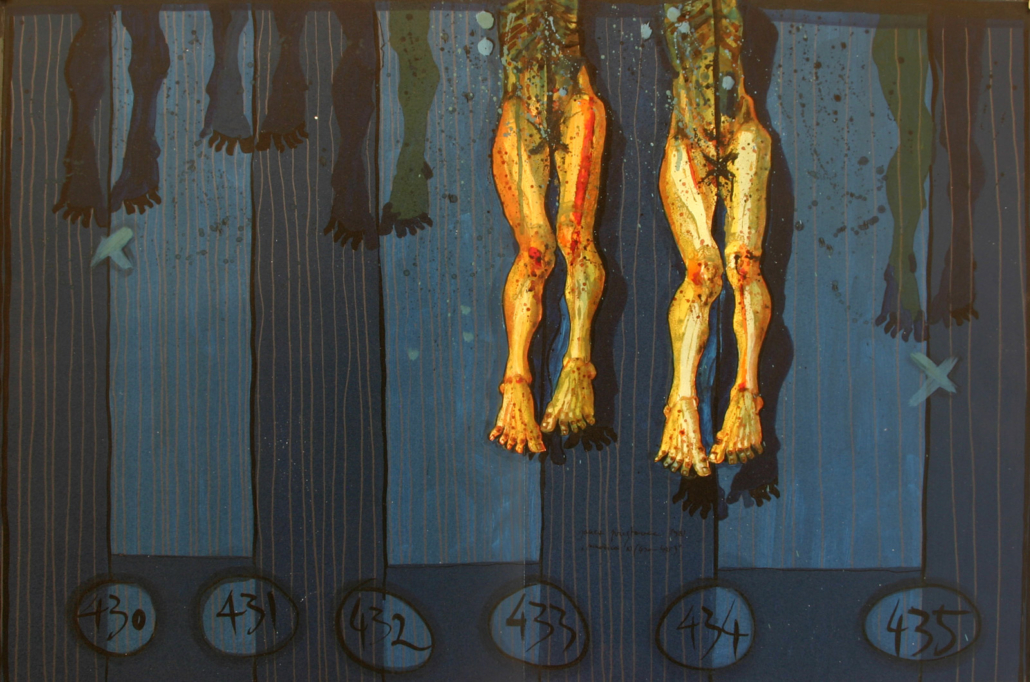
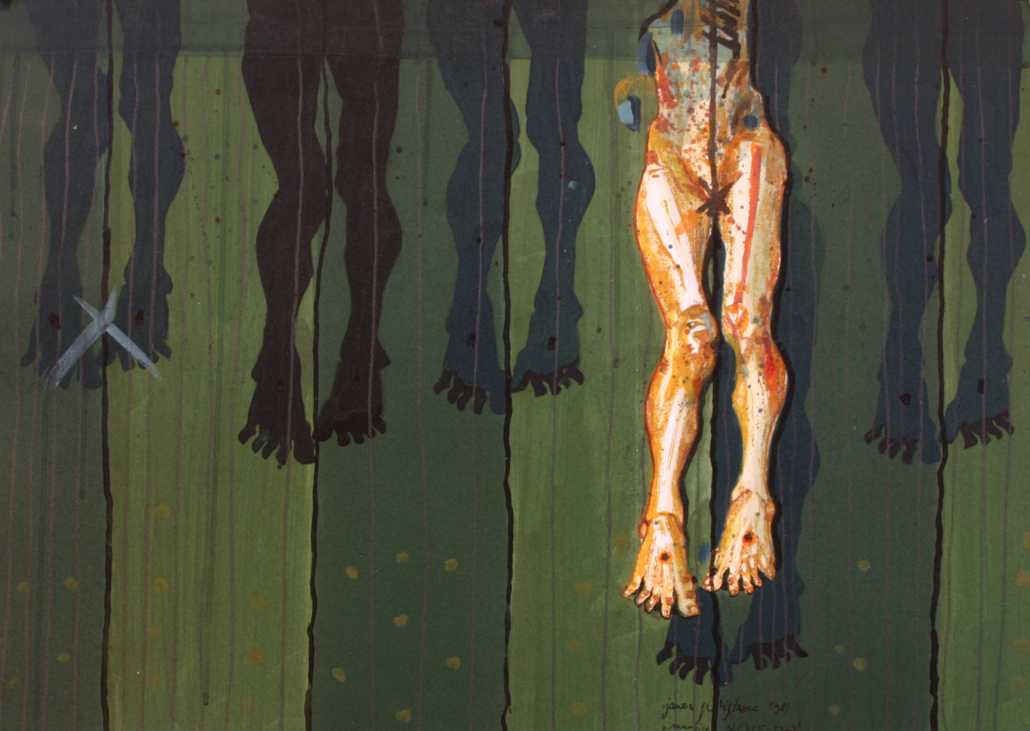
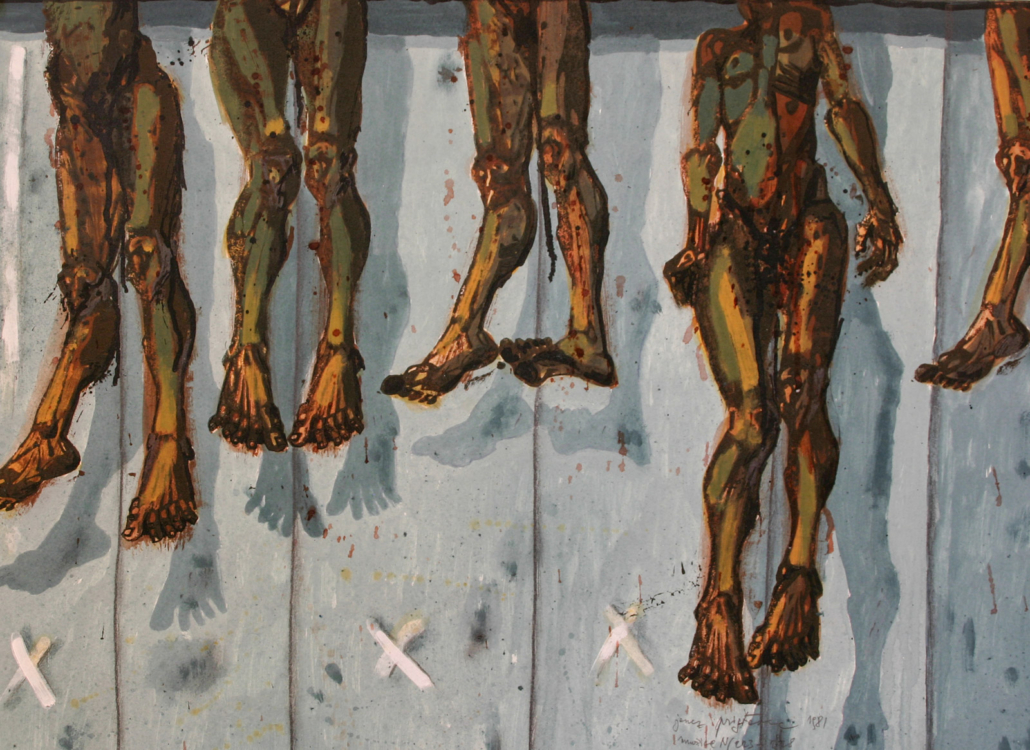
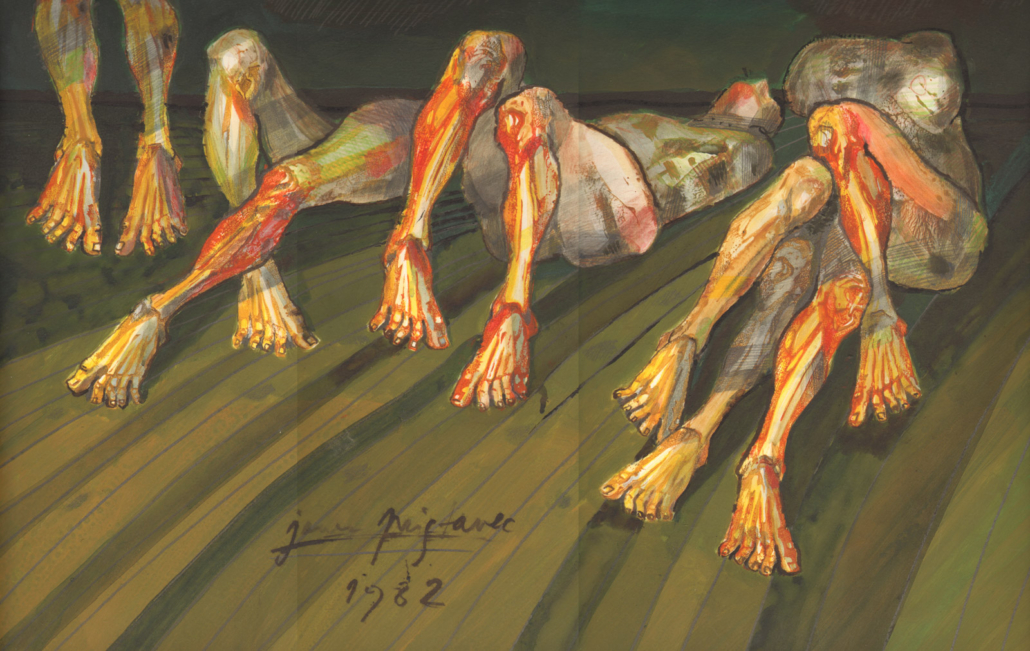
Množica N is a small and visually concentrated group of works created around 1981 and 1982. Although closely related to the broader Množice cycle, it develops a distinctive compositional idea. Instead of distributing complete figures freely across the sheet, Pristavec frequently crops them at the upper edge, leaving their torsos, legs and feet suspended within the image.
This unusual framing prevents the viewer from seeing the figures as stable, self-contained individuals. They may appear to be hanging, descending, entering the composition or passing beyond its visible limits. Pristavec does not provide a narrative explanation. The uncertainty of their position is precisely what gives the group its physical and psychological tension.
The elongated legs and downward-pointing feet emphasise gravity, while dark shadows repeat the bodies as vertical silhouettes. In some works the shadow seems firmly attached to the figure; in others it becomes an almost independent presence. The visible body and its dark double establish a rhythm of appearance and disappearance, weight and immaterial trace.
Blue, green, grey and black fields are divided by vertical lines and darker bands. Against these cool grounds, the ochre, yellow and red figures acquire an intensified bodily presence. Colour does not describe a realistic environment but separates the figures from the surrounding structure and directs attention towards individual limbs, joints and areas of muscular tension.
Numbers, circles, crosses and other graphic marks appear in several compositions. Like the letter N itself, these signs should be retained without forcing them into a specific symbolic interpretation. Visually, however, they reinforce the serial character of the works and introduce an alternative system of order beside the repeated bodies.
The final horizontal composition changes the direction of the group. Figures no longer descend from above but crouch, crawl and collapse across diagonal bands. This reversal reveals the central concern of Množica N: the body subjected to suspension, gravity and changing orientation. Related to Množice, the group nevertheless forms an autonomous investigation of the fragmented figure and its unstable place within pictorial space.