


Nudes on canvas
The Body between Study, Colour Sign and Late Lyricism
For Pristavec, the nude is a lifelong test: how much body does a painting need to remain human, and how far may colour and rhythm transform it?


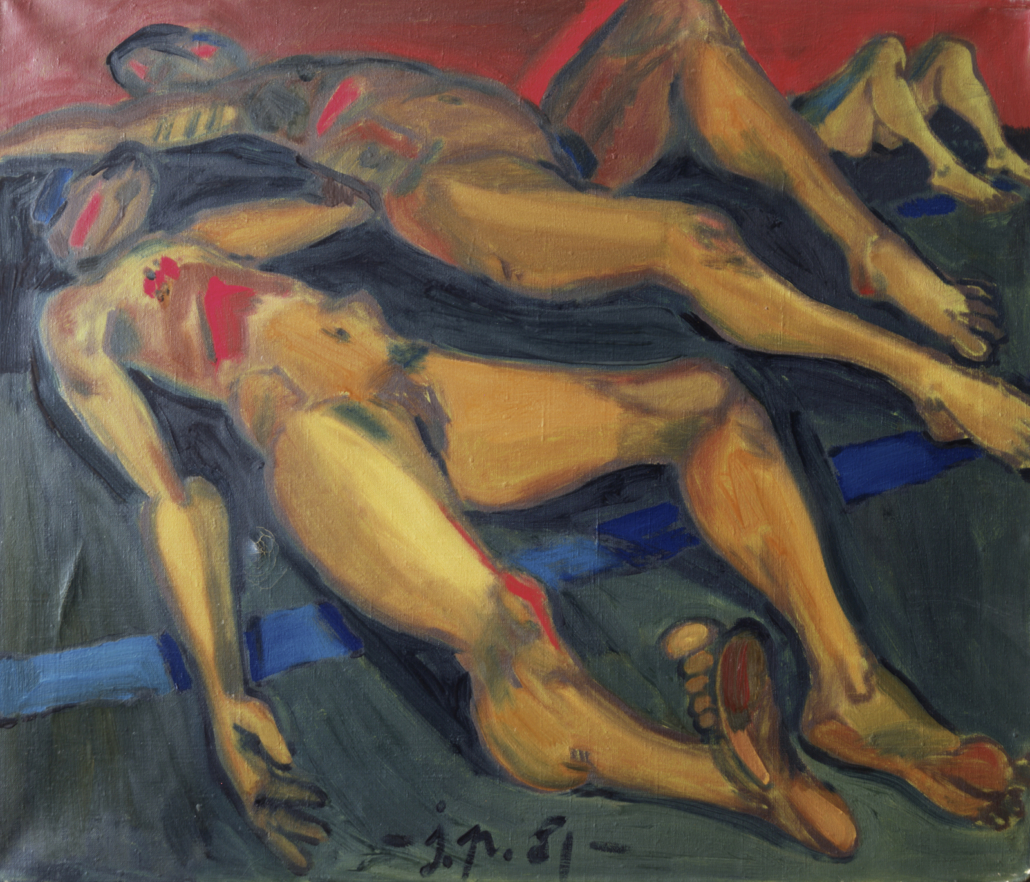


The nude is one of the few motifs that appears throughout almost the whole of Pristavec’s creative life. It is therefore not a single cycle but a longitudinal section through his development. In the early works, the body is constructed through academic knowledge of weight, anatomy and volume. Later, modelling gives way to strong contour, plane and colour that no longer describes skin but organises the body according to its own logic.
The interior frequently acts as a theatrical frame. Bed, chair, window, curtain, table or geometric colour field guide the pose and determine the distance from the viewer. Since the face is often not individualised, psychological meaning passes to posture. Pristavec lengthens an arm, enlarges a hand or foot, raises a knee and closes the body into an arc. Deformation is not error but compositional decision.
The relationship between body and flowers is also important. A vase may balance a reclining figure, a bouquet continues the rhythm of the limbs, and flower heads repeat the forms of breasts, face or knee. In the late nudes, the difference between figure and environment diminishes: skin, drapery and background are built with equal freedom of brushwork. The cycle is therefore not merely a history of the female body in the artist’s work, but a history of his understanding of painting – from study and observation to colour sign, ornament and late lyrical reduction.
The nude is not a stable iconographic genre in Janez Pristavec’s work but a recurring laboratory of the body. Across decades it changes the relationship between anatomy and sign, observation and deformation, the viewer’s gaze and the autonomy of the colour surface.
Among Pristavec’s recurring motifs, the nude possesses particular analytical value. Still life allows him to test the space of objects, Maribor records changes in his view of landscape and city, and the animal cycles explore the relation between character and sign. The nude, however, confronts all the principal problems of his painting directly: construction of the figure, the relation between contour and chromatic mass, the question of the gaze, the positioning of the body in space and the boundary between observation and symbolisation. Because the motif recurs across an extended period, it functions as an internal gauge of his stylistic shifts.
The surviving body of work of 76 reproductions does not reveal a simple linear development from realism towards abstraction. Pristavec repeatedly returns to earlier solutions, simplifying them, intensifying them again or connecting them with new experiences. In some works the body is volumetric and heavy; in others it is divided into coloured segments; elsewhere it becomes almost weightless, with the face reduced to a handful of marks. The development is better understood as an oscillation between the body as an observed phenomenon and the body as a pictorial sign.
The earliest works in the surviving body of work still preserve a clear awareness of the model as a body in space. Torso, limbs and the distribution of weight are constructed through a relatively coherent volumetric logic. Tonal transitions and chromatic modulation define the tension of the skin, while a couch, chair or interior provides the body with spatial support. Even when colour is already unnatural – blue accents on the legs or an intensely red surrounding field – it continues to articulate volume.
Yet the academic experience begins to change at an early stage. Instead of a neutral studio background, Pristavec introduces architectural cuts, window grids, doors, stairs, mirrored doubles and sharply separated fields of colour. The body is no longer only an object of observation but an element within a constructed composition. The opening works of the surviving body of work in particular suggest his interest in the relation between the actual model and its image in a painting or mirror; the nude is placed within a space that is itself a reflection on artistic labour.
Pristavec’s nudes are rarely located in neutral space. They recline on beds and couches, sit beside tables, chairs or vases, and stand near curtains, windows or painted architectural partitions. The interior is not a description of domestic life but a stage that determines how the body is seen. Horizontal beds extend it, vertical edges compress it, while diagonal planes push it towards the viewer or into depth.
In several works the space consists of large, almost geometric colour fields. The body appears as a softer organic counterpoint to the straight edges. Elsewhere the interior is constructed more painterly, from spilled colour, scratches, drips and overlapping layers. The boundary between body and environment then becomes unstable: skin colour runs into the bed, drapery assumes the chromatic temperature of the torso, and the background enters the contour of the figure.
Because faces are often not individualised, meaning is carried by pose. The body reclines with arms above the head, sits hunched forward, curls into an almost circular form, raises a knee towards the face or opens across a broad diagonal. These positions are not neutral records of the model. They are constructions of mood: rest, withdrawal, exposure, self-possession or theatrical self-presentation.
Pristavec frequently chooses uncomfortable or anatomically exaggerated twists. He enlarges a foot, knee or hand, lengthens an arm and shortens the torso. Such deformation directs the eye and produces internal rhythm. The emphasised body parts are not mistakes but compositional anchors. A large foot may close the lower edge, a raised knee may divide the format, and an arm above the head may create an arc linking figure and background.
Pristavec’s nude is most convincing when the body is neither idealised nor dissolved. It remains present while its anatomy is translated into rhythm, plane and chromatic tension. It thus becomes a memory of the act of painting and one of the key measures of the artist’s development.