

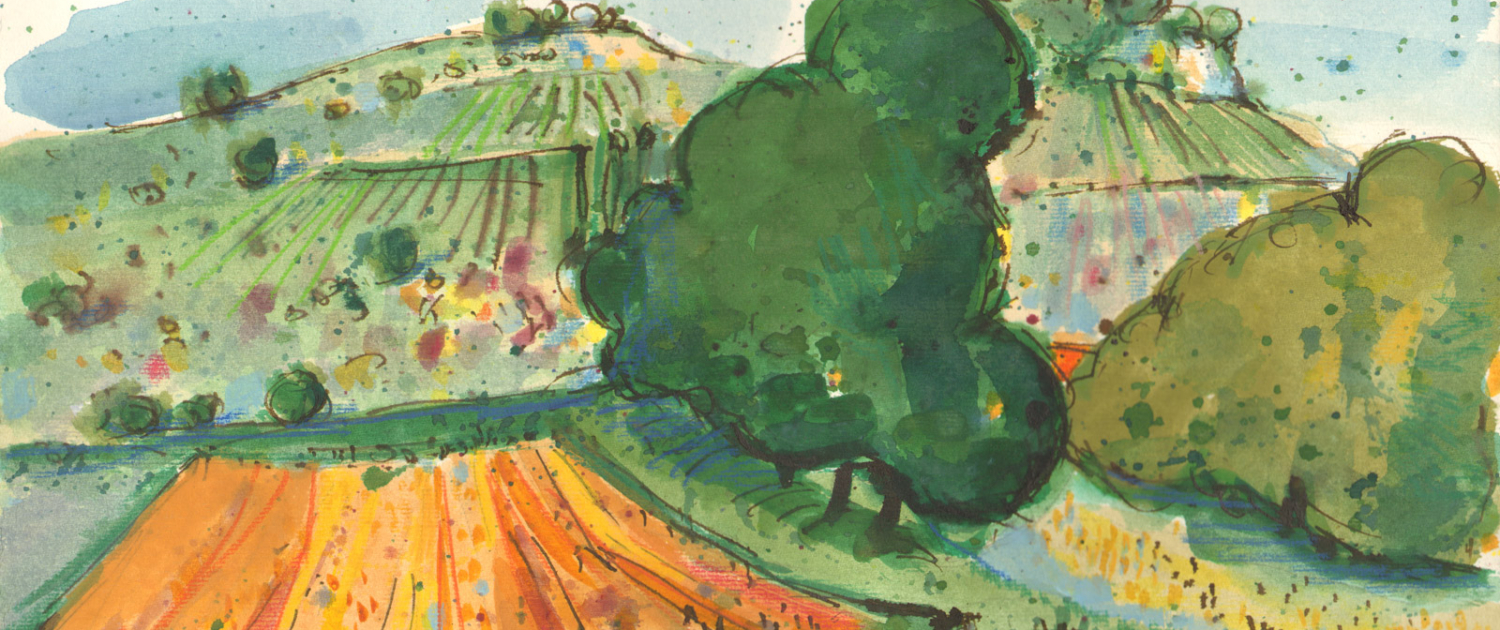
Lent – the view across the Drava river
River, Roofs and the Repeated View
Looking across the Drava, Pristavec transforms Lent from a recognisable riverfront into a changing structure of roofs, towers, colour and reflected light.
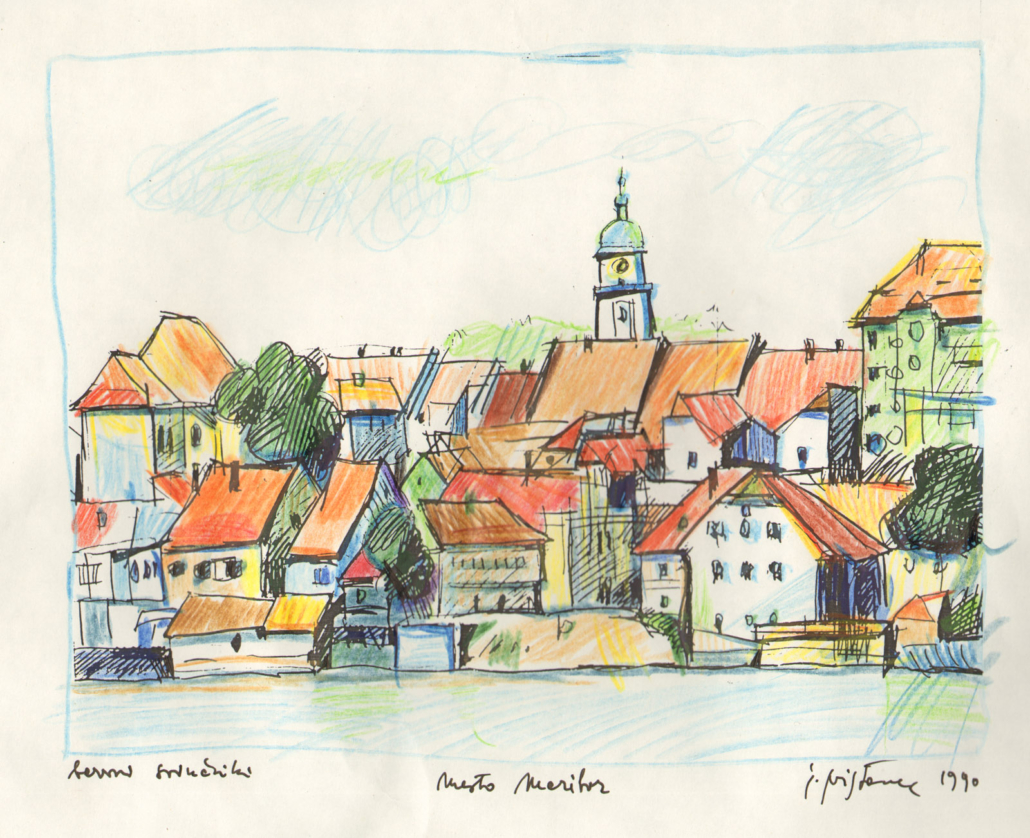
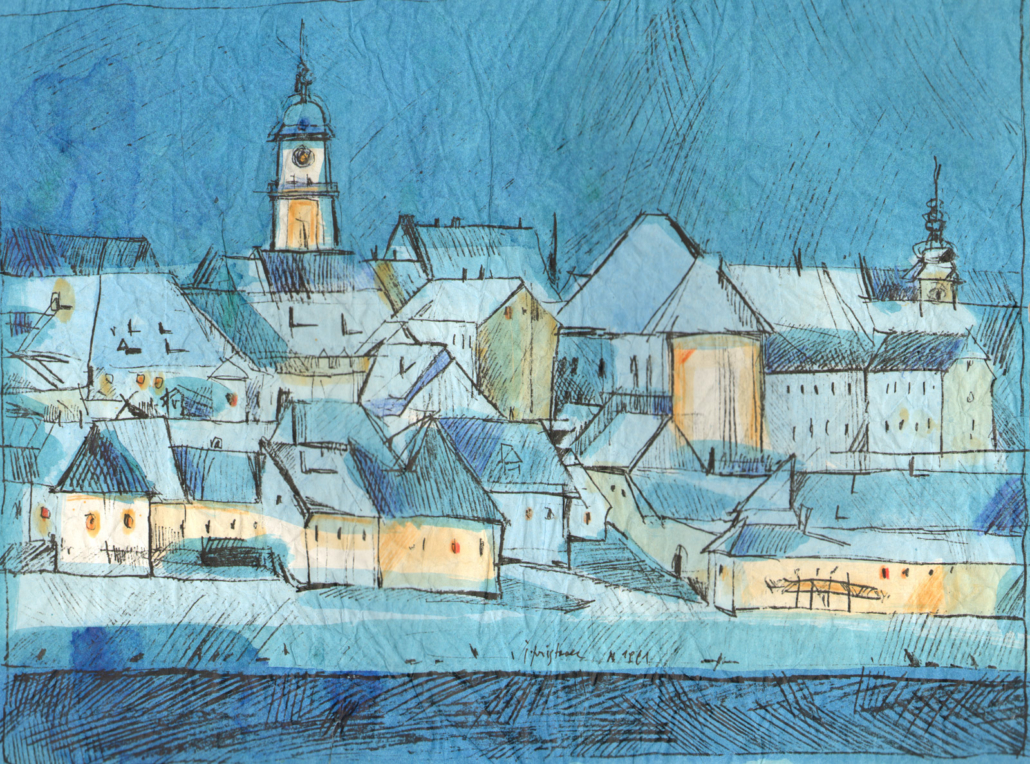
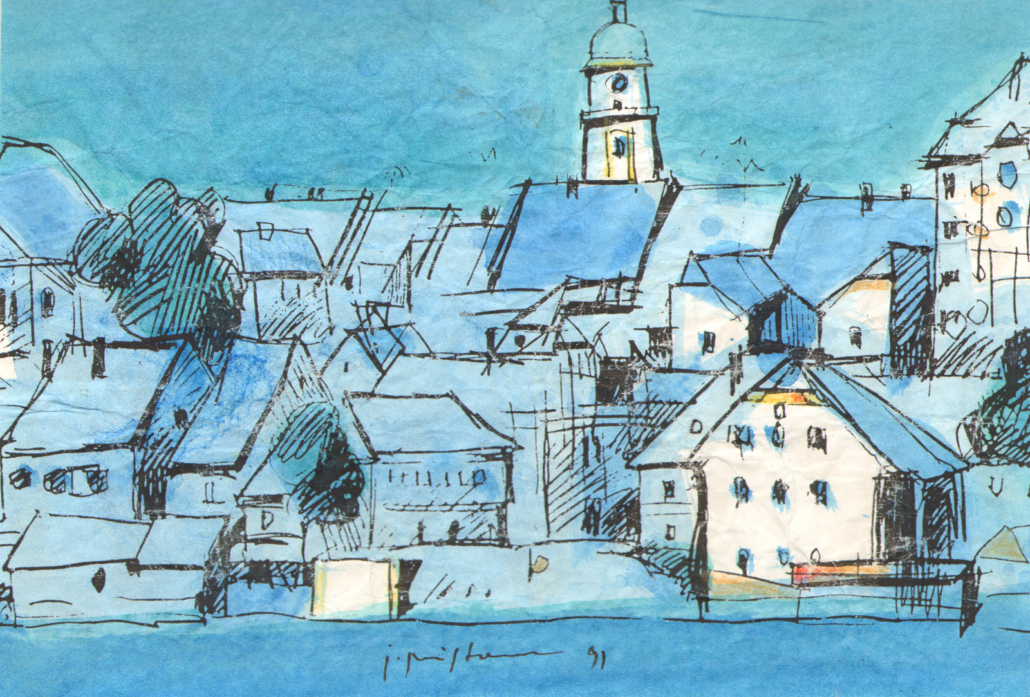
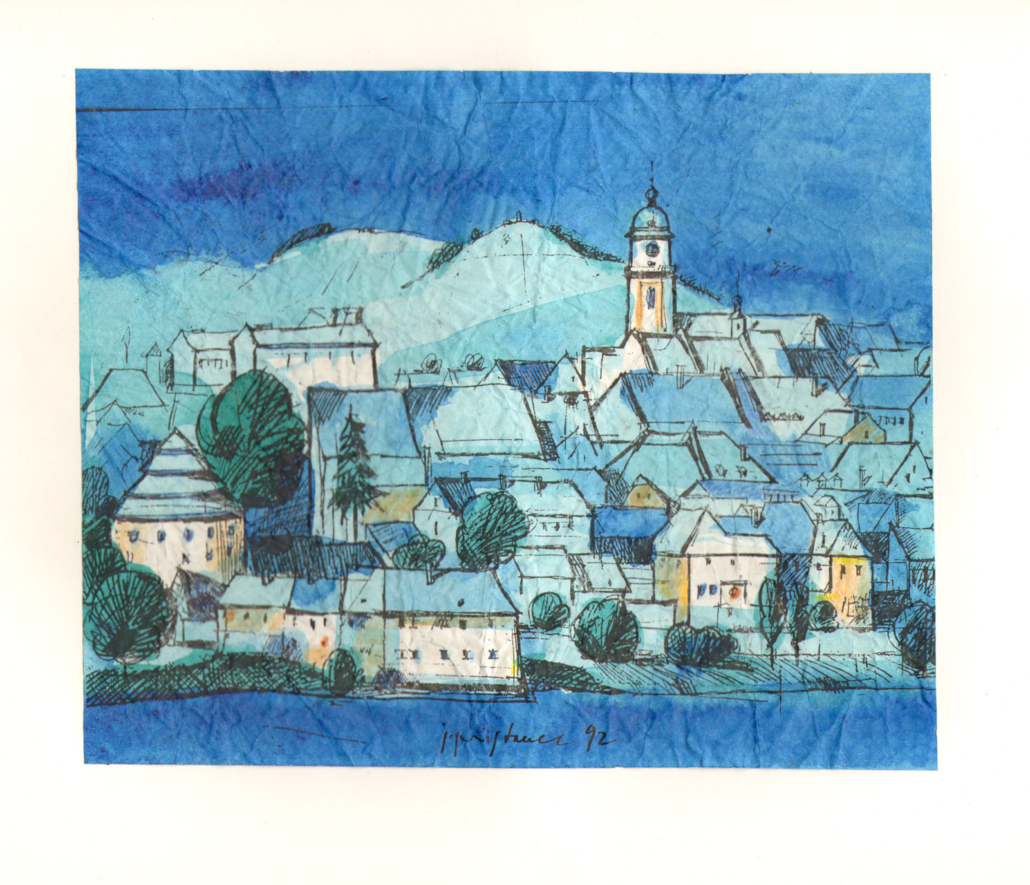
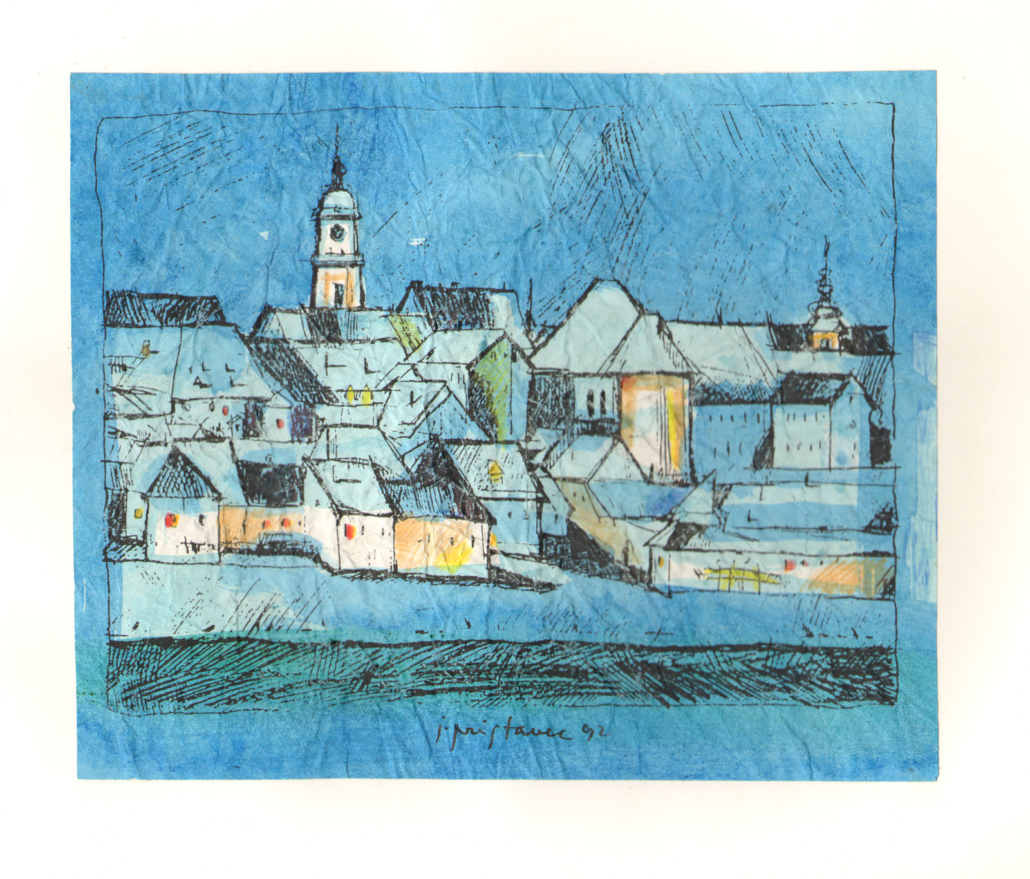
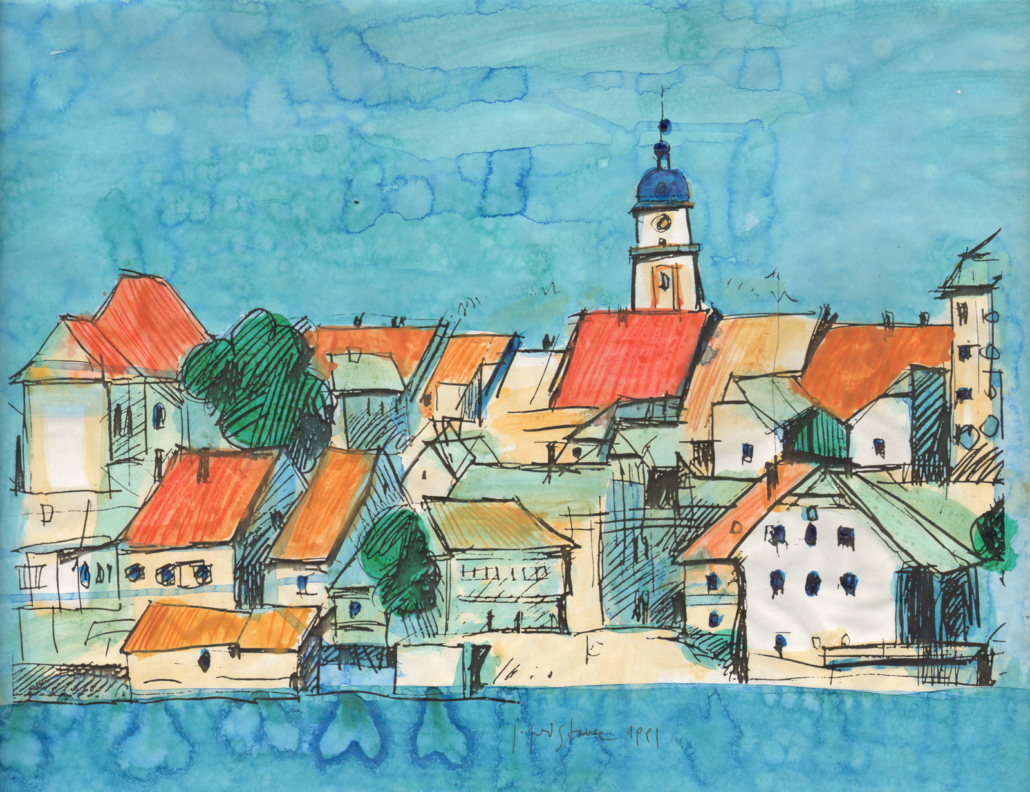
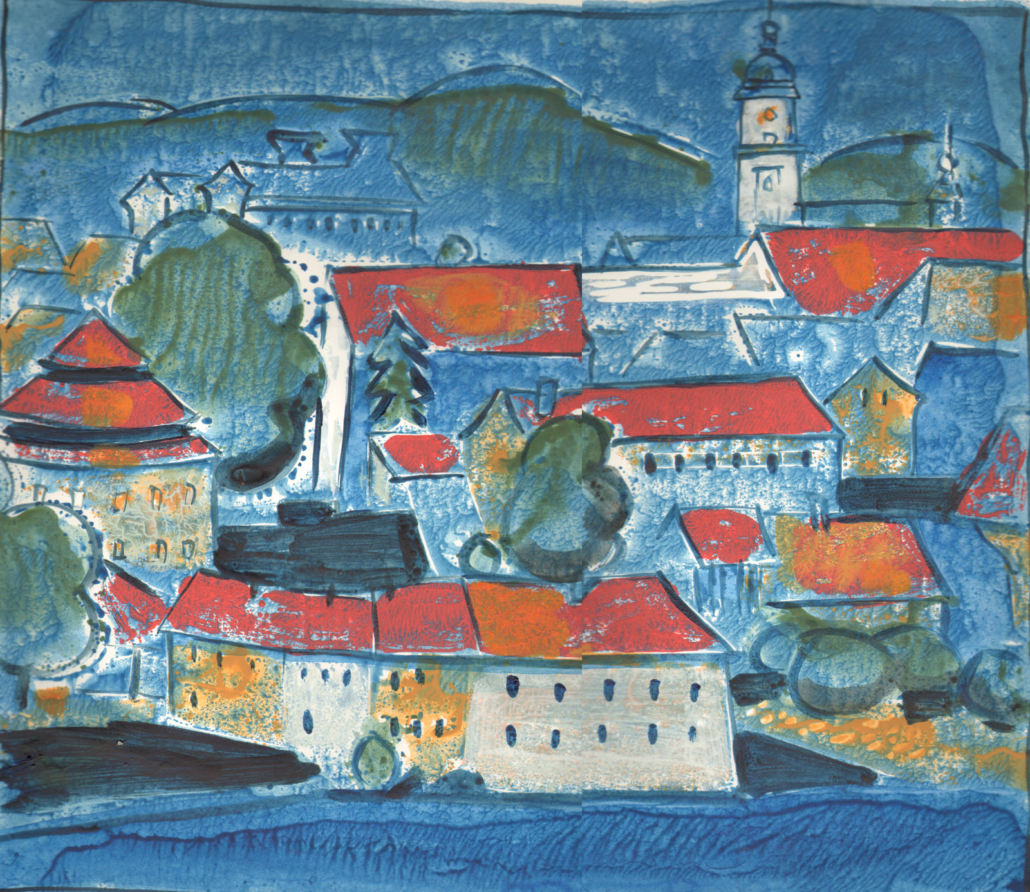
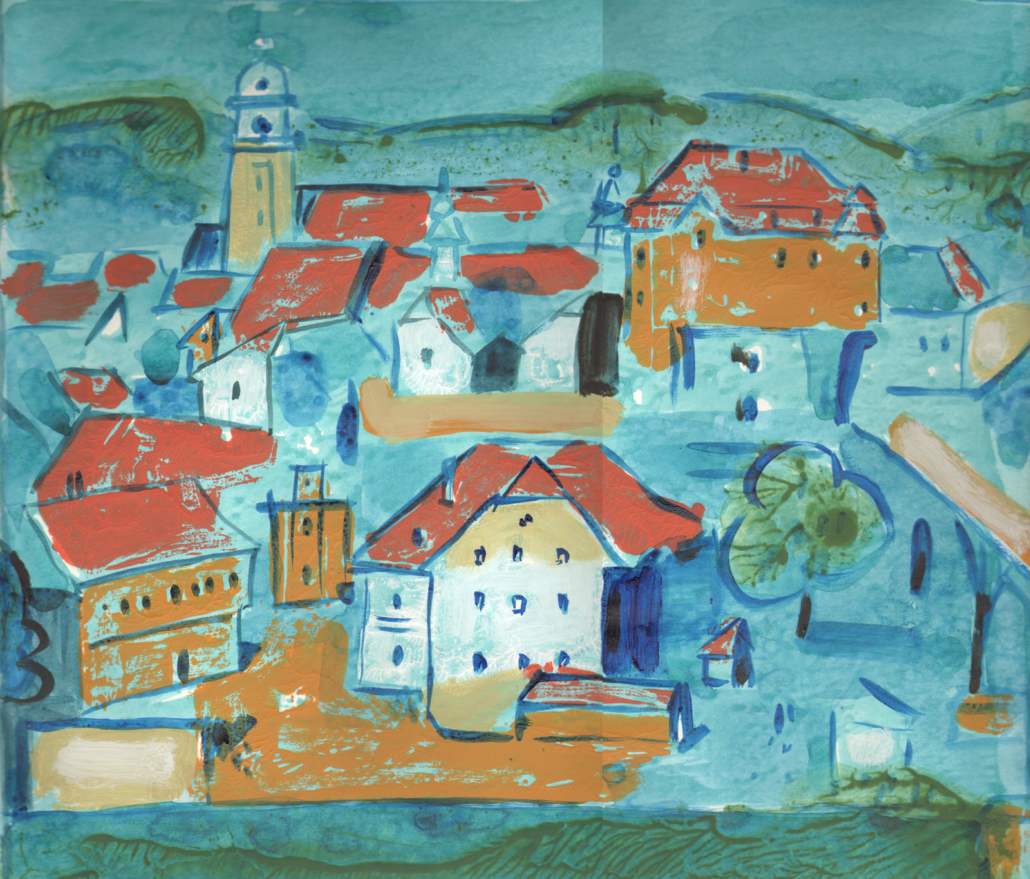
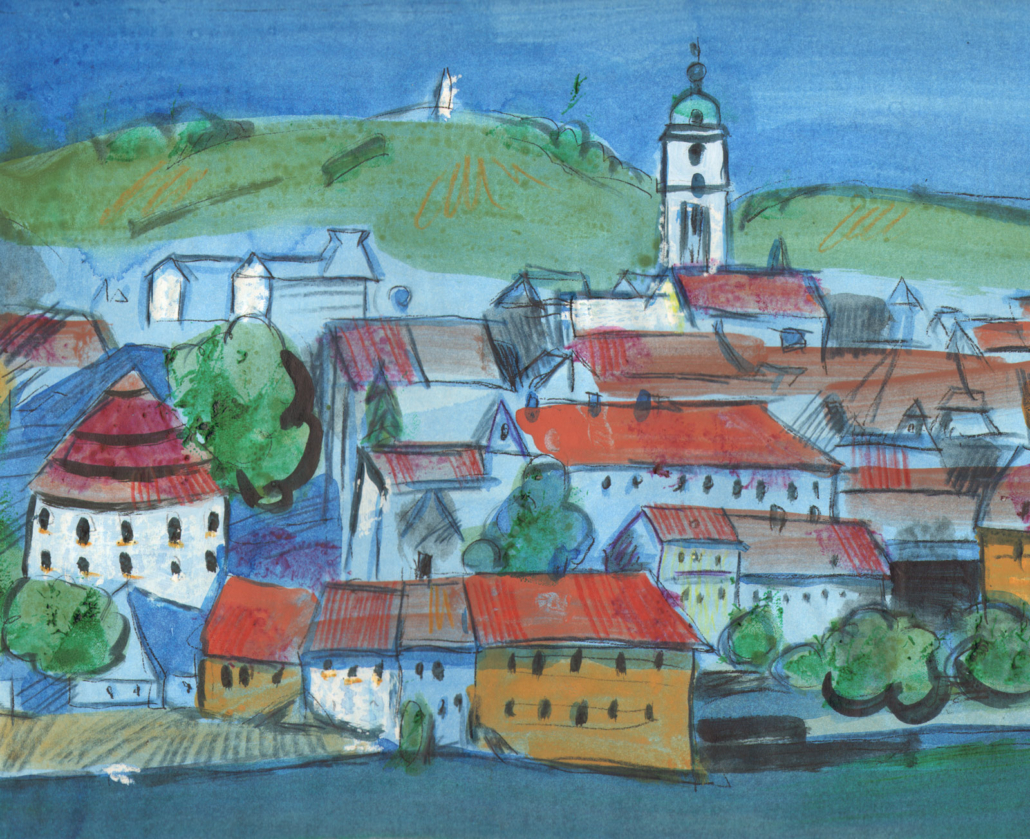
Between 1990 and 1992, Janez Pristavec repeatedly returned to views across the Drava towards Lent and the historic centre of Maribor. This sustained examination of a closely related viewpoint forms the most coherent urban series among his works on paper. Rather than seeking a single definitive image, he reconstructs the city through drawing, watercolour and monotype, allowing each technique to reveal a different aspect of the familiar view.
The river establishes a broad foreground boundary, while the riverfront and the historic centre behind it are compressed into a comparatively shallow band of facades, roofs and towers. Pristavec does not lead the eye gradually into deep perspective. Instead, he arranges the architecture across the sheet, transforming the urban panorama into a rhythmic sequence of horizontal layers and vertical accents.
The coloured-pencil drawing from 1990 remains closely connected with architectural observation. Individual roofs, windows and facades are carefully articulated through lively contours, hatching and restrained passages of colour. Yet even here, exact description is subordinated to the larger rhythm of the city. Roofs accumulate as repeated angular units, while towers rise above them as stable points of orientation.
In the watercolours of 1991 and 1992, colour assumes a more autonomous role. The same urban structure may appear pale and open in one version, immersed in blue in another or intensified by warm red and orange roofs. Transparent washes allow the drawing to remain visible, while denser passages merge individual buildings into a continuous chromatic formation.
The monotypes from 1991 introduce a heavier and more materially active surface. Unevenly transferred colour gives the architecture a weathered texture, and the city appears to emerge from a dense blue or blue-green field. Each impression preserves the recognisable configuration of Lent while remaining unique through variations in pressure, colour density and subsequent painterly intervention.
Repetition is therefore not duplication but investigation. By returning to the same view, Pristavec tests how much of Maribor’s identity depends upon architectural detail and how much can be carried by a small number of visual signs: the river, the layered roofs, the towers and the surrounding hills. Lent becomes both a specific place and a pictorial structure continually remade through line, colour and surface.
Maribor beyond Lent
Hills, Streets and the Changing City
Beyond the familiar riverfront panorama, Pristavec discovers Maribor in the places where houses, vineyards, roads, trees and modern infrastructure meet.
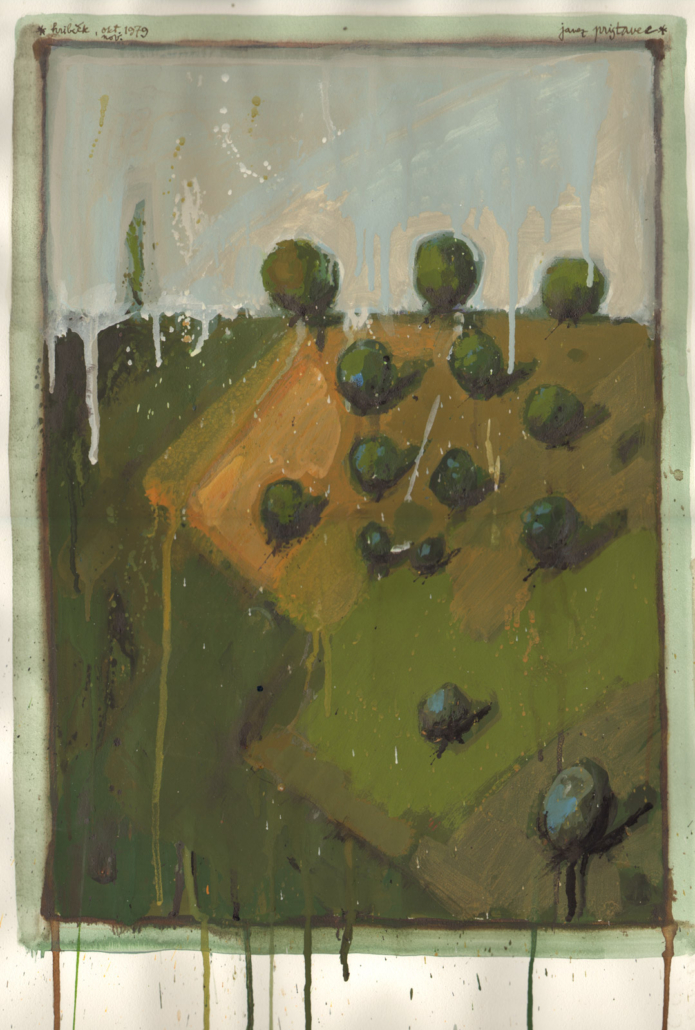
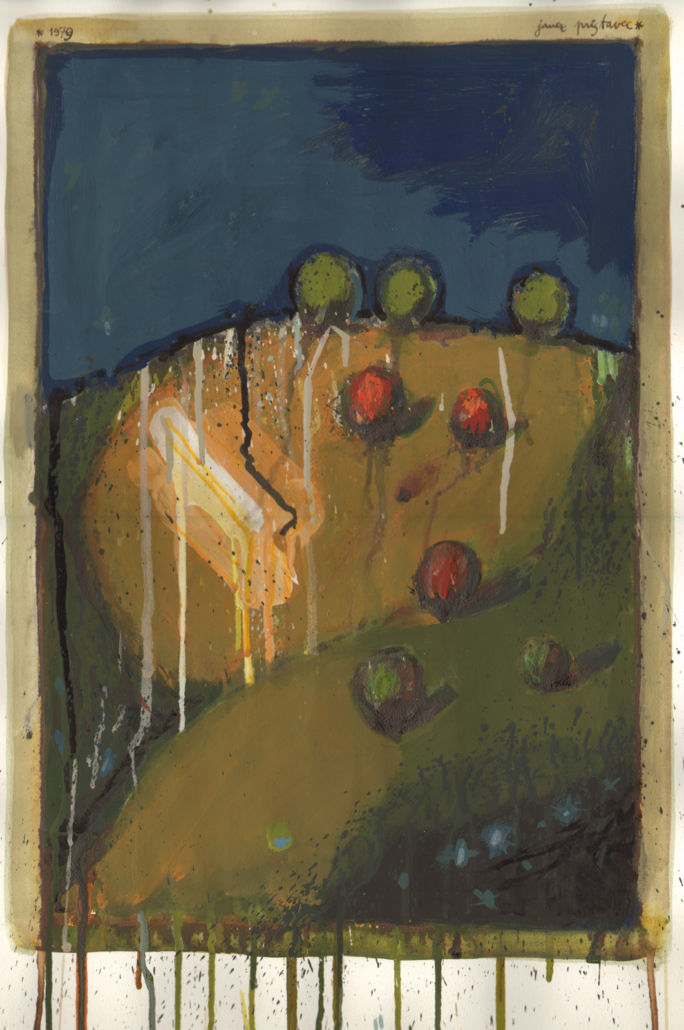
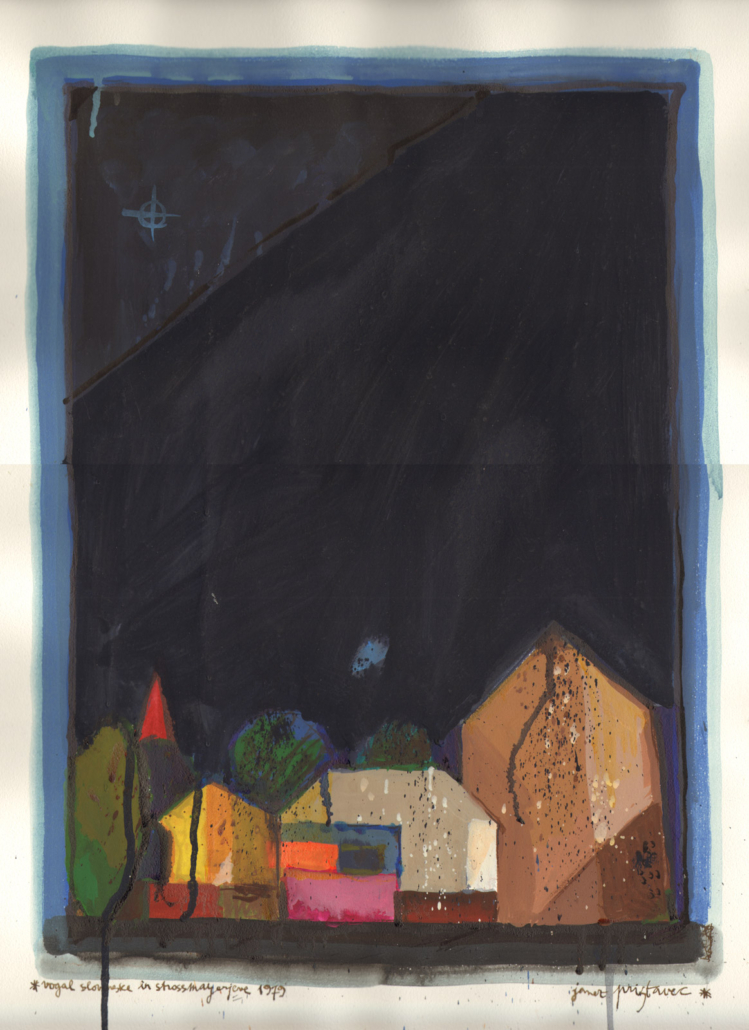
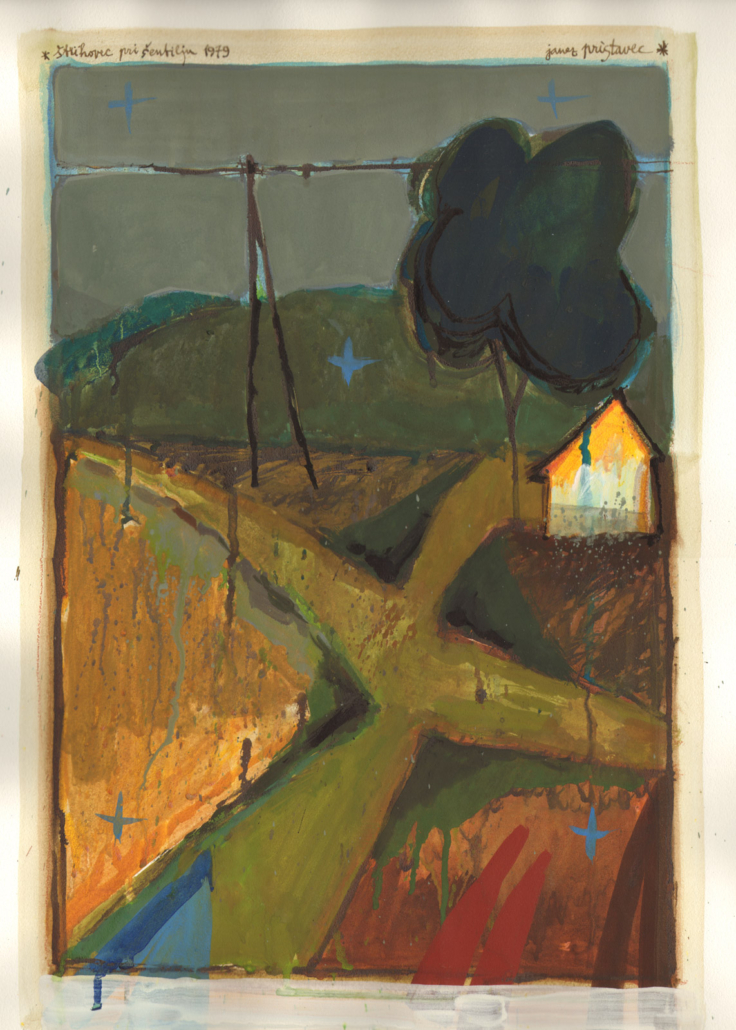
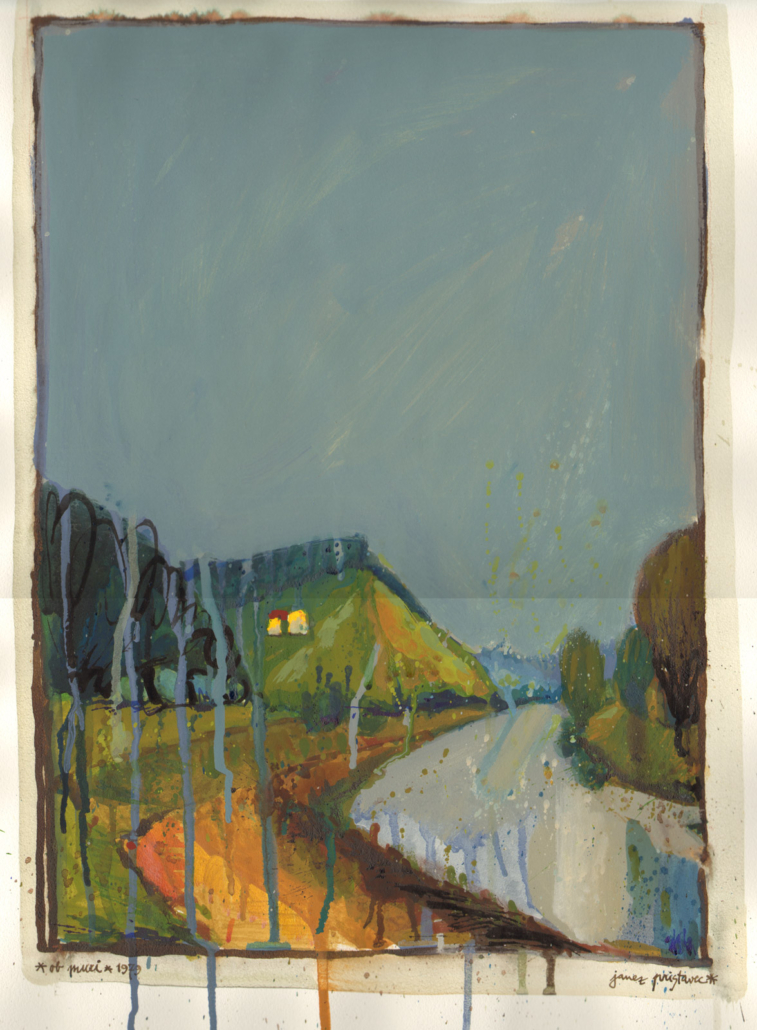
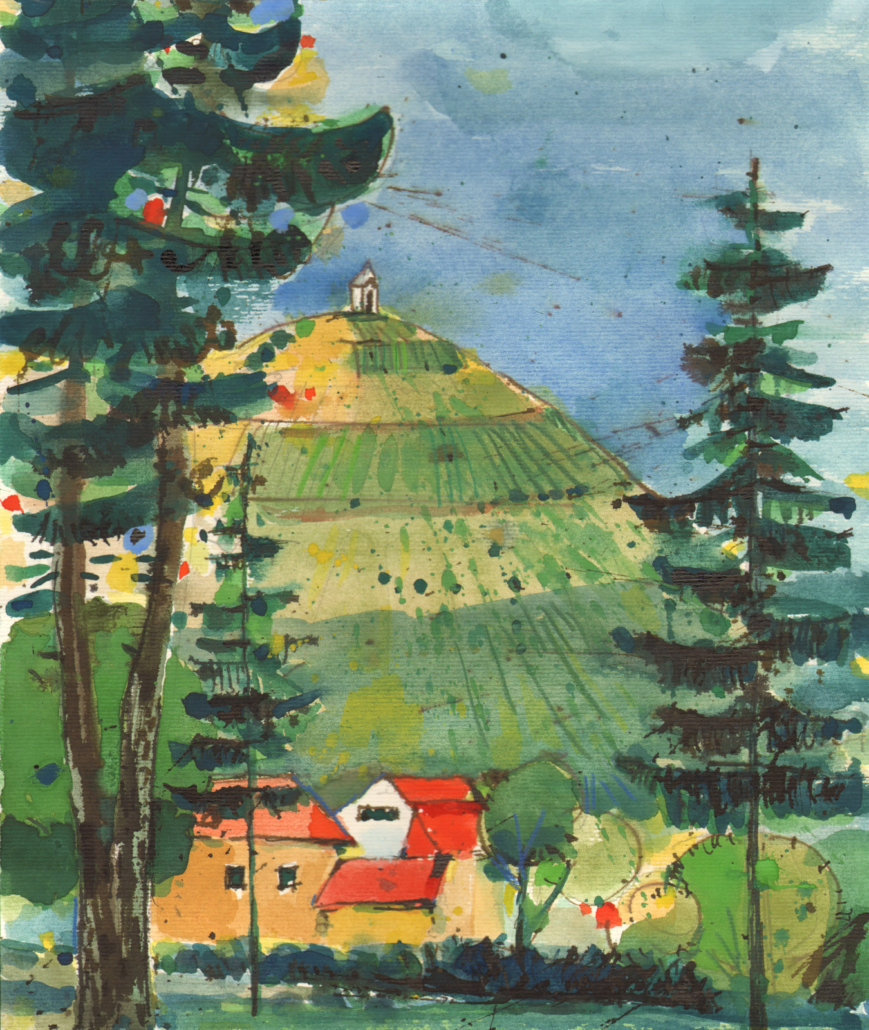
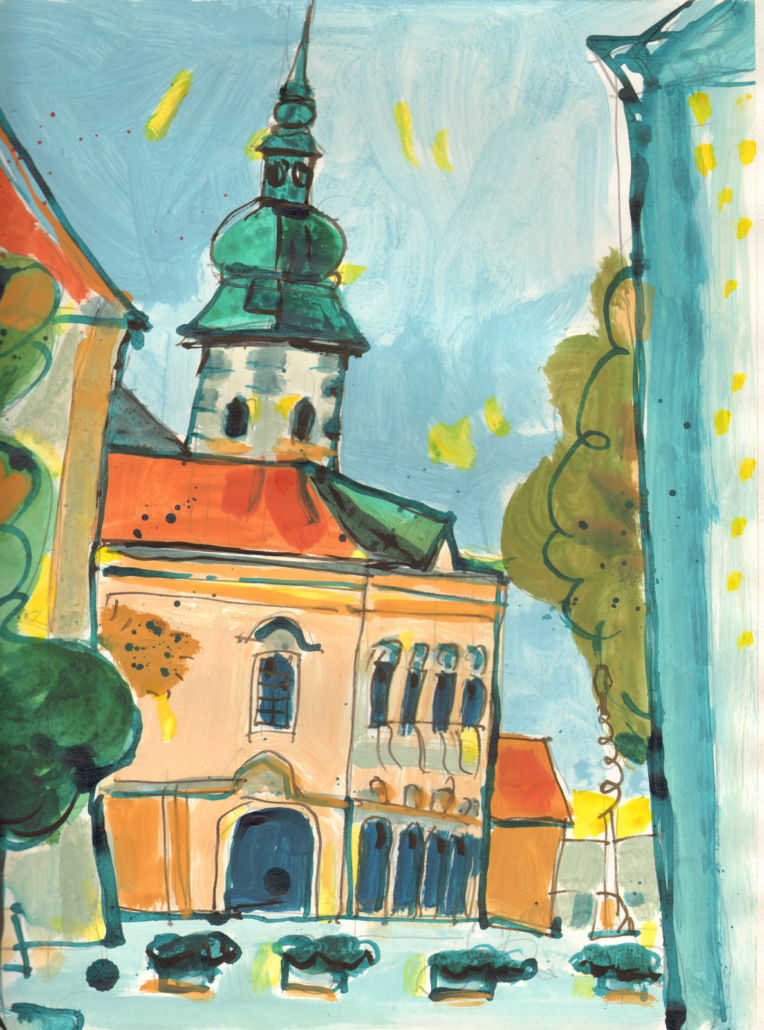
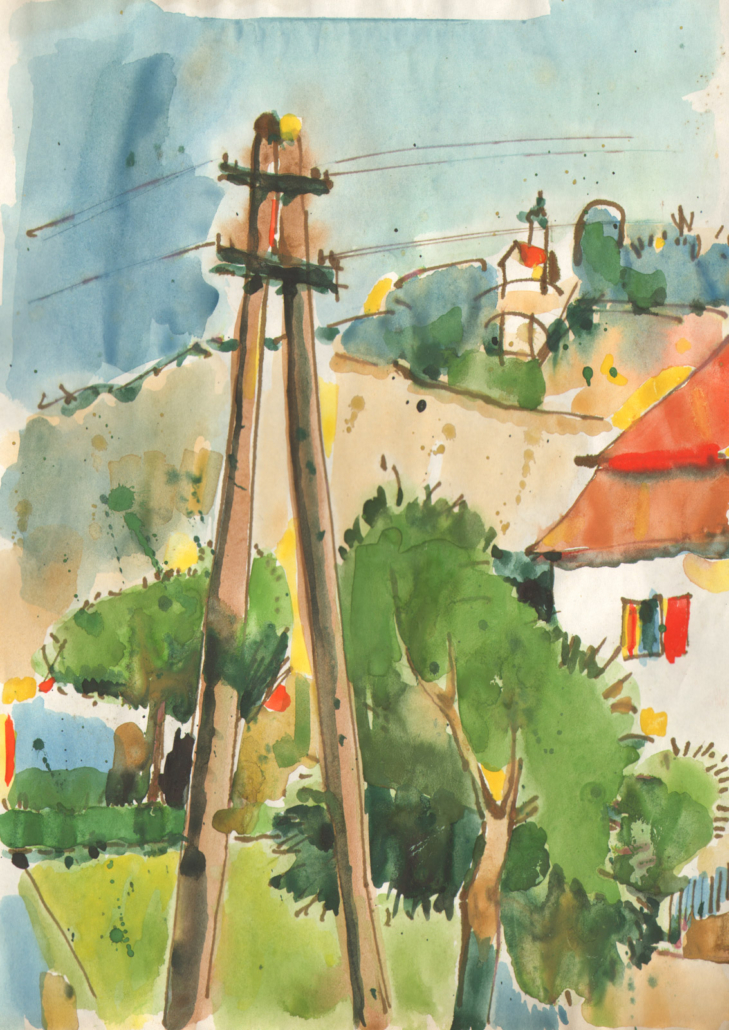
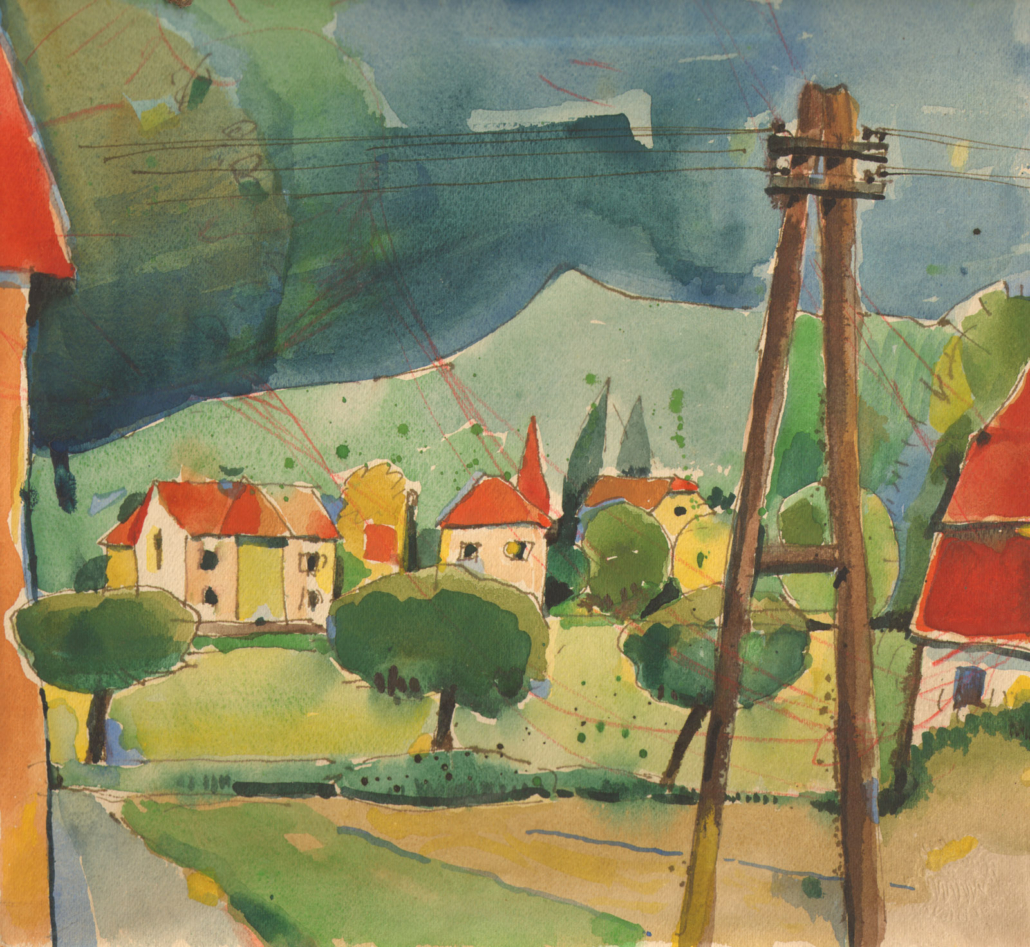
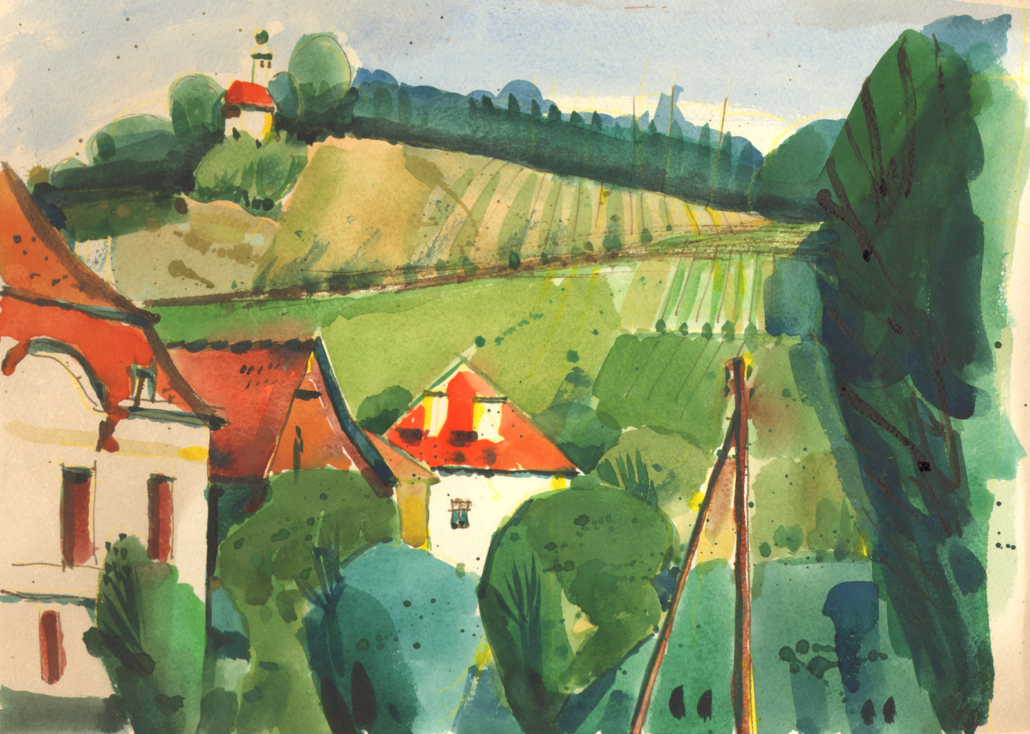
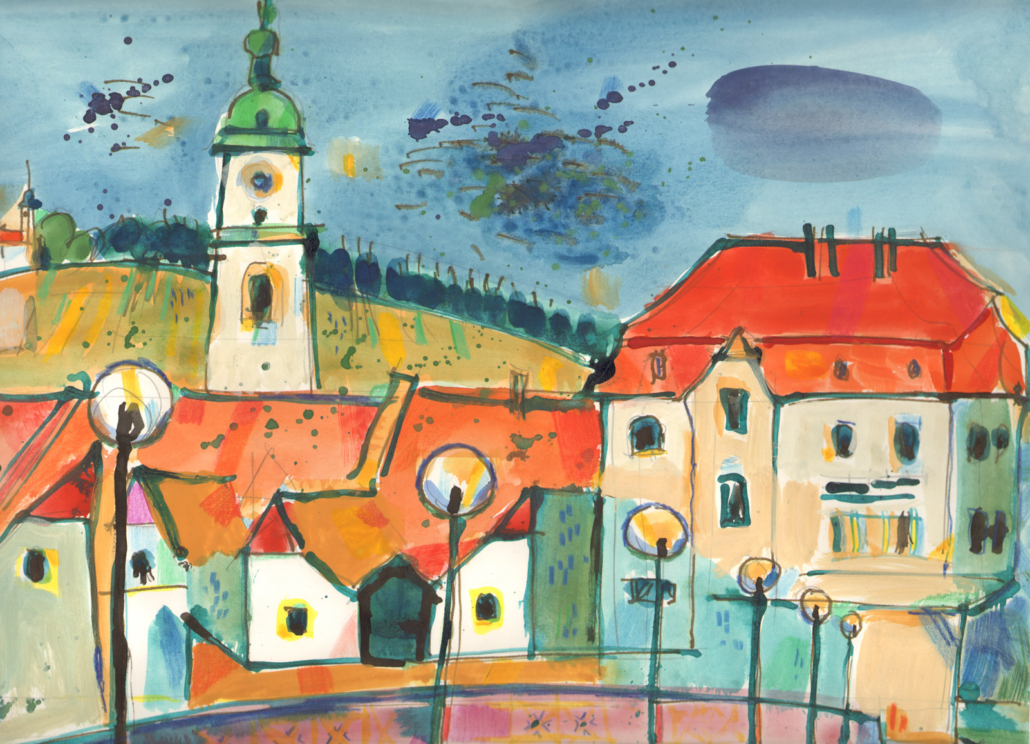
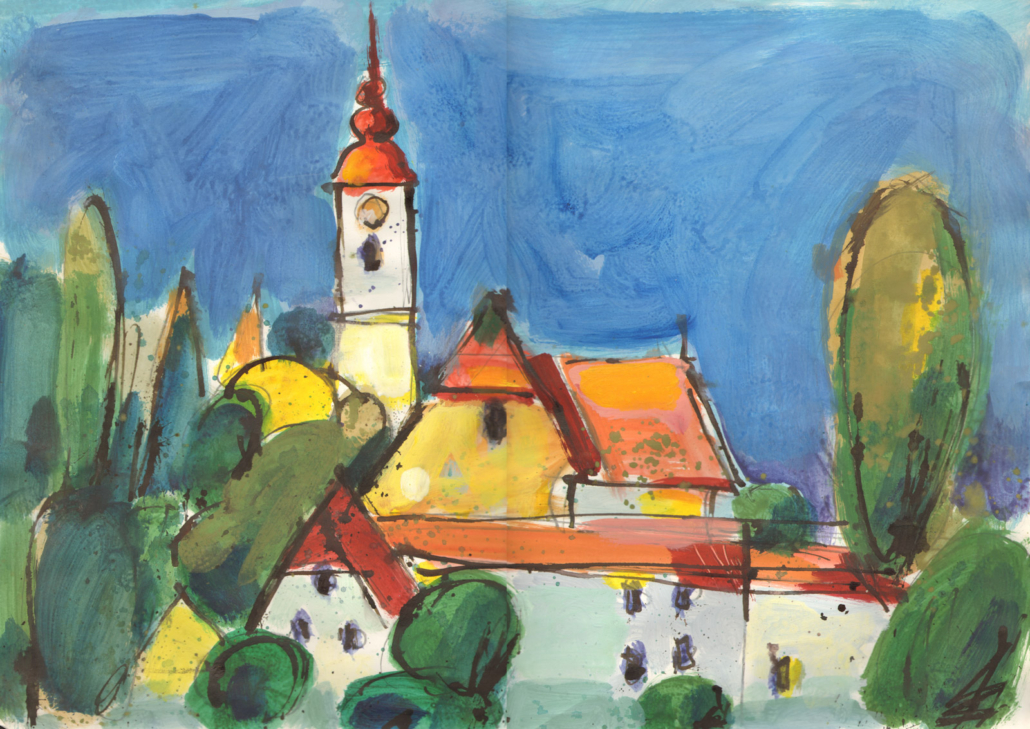
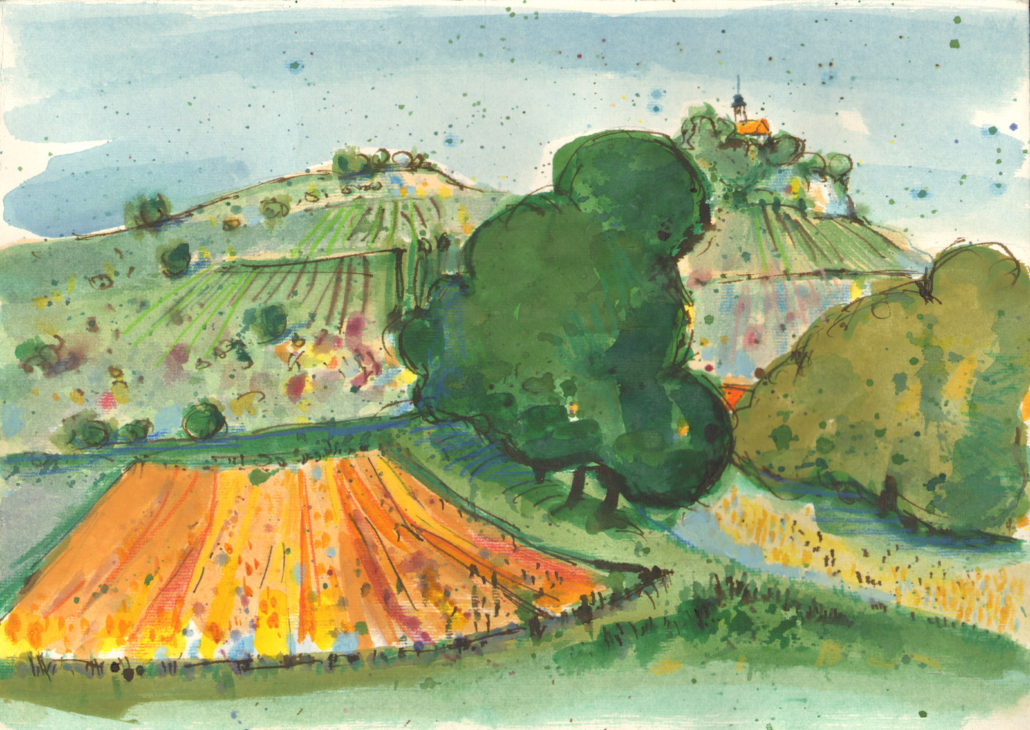
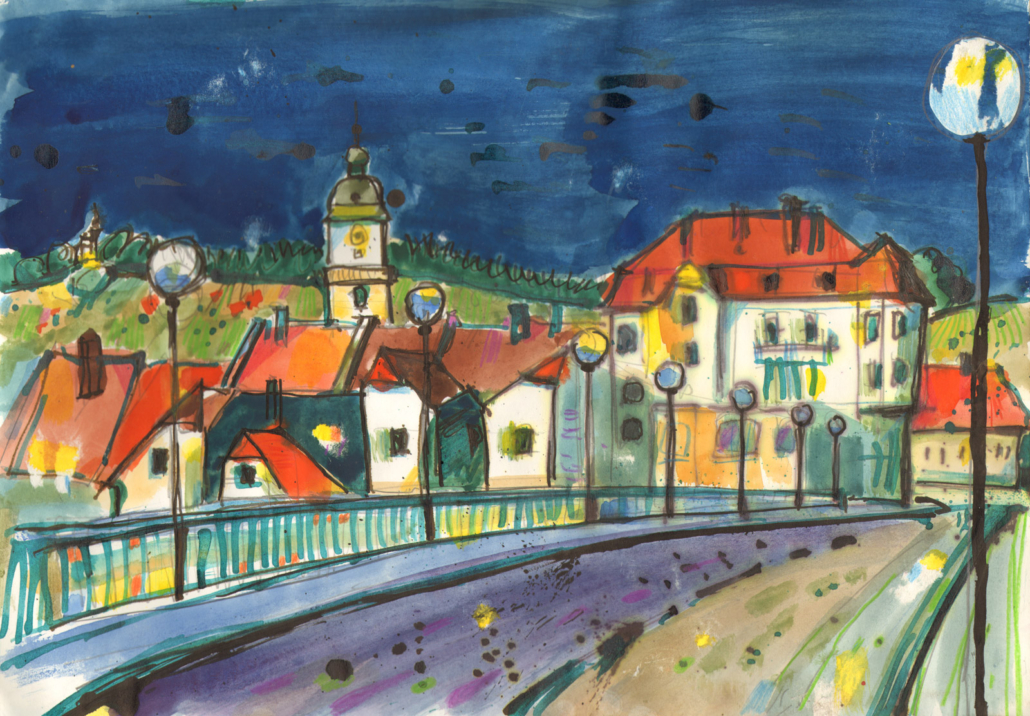
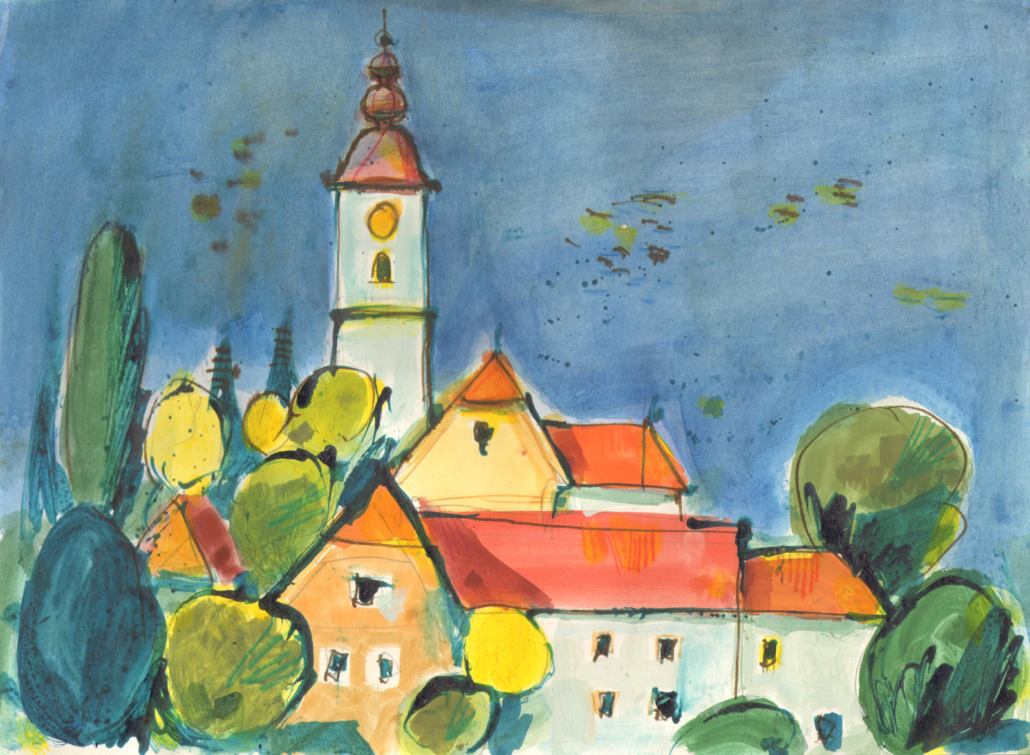
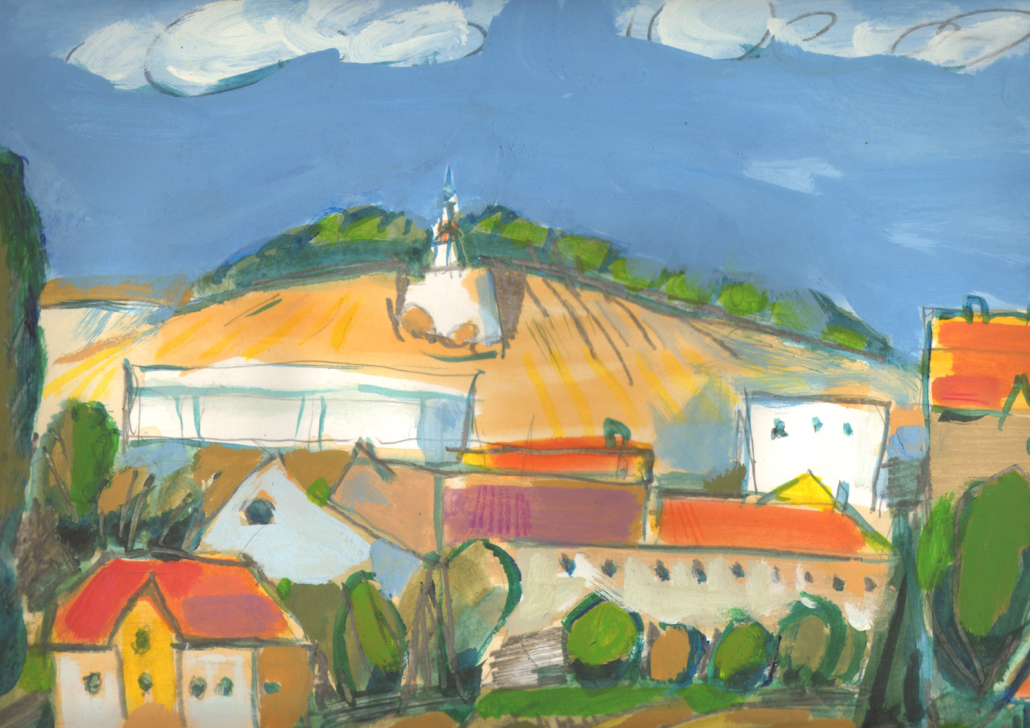
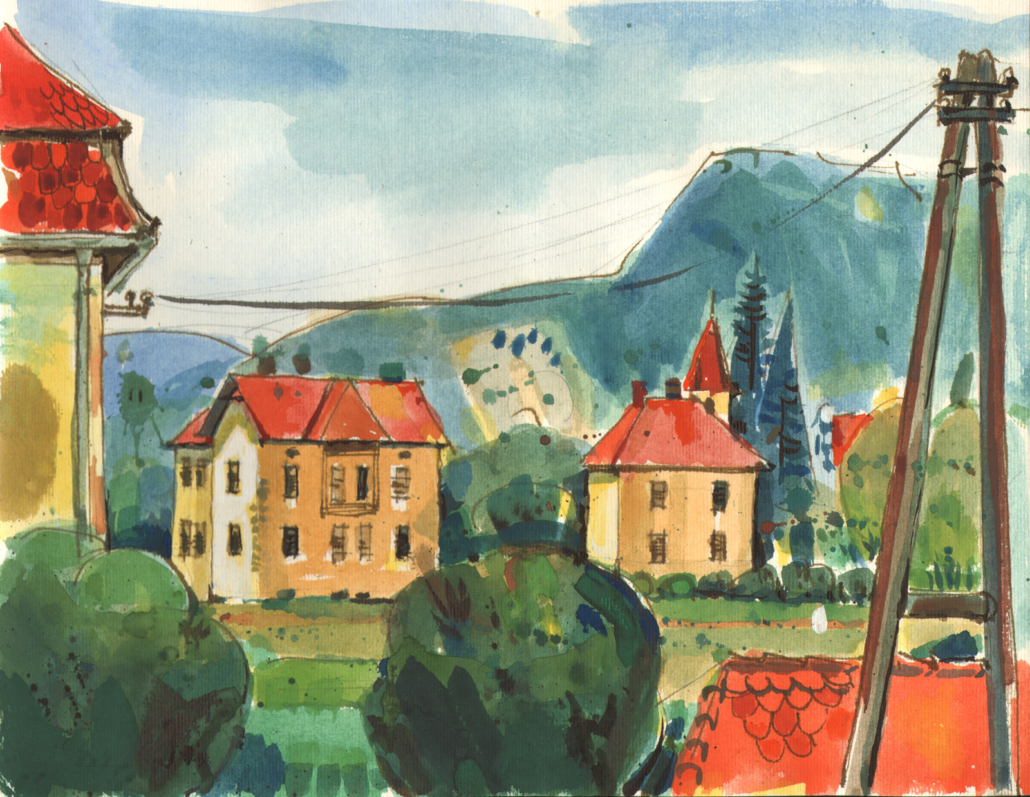
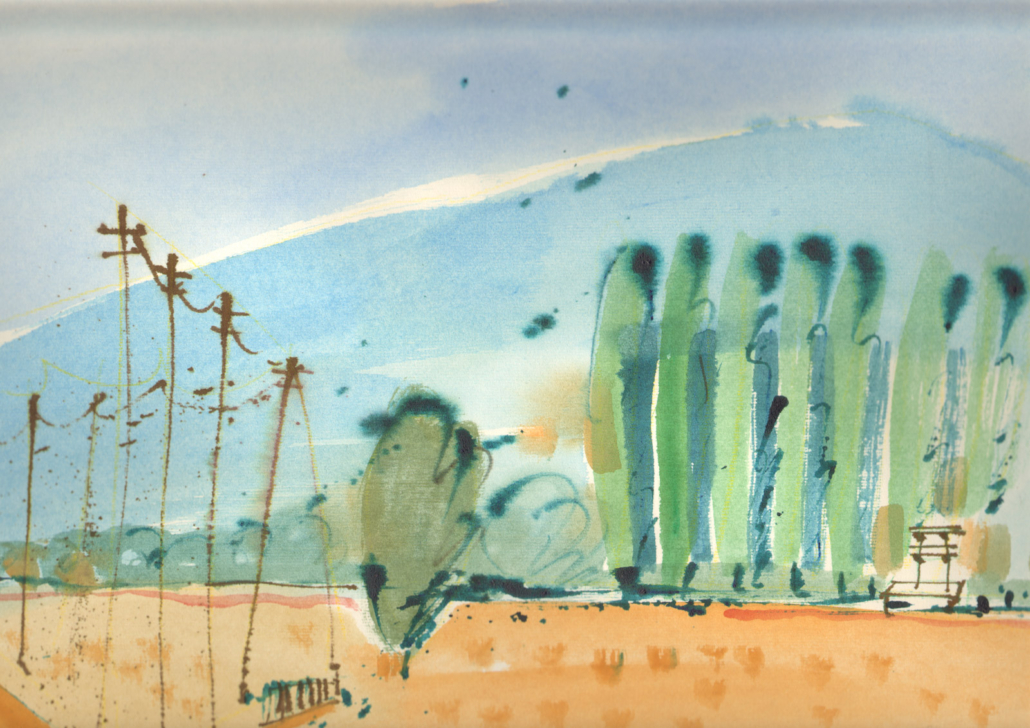
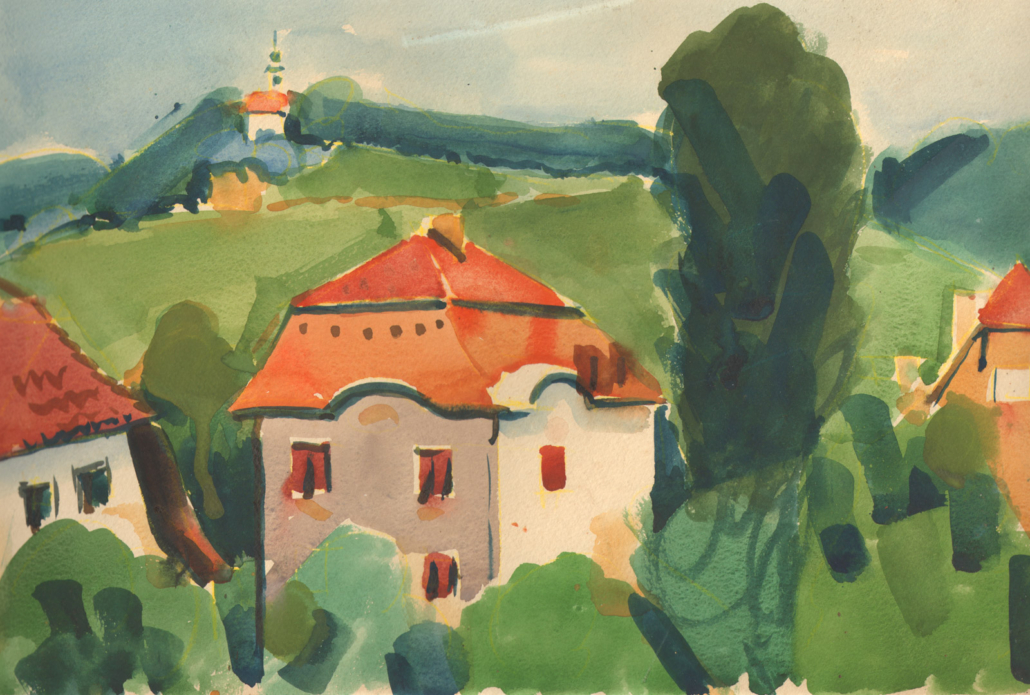
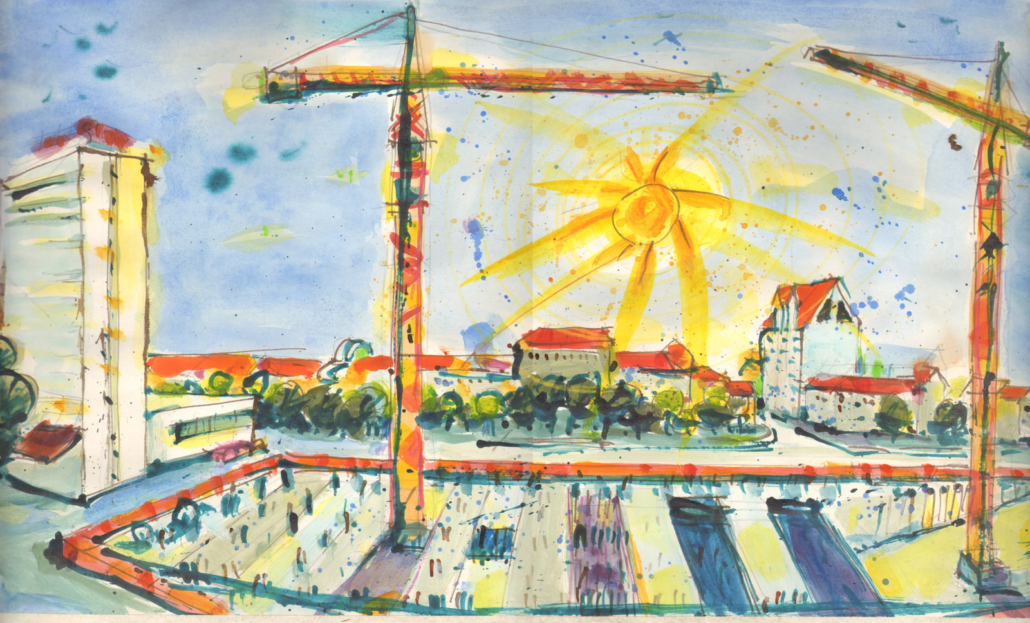
These works do not constitute a single enclosed cycle. They form a broader urban topography extending from five early sheets dated 1979 to a group of presently undated watercolours. Together, they reveal Pristavec’s interest in Maribor beyond its most recognisable historical image: its cultivated hills, peripheral neighbourhoods, churches, roads, individual houses and sites of modern construction.
The vertical works from 1979 approach the city through fragmentary and peripheral motifs. A road curves towards a hill, isolated houses appear beneath broad areas of sky, and trees or cultivated fields divide the landscape into simplified zones. Painted borders enclose the compositions, while drips, stains and small graphic marks preserve visible traces of the working process.
These early sheets are already far removed from conventional topographical illustration. Roads become broad bands, buildings are reduced to elementary blocks and trees appear as dark rounded signs. The city begins at its edges, where architecture, agriculture and vegetation form a continuous pictorial environment.
Piramida and the surrounding cultivated hills provide an important point of orientation in several later works. Rows of vines articulate the slopes, while the chapel, church towers and red-roofed houses create vertical and chromatic accents. Pristavec adjusts their scale and distance freely, preserving the recognisable character of the place without submitting the composition to strict optical accuracy.
Other watercolours bring the viewer down to street level. Churches, houses, lamps, utility poles and connecting wires establish a graphic rhythm across the sheet. These everyday elements show that Pristavec’s attention was not limited to picturesque monuments. Roads, gardens, suburban buildings and electrical infrastructure are treated as integral parts of the lived city.
A particularly striking composition presents a construction site dominated by cranes and an intensely yellow sun. Historic architecture remains visible in the distance, while modern building activity occupies the foreground. The crane becomes a contemporary counterpart to the traditional tower: another vertical structure around which the changing city is organised.
Across the group, paper remains an active pictorial surface. Transparent washes, exposed drawing, splashes, drips and areas of opaque colour record the successive stages through which observation is transformed into an image. Maribor emerges not as a city preserved outside time, but as an environment continually encountered, altered and reconstructed through memory, movement and painting.