


Mythology series
Late Synthesis, Personal Mythography and the Painting of Metamorphosis
In the late Mythology, all of Pristavec’s paths converge: figure, animal, nude, mask, colour surface and personal imagination.


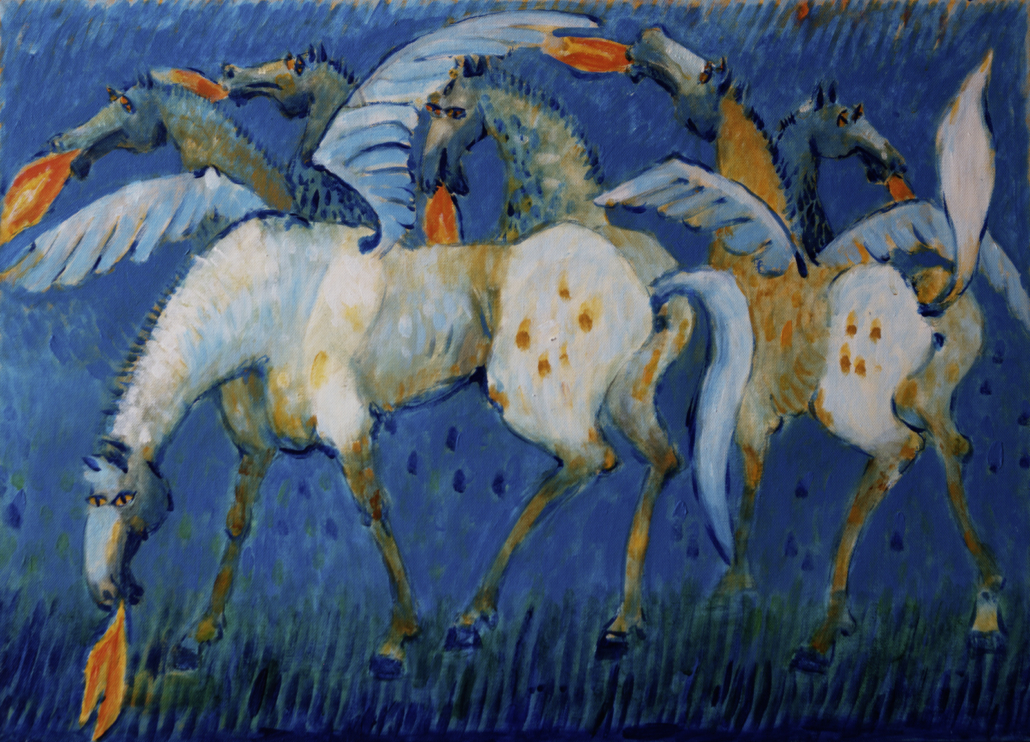


Mythology was created mainly in 2006 and 2007 and represents the final major completed ensemble in Pristavec’s oeuvre. Ancient myths, Christian legends, Slovenian literary tradition and the artist’s personal imagination meet within it. Pegasus, centaur, Minotaur, Nereid or dragon are not iconographically exact reconstructions but carriers of bodily and psychological tension.
The hybrid is the central figure of the cycle. Human and animal parts are joined visibly, often through strong contour, colour change or abrupt bodily turn. Pristavec does not conceal the imperfect junction, because he is interested precisely in the moment of metamorphosis. Pegasus combines the bodily weight of the horse with the possibility of flight, the centaur reason with instinct, while the Minotaur and dragon embody a danger that is both alien and unexpectedly human.
Narrative is not linear. Several actions may be condensed into one field; figures overlap, fall, attack or fly in different directions. Colour functions dramatically: blue opens night, water or transcendent space; red condenses bodily conflict; yellow and orange create impacts of light. Mythology is a late synthesis because drawing discipline, crumpled surface, mask, nude, animal, theatrical space and serial repetition all enter it. The cycle does not merely summarise earlier solutions but translates them into a new personal mythography.
Mythology is not simply the final chapter of Pristavec’s work but an active synthesis of his fundamental pictorial problems. Human and animal body, drawing and colour mass, narrative and ornament merge within it into a personal world of metamorphosis.
Mythology occupies a distinctive position within Janez Pristavec’s oeuvre. Because it was made near the end of his life, it would be easy to describe it as an epilogue, a final retrospective glance or a symbolic farewell. Such a reading is tempting but too narrow. The cycle is not simply a conclusion; it actively transforms everything the artist had developed over previous decades: the discipline of drawing, emancipated colour, deformed figuration, the animal body, theatrical staging, the erotic charge of the nude and the material tension of the pictorial surface.
Lateness here does not mean calm or withdrawal. On the contrary, the paintings are concentrated, restless and often almost combative. Pristavec does not return to myth in order to recover classical order. He turns to it because myth grants him the highest degree of freedom: the freedom to fuse human and animal, narrative and sign, cultural memory and private fantasy, recognisable figure and chromatic eruption.
The first reproduction in the surviving body of work depicts the artist beside a canvas on which winged horses are appearing. Flowers, ceramic vessels and traces of the working environment surround him. The image is more than a studio document. It acts as a programmatic prologue, presenting myth as something that comes into being before the viewer within the concrete space of the painter’s labour.
The scene is governed by a significant duality. The artist is both observer and maker of the beings he paints. Pegasus is not summoned from a remote antiquity but born on the canvas among ordinary studio objects. Mythological and everyday reality are not separate worlds. Vase and painting, model and imagination, work surface and vision occupy the same space.
The title Mythology might suggest a homogeneous classical cycle, yet the surviving body of work reveals a wider and more syncretic repertoire. Alongside Pegasus, centaurs, the Minotaur, Nereids and other classical beings appear Urška and the Water Man, a saint confronting a dragon, and scenes close to apocalyptic or folkloric imagination. The cycle is not bound to a single mythological tradition.
This heterogeneity is not an iconographic inconsistency but a defining feature of personal mythography. The artist treats cultural memory as an open archive in which the ancient, the Christian, the Slovenian and the invented are not rigidly separated. He selects situations that permit conflict, flight, abduction, metamorphosis, heroic action or bodily fusion.
This openness allows the motif to operate on several levels. A centaur is not only a character from a specific tale but a conjunction of instinct and reason; Pegasus is not merely a winged horse but a figure of ascent; the dragon is adversary, bodily danger and chromatic knot; the Minotaur is a carrier of inner division. Meaning emerges not only from the title but from posture, colour field, directional movement and the relation between bodies.
Such space does not represent one isolated second. It is a field of compressed action in which time becomes open and cyclical. The viewer does not follow a story from left to right but enters a network of events, reading the composition much as one reads memory, dream or a mural where different moments coexist.
The hybrid is the fundamental figure of the cycle. The centaur joins human and horse; the Nereid approaches a piscine or serpentine body; the winged horse crosses the boundary between earth and air; the dragon combines parts of several animals. Such bodies are not exceptions within an ordered world. They establish its law.
Pristavec does not conceal hybridity. Junctions are frequently emphasised by contour, a change of colour or a sudden twist in the body. Anatomy is not smoothed into a plausible fantasy creature because plausibility is not the aim. What matters is the visible transition, the point at which one kind of body becomes another.
The cycle is better understood as a late opening than a farewell. Myth allowed Pristavec his greatest freedom, yet it remained anchored in decades of observing body, animal, surface and colour. The entire oeuvre condenses here into one last major pictorial field.


