

Portraits on paper
Gesture, Character and the Archive of Encounters
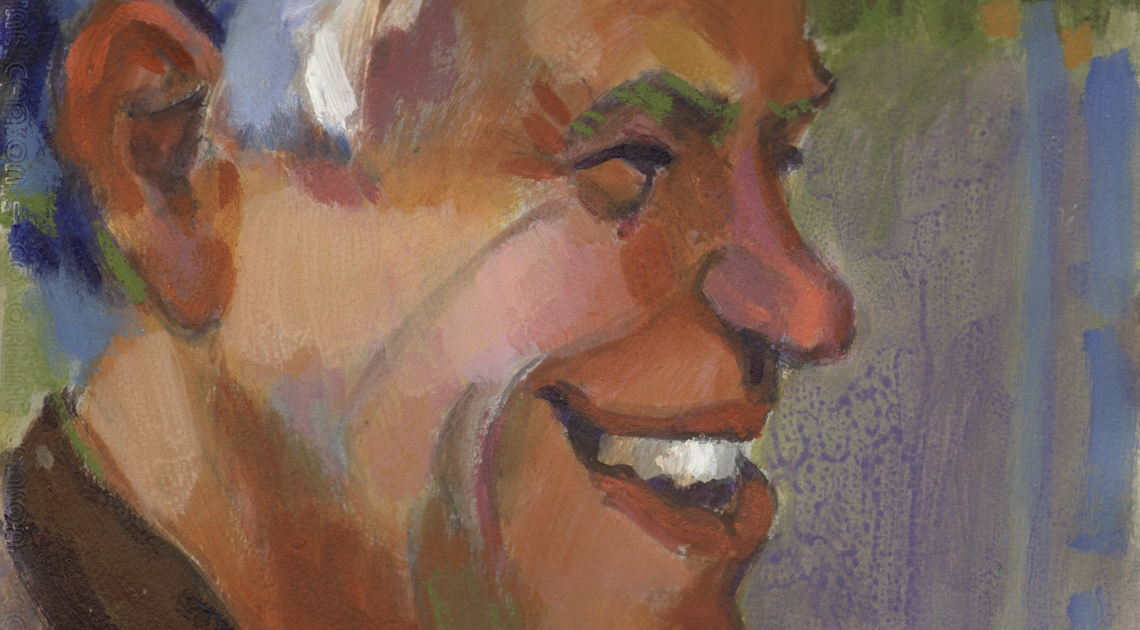
On paper, portraiture becomes an art of rapid recognition. A line, a chromatic accent or an emphasised feature must preserve the identity of the sitter while revealing the artist’s immediate response to their presence.


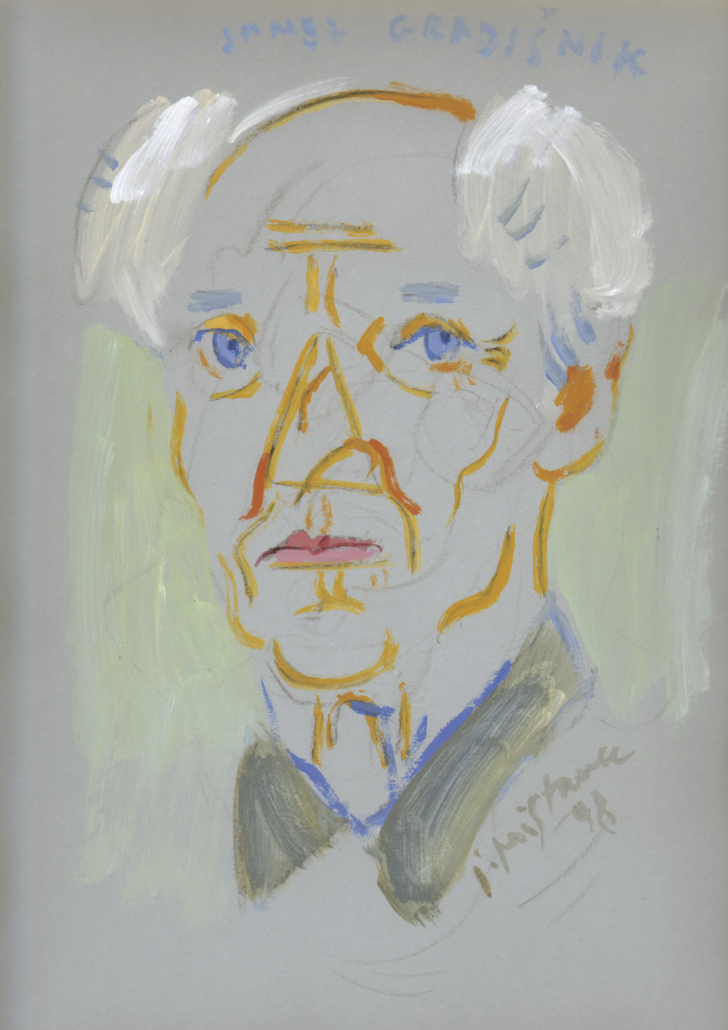
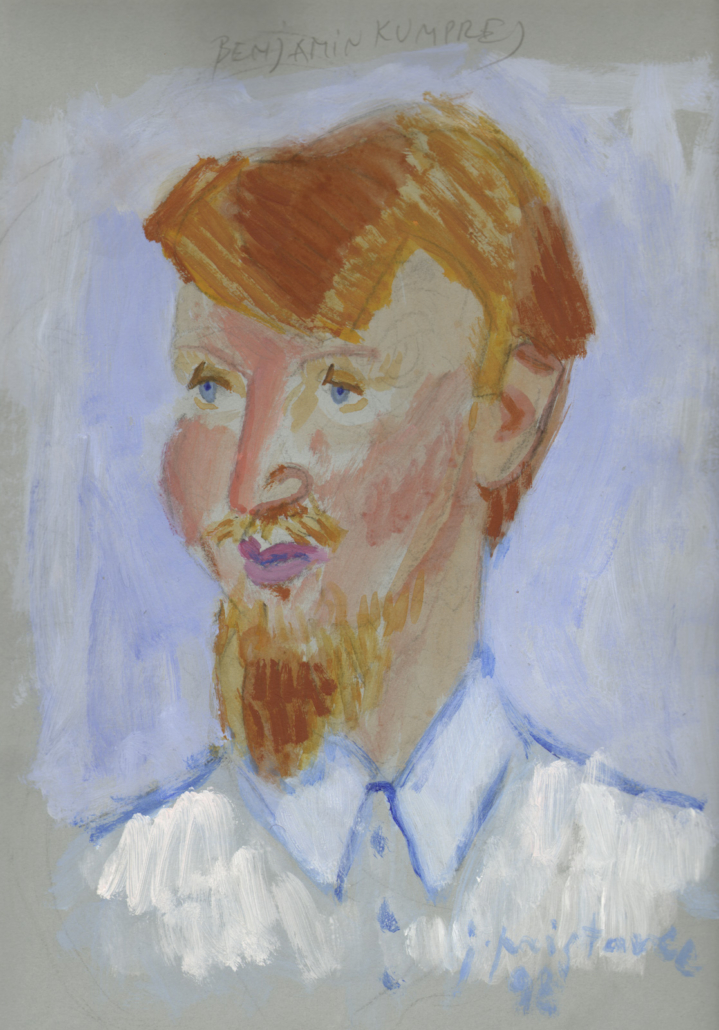


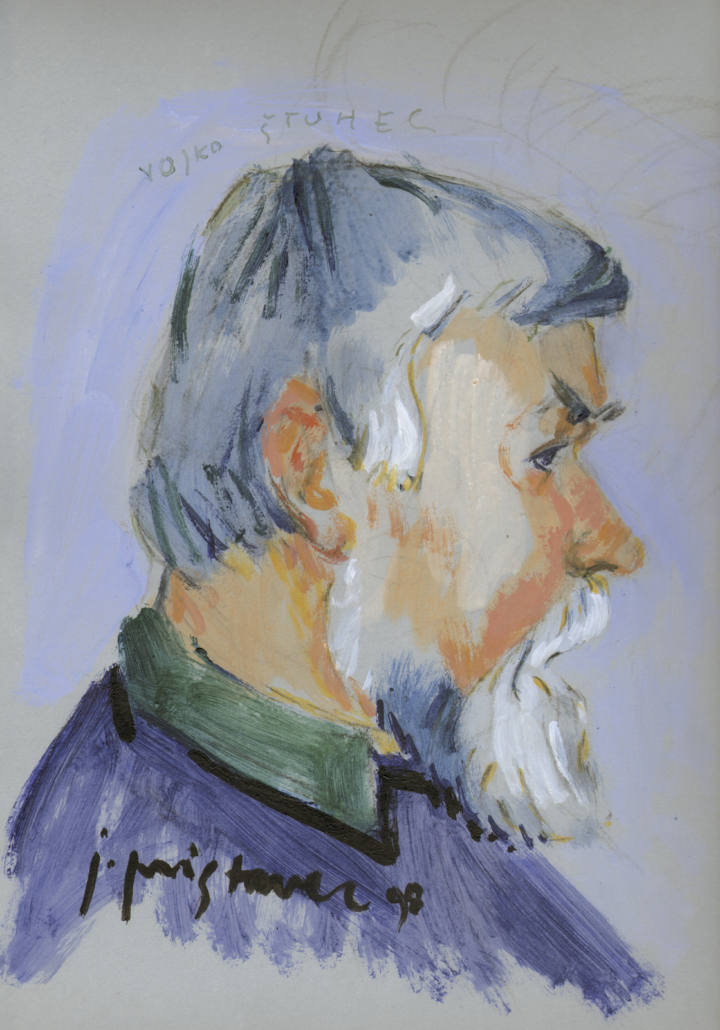


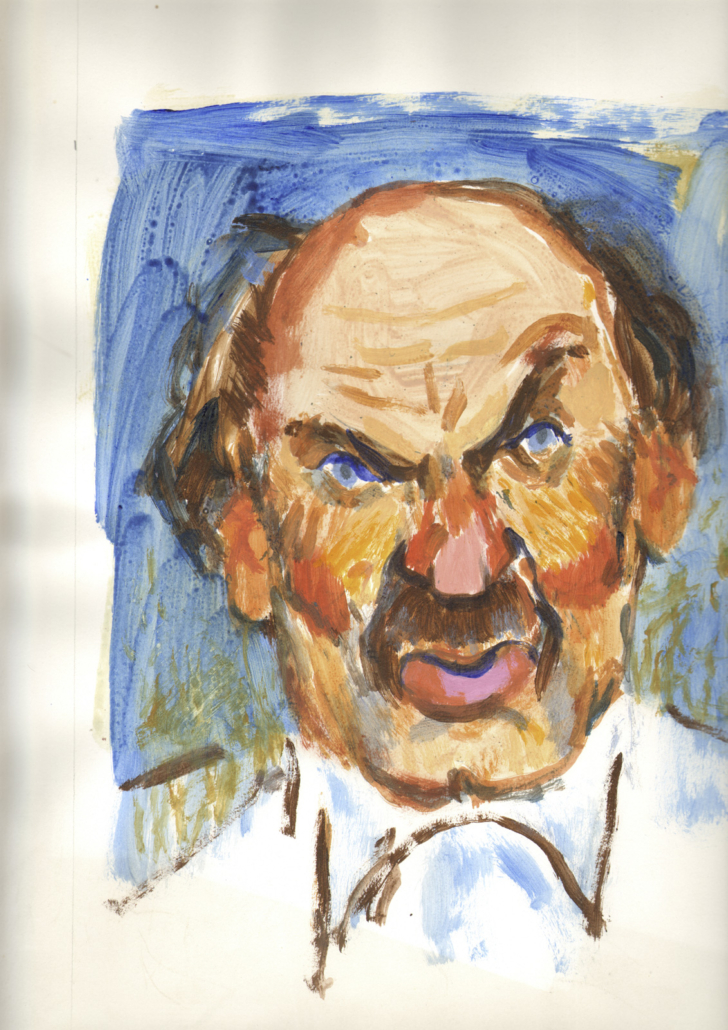


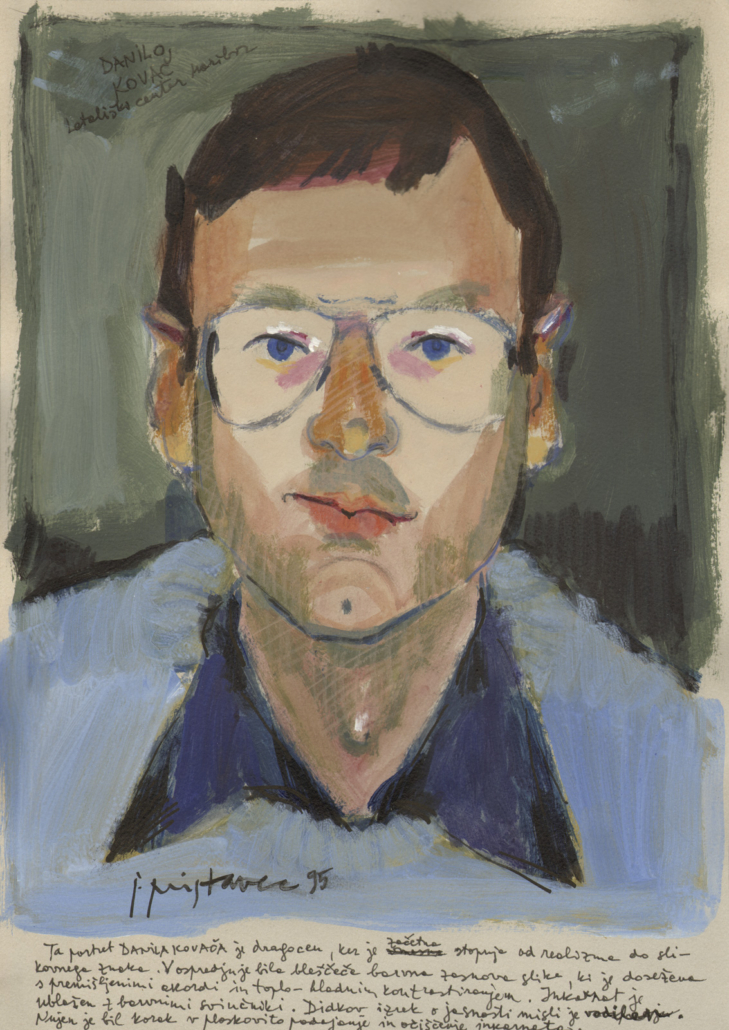


Pristavec’s portraits on paper occupy the space between drawing, painting and caricature. Compared with the material density of canvas, paper encourages speed, economy and directness. The face is often captured through a limited number of decisive marks: the inclination of the head, the rhythm of the profile, the weight of an eyelid or the characteristic tension of the mouth. Expressive deformation does not erase likeness but intensifies those features through which a person becomes recognisable. Portraits of artists, writers, musicians, actors, family members and people from Maribor together form an extensive visual archive of Pristavec’s cultural, personal and urban environment.
Pristavec’s portrait oeuvre includes portraits on canvas, portraits on paper, public drawing and caricature. These groups are not separate worlds. Together they reveal an artist who continually tested how far the human face could be transformed without losing its individual presence.
On paper this test becomes particularly immediate. The support does not encourage prolonged correction or the gradual construction of a dense pictorial body. Instead, it preserves the sequence of decisions: the first contour, the interruption of a line, the sudden chromatic emphasis and the mark that changes observation into interpretation. Some sheets approach painting through saturated acrylic colour, while others reduce the face to a few sharply selected features. Between these poles lies a wide spectrum of portrait possibilities.
The collection brings together Slovenian artists and cultural figures, members of the artist’s family and people from the Maribor environment. It therefore exceeds the boundaries of a conventional portrait gallery. The works record friendships, professional connections, family bonds, public encounters and the cultural life of a particular place and period. Individual sheets may be intimate or humorous, commemorative or analytical, yet together they constitute a form of social memory.
Caricatural intensification plays an important role within this practice. Pristavec enlarges a forehead, sharpens a profile, stresses a hairstyle or condenses the expression around the eyes and mouth. Such transformations are not merely comic additions. They are methods of recognition. By reducing the abundance of visible information, the artist searches for the few features capable of carrying the identity and character of the entire face.
Portraiture on paper has a special position in Pristavec’s oeuvre because it brings artistic freedom into direct contact with the irreducible individuality of another person. Each sheet must preserve enough likeness for the sitter to remain present, yet enough formal independence for the work to become more than a record of appearance.
The portraits on paper were produced within a relatively concentrated period, principally between 1994 and 2001, although the collection also includes undated works. This concentration gives the corpus the character of an extended campaign of observation. Pristavec repeatedly returned to the human face, approaching it not through a single fixed method but through a succession of painterly and graphic experiments.
The paper support was essential to this process. Unlike canvas, which permits extensive overpainting and the gradual construction of a chromatic mass, paper records hesitation, acceleration and interruption with particular clarity. A contour may remain open; one part of the face may be described in detail while another dissolves into an empty field. The unpainted surface is not simply an unfinished area. It becomes an active interval that allows the portrayed figure to emerge without being completely enclosed.
This economy gives the works their immediacy. A head may be established by only a few lines, but those lines carry several functions at once. They describe the edge of the face, indicate movement and organise the rhythm of the sheet. A dark stroke beside the nose may define both anatomy and temperament; a rapid curve may simultaneously describe cheek, age and expression.
Colour is used with similar freedom. It is rarely limited to the natural tones of skin, hair or clothing. Red, blue, violet, green and yellow enter the face as autonomous expressive forces. They may divide the physiognomy into contrasting zones, direct attention towards the eyes or mouth, or connect the sitter with the surrounding field. Even where the format is intimate, colour can give the head an unexpected pictorial monumentality.
The resulting likeness does not depend upon anatomical exactitude alone. Recognition is frequently achieved through disproportion, emphasis and abbreviation. One feature may be enlarged while another is almost omitted. The characteristic angle of the head, the shape of the glasses, a beard, hat or hairstyle may become more important than the correct modelling of facial volume.
In this respect, Pristavec’s portraits approach caricature without always becoming caricatures in the conventional sense. Caricature is not simply a separate humorous genre but one of the fundamental possibilities of his portrait language. It reveals how little visual information may be required for a person to remain unmistakably themselves.
Such reduction also introduces an ethical dimension. Exaggeration can disclose character, but it can also turn an individual into a fixed type. The most successful works preserve a delicate balance between wit and respect. They intensify the sitter’s distinctive features without denying their complexity. Humour remains connected with recognition rather than humiliation.
The portraits of Slovenian artists and cultural figures give this balance a broader historical importance. Painters, sculptors, writers, poets, actors, directors and composers appear not as distant cultural monuments but as living, psychologically particular individuals. Their public identity is brought into contact with bodily presence: fatigue, reserve, concentration, irony or vulnerability.
Pristavec frequently portrayed people whose work formed part of the intellectual and artistic environment in which he developed. The series can therefore be read as an unconventional map of Slovenian culture. It does not construct that culture through institutions, movements or official hierarchies, but through faces. Cultural history becomes a sequence of individual encounters.
The family portraits introduce a different register. Here social recognition gives way to proximity, repetition and personal memory. Parents, relatives, children and the artist himself return across several sheets. Repeated portrayals do not merely reproduce the same identity. They record changes in mood, age, distance and artistic approach. The familiar face becomes a field in which memory and present observation continually overlap.
The self-portraits are especially important in this context. When the observer and the observed person are the same, the portrait ceases to be only an encounter with another. It becomes a test of self-recognition. Pristavec does not idealise his appearance or construct an elevated image of the artist. The face may be serious, comic, withdrawn or deliberately distorted. Self-portraiture allows him to direct the freedom of caricatural transformation towards his own identity.
The portraits of people from Maribor give the corpus its strongest local dimension. Photographers, gallery figures, acquaintances and other recognisable personalities transform the collection into an urban archive. These works preserve not only individual physiognomies but also a network of relationships surrounding the artist. Maribor appears indirectly, through the people who inhabited its artistic, cultural and everyday life.
Public drawing intensified this social character. Portraiture became an event taking place in front of an audience and often in direct contact with the sitter. The speed of execution was no longer solely an artistic choice but also a condition of the encounter. Observation, performance and recognition occurred almost simultaneously. The publication Encounters extended this ephemeral practice into a more lasting archive.
The large number of surviving sheets is therefore significant. Their value does not lie only in the quality of isolated works, although many possess considerable formal and psychological strength. As a corpus, they document the persistence with which Pristavec observed the human face and the breadth of the community that entered his artistic world.
At the same time, the collection should not be understood as a neutral catalogue of appearances. Every portrait is a transformation. The sitter passes through Pristavec’s particular visual language of interrupted contour, chromatic contrast, asymmetry and expressive emphasis. The archive is subjective: it records people as they were seen, remembered and pictorially reconstructed by one artist.
Portraits on canvas and portraits on paper consequently offer different but complementary truths. Canvas gives the face material weight, chromatic density and a more slowly constructed presence. Paper preserves the velocity of perception and the risk of an irreversible decision. On canvas the head often becomes a substantial pictorial body; on paper it remains closer to an event—the moment in which another person is recognised through gesture, line and colour.
Taken together, the portraits on paper form both an artistic investigation and a collective biography. They reveal an artist testing the limits of likeness, but also a family, a city and a cultural environment assembled through individual faces. The collection is therefore not merely a gallery of sitters. It is an archive of encounters and a social portrait of the world in which Janez Pristavec lived and worked.