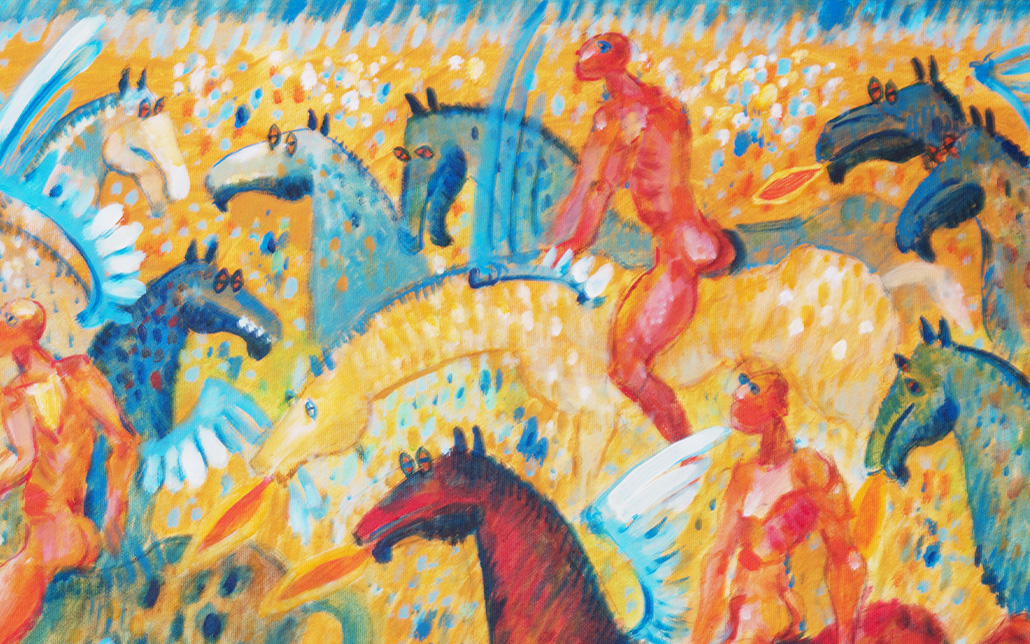
Riders on Winged Horses
The painting “Riders on Winged Horses” (2007) is part of Pristavec’s mythological series, where ancient symbolism, contemporary expression, and the artist’s vision of transcendence intertwine. In this piece, Pristavec fuses movement, light, color, and myth to create a near-visionary image floating between the earthly and the celestial. The motif of winged horsemen is rare in contemporary art and serves as a metaphor for spiritual transition, freedom, and the ecstasy of creative spirit.
Iconographic Analysis
The painting depicts three riders on large, winged horses galloping along a diagonal axis. Their bodies appear stretched, almost levitating, surrounded by intense fields of color in warm orange, pink, and blue tones. The horses’ wings are expressive, resembling mythical creatures such as Pegasus or hippocamps. Each rider has a unique posture and gesture, suggesting various states—determination, ecstasy, mystical rapture.
Color and Composition Analysis
The color palette is dominated by warm gradients, with contrasts between red-orange and blue-green. Light flows from the bottom right corner to the upper left, evoking a sense of ascent or flight. The composition is based on flowing lines and a diagonal buildup of tension. Pristavec uses color not only as an optical effect but as a vehicle of emotional and spiritual meaning.
Technique and Painterly Execution
Acrylic on canvas (50×70 cm) is applied in layered textures. Brushstrokes are broad, rhythmic, at times gestural, but subordinated to compositional clarity. The horses are stylized, muscular, with emphasized legs suggesting motion. Wings and figures are not realistic but symbolic—emphasis lies in dynamism and emotional expression.