


A lifelong monograph: The comprehensive Lent ouvre


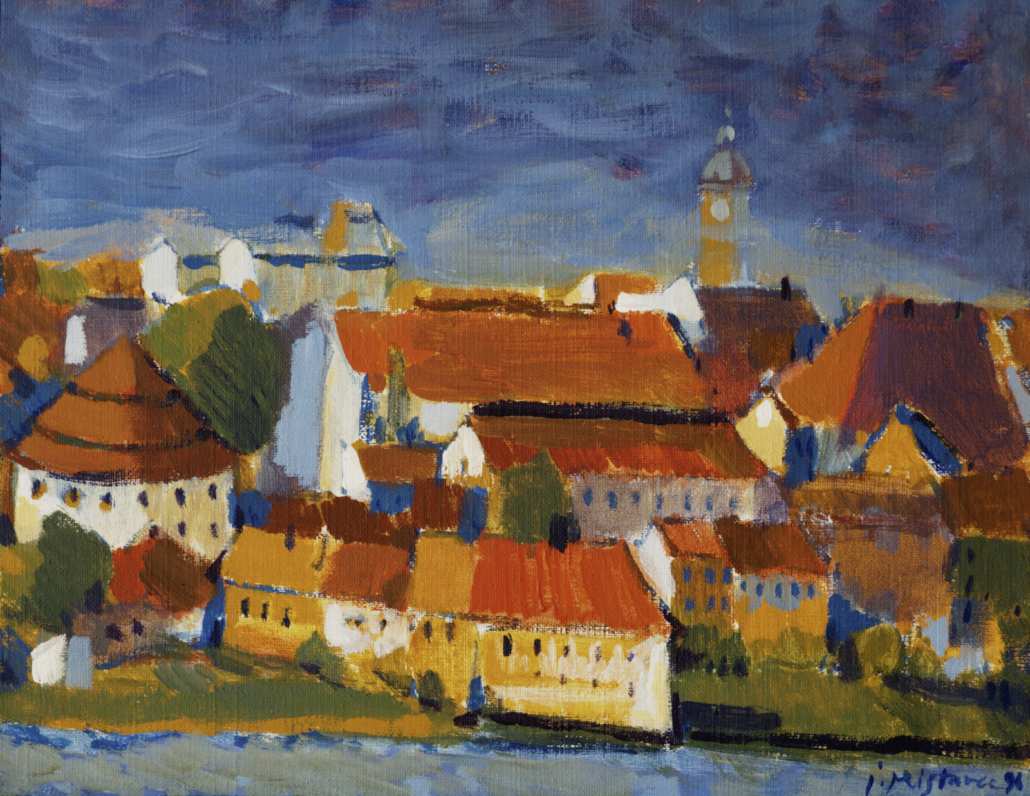


Looking at all 30 canvases simultaneously reveals what is arguably the crown jewel of Janez Pristavec’s artistic legacy. This is not just a collection of cityscape paintings; it is a 22-year monographic evolution. By keeping his geographic focus locked on the exact same riverbank—the historic Lent district of Maribor—Pristavec transformed his home into a controlled artistic laboratory. While the physical layout of the city remains recognizable throughout, the style shifts radically, charting a brilliant course through the history of European modernism.
Chronological Evolution of the Medium and Style
The 30-canvas trajectory shows that Pristavec did not develop in a straight, predictable line; instead, he periodically reinvented his visual vocabulary to solve different artistic problems.
| Era | Core Style | Technical Execution | Visual Atmosphere |
| The Formative Years (1986–1989) | Textured Expressionism | Dense, tactile paint application; visible, heavy, and gestural brushstrokes; raw emotional resonance. | Moody, nostalgic, nocturnal; heavy dark indigo skies filled with swirling clouds and bird-like marks; glowing window cells. |
| The Graphic Maturity (1993–1995) | Cloisonnism & Flat Modernism | Total abandonment of texture; smooth, flat color planes locked inside bold, dark graphic outlines. | Sharp, clean, architectural twilights; high optic contrast between blinding whites, burning oranges, and flat indigo slabs. |
| The Transitional Turn (1996–2000) | Atmospheric Impressionism | Loosening of the dark graphic lines; broader, softer brushwork; introduction of industrial diagonals. | Hushed, naturalistic, transitional weather; soft winter hazes, melting gray-blue snows, and the introduction of a vibrant red bridge. |
| The Ultimate Peak (2006–2008) | Neo-Impressionist Divisionism | Replacement of flat planes with thousands of short, rhythmic, independent flecks of pure color and overlayed patterns. | Vibrating, shimmering landscapes; electric winter nocturnes, pointillist snowfall screens, and delicate rain curtains. |
Iconographic Constants: How the City Evolved
Throughout the 22-year span, five core iconographic anchors reappear constantly. However, as Pristavec matured, these physical structures transformed from architectural records into pure geometric symbols:
The Drava River
-
Early Phase: A painterly, textured teal surface that mirrors the shifting sky.
-
Middle Phase: An absolute, unyielding horizontal slab of pure dark indigo that pins the composition to the bottom of the canvas.
-
Late Phase: A shimmering, pointillist body of water that dissolves into dancing vertical reflections.
The Medieval Fortifications (Water, Judgement, and Round Towers)
-
Early Phase: Isolated, dominant focal points on the left side of the canvas, anchor points of local history.
-
Late Phase: Completely assimilated into the broader geometric tapestry of the city, defined entirely by how light fractures across their circular white stone walls.
The Cathedral Bell Tower (Stolnica)
-
The undisputed axis mundi (center of the world) of the entire 30-picture cycle. Across three decades, its baroque lantern remains the permanent vertical sentinel, balancing the heavy horizontal pull of the Drava River. It stands as a beacon of stability whether surrounded by flat graphic twilights or buried under a thick pointillist snowstorm.
The Old Bridge (Stari most)
-
Introduced in the 1990s as a rigid, steel-blue diagonal engineering feat cutting across the right quadrant. By 2007, it undergoes a radical compositional takeover, moving directly into the immediate foreground. Its massive red brick arches become a majestic viewfinder through which the viewer is forced to look to see the historic town behind it.
The Franciscan Church
-
Appearing predominantly in his mature, late-career panoramas, the twin red spires of this church expand the visual weight of the skyline to the right, creating a complex, syncopated rhythm of vertical peaks against the rolling backdrop of Piramida Hill.
The Grand Dualism: Fire and Ice
When viewing all 30 works together, a striking psychological and coloristic dualism emerges between Pristavec’s handling of extreme seasons:
The High-Summer Vibrations
In his summer and daylight vedutas, Pristavec employs an absolute explosion of primary and complementary colors. Burning crimsons, blazing oranges, and radiant yellows crash directly against deep turquoise waters and emerald trees. Light does not fall from an external sun; it is generated by the violent, joyful collision of high-saturation colors.
The Luminous Winter Nocturnes
In his snowscapes, Pristavec achieves a masterful psychological contrast. He wraps the skies and snow-laden roofs in freezing, deep indigos, icy cyans, and pale pink washes. Yet, beneath this freezing blanket, the house facades glow with warm ambers, tangerines, and brilliant yellows. This creates a deep feeling of insulation, contrasting the hostile, quiet winter elements with the warm, beating heart of human life inside the city.
Final Art-Historical Placement
The collective 30 pictures prove that Janez Pristavec was a master of synthesis. He took the centuries-old, stone-and-mortar substance of a Central European city and updated it through successive waves of the European Avant-Garde:
-
He channeled the structural distortions of German Expressionism to convey the moody nostalgia of his youth.
-
He adopted the flat, clean clarity of Post-Impressionist Cloisonnism and the Ligne Claire aesthetic to give his hometown an industrial, timeless monumentality.
-
He culminated his career by mastering Neo-Impressionist Divisionism, fracturing the atmosphere of Maribor into vibrating, singing particles of light, reminiscent of Giovanni Segantini and Gustav Klimt’s jewel-like textures.
Comprehensive Summary for the Digital Catalog
The Maribor (Lent) Cycle (1986–2008) is a monumental, lifelong love letter to the artist’s birthplace. By treating Lent as a constant, unchanging layout, Pristavec freed himself to explore the infinite boundaries of style, color, and light. Moving seamlessly from heavy textured expressionism to flat graphic modernism, and finally into a shimmering, pointillist divisionism, this 30-canvas masterclass stands as a towering achievement in modern landscape painting—proving that the place a creator lives their entire life can become an infinite, radiant gateway to the entire artistic universe.
Contextual expansion: the complete Maribor territory


Until now, we viewed his Maribor works primarily as a lifelong dialogue with the riverbank of Lent. This selection expands the horizon significantly, proving that Pristavec’s vision covered the entire geographic and cultural identity of Maribor. He didn’t just paint the historic port; he mapped out the city’s inner courtyards, its industrial realities, its rural wine-growing outskirts, and even its peripheral modern infrastructure.
Spatial Expansion: The Multi-Layered City
With this batch, Pristavec breaks away from the safety of the riverbank perspective and divides the identity of Maribor into three distinct spatial layers:
-
The Rural & Agricultural Fringe: In
1995_city_1995_45x45cm_Maribor.jpg, the artist captures the rolling wine-growing hills surrounding the city (evoking the vineyard valleys of Malečnik or Svečina). The canvas is dominated by agricultural rows, green terraced hills, and a lonely hilltop chapel. Similarly,1990_city_1990_30x30cm_Maribor.jpgisolates a single, majestic pine tree framing a rustic home, celebrating the green, organic borders of his life. -
The Industrial Reality: In a bold departure from romanticism,
1990_city_60x60_Maribor.jpglooks down from a high cliff (likely Meljski hrib) to view the winding Drava River flowing past an industrial zone. Pristavec includes a towering red factory chimney—a brilliant nod to Maribor’s 20th-century history as a major textile and manufacturing hub. -
The Inner Civic Core: In
1996_city_1996_50x40_Maribor.jpgand1999_city_1999_30x40cm_Maribor.jpg, Pristavec moves into the heart of the old town squares. He paints the iconic arcaded facade and clock tower of the Maribor Town Hall (Rotovž) or Maribor Castle, trading wide horizons for intense, close-up urban massing. -
The Technological Periphery: Perhaps the most surprising work,
2007_city_2007_40x30cm_Maribor_winter_1.jpg, showcases high-voltage electricity transmission towers and power lines cutting across a heavy winter snowstorm. This highlights an artist who was entirely unafraid to capture modern, industrial grid infrastructure encroaching upon nature.
Morphological and Technical Evolution
This batch confirms and strengthens the technical timeline we established for the Lent paintings, showing a flawless synchronization in his stylistic evolution:
[1990 Expressionism] —> [1995-1996 Cloisonnism] —> [1999 Nocturnal Wash] —> [2006-2007 Pointillism]
Heavy, raw strokes Flat planes, dark lines Soft, velvet indigo washes Vibrating color static
1990 Raw Expressionism: 1990_city_60x60_Maribor.jpg utilizes a dense, textured, and heavy palette. The deep blue of the sky and the white of the river are applied with thick, urgent strokes that feel alive and unsettled.
1995–1996 Graphic Precision: 1996_city_1996_50x40_Maribor.jpg showcases the absolute peak of his clear-line graphic phase. The ancient building is cast in burning oranges and ocher yellows, perfectly bound by heavy, dark outlines against a solid, unyielding sky.
1999 The Nocturnal Wash: Represented beautifully by 1999_city_1999_30x40cm_Maribor.jpg, this phase shows a deliberate softening of the previous era’s hard outlines. Pristavec transitions into fluid, velvet-like acrylic washes of deep indigo and midnight violet. Instead of rigid architectural separation, the shapes begin to bleed together under a soft, internal glow, capturing a deeply atmospheric, nocturnal peace.
2006–2007 The Pointillist Climax: In 2006_city_2006_50x70cm_Maribor.jpg and 2007_city_Maribor.jpg, the solid shapes dissolve completely. The city is covered in a dense visual static of thousands of dancing paint flecks. In 2006_city_2006_50x70cm_Maribor.jpg, this technique takes the form of long, vertical blue and white streaks that wash over the city like a sudden summer cloudburst or an intense atmospheric shimmer.
New Iconographic Anchors
This expansion introduces two key visual landmarks that must be cataloged alongside his famous river towers:
Piramida Hill as the Urban Backdrop
In 2006_city_2006_50x70cm_Maribor.jpg and 2007_city_2007_60x40cm_Maribor.jpg, Pristavec focuses heavily on the classic northwards view over Maribor’s rooftops. The compositions are crowned by the rolling, vineyard-covered slopes of Piramida Hill, complete with the distinct white silhouette of the classic chapel at its peak. Piramida acts as a soft, maternal green shield guarding the dense network of red roofs below.
The Civic Arcades & Clock Towers
By capturing the inner town architecture (1996_city_1996_50x40_Maribor.jpg, 1999_city_1999_30x40cm_Maribor.jpg), Pristavec honors the Renaissance and Baroque heritage of the city core. The repeating rhythmic geometry of the open arcades provides a beautiful, patterned structure that allows his color blocks to sing.
Atmospheric Mastery: The Velvet Night
While the previous batches highlighted his mastery over winter snow, 1999_city_1999_30x40cm_Maribor.jpg introduces his mastery over the velvet urban night.
By re-imagining the same town hall scene from 1996, the 1999 canvas softens the harsh graphic lines into fluid, deep indigo, violet, and midnight blue washes. The building’s windows and walls glow from within like warm embers against the cool, starlit dark sky. This brings an incredibly cozy, protective, and deeply romantic atmosphere to the city’s historical architecture.
Comprehensive Summary
With these additional 10 works integrated into the collection, the Maribor Oeuvre expands from a localized riverfront series into a complete, multi-layered visual monograph of a Central European city. Pristavec successfully captured every facet of his home—from its rolling wine hills and town squares to its industrial riversides and modern power grids. By shifting fluidly across raw expressionism, flat graphic lines, and vibrating pointillist light over three decades, he proved that his hometown was not just a place to live, but a complete, self-contained universe of artistic exploration.
Classical macro-methodical analysis of the cycle: Adriatic


This type of analysis examines the entire body of work from the artist’s final Adriatic journey in 2007 through strict art-historical categories: concept, morphology of the medium, iconography of motifs, light dynamics, and placement within the broader European modernist canon.
Conceptual Starting Point of the Cycle
The “Cities and the Adriatic” cycle from 2007 represents Janez Pristavec’s transition from hermetic canvases steeped in mythology and symbolism into the realm of pure morphological lyricism, where the external, tangible world acts as the primary trigger for the artistic event. The artist does not use the Adriatic landscapes as topographic documents, but rather as scenography to explore two fundamental components of painting: color emancipation and luminous atmosphere. Geographical points—such as Rab, Dubrovnik, and Piran—serve as visual anchors through which the author seeks the genius loci (the spirit of the place) and translates it into a universal pictorial language.
Morphological Analysis and Technical Characteristics
The choice of acrylic on canvas directly dictates the rhythm and expressiveness of the entire series. Due to the fast-drying nature of this medium, Pristavec eschews classical academic tonal graduation, opting instead for a direct, pulsating application. Within the cycle, we morphologically recognize two distinct directions:
-
Lyrical, Translucent Brush Drawing: In works, the color planes appear airy, almost like watercolor. The form and architectural outlines are defined by a rapid, expressive dark line that preserves a sketchy freshness and emphasizes the spontaneity of the moment.
-
Thick, Divisionist Application: The texture becomes completely dense. The artist utilizes short, rhythmic, almost pointillist brushstrokes. Colors do not mix on the palette but blend optically in the viewer’s eye, creating the impression of vibrating air saturated with summer heat.
Motifs and Iconographic Comparison of Works
The iconographic repertoire of the collection comprises three key elements that recur rhythmically, binding the individual canvases into a coherent whole:
Natural Frame (Repoussoir)
Mediterranean trees (pines and stone pines) play a crucial role in structuring the space.
-
In the work
2007_city_60x50cm_Isle_Rab.jpg, a powerful, arched trunk stands out on the left side, its bark glowing in warm red and orange tones, which complementarily balances the deep blue of the bay below. -
In
2007_city_70x50__isle_rab.jpg, soft canopies frame the upper edge, pushing the sacred architecture safely into the background. -
In the composition of
2007_city_70x50_Adriatic_2.jpg, three vertical trunks act like pillars or theatrical wings, cutting across the panoramic view and heightening the sense of depth.
Urban Vertical (Bell Towers)
Bell towers are the central anchors of compositional stability in these Adriatic vedutas.
-
In the work
2007_city_70x50__isle_rab.jpg, a simple Romanesque bell tower with biforas merges with the white church facade featuring a rosette window, representing a classic example of sacred Adriatic iconography. -
In coastal vedutas, such as
2007_city_70x50_Dubrovnik_2.jpg(which captures the distinct Piran hillside silhouette) and2007_city_70x50_Piran_2.jpg, the slender silhouette of a bell tower cuts the horizon, offering a vertical counterweight to the pronounced horizontal line of the sea.
Rhythmic Grid of Red Roofs
When the gaze rises above the town, the architecture deconstructs into an almost cubistic network of forms.
-
In works like
2007_city_70x50_Dubrovnik_1.jpg, the densely clustered town houses transform into a dynamic mosaic of orange, red, and oker rectangles and triangles. This rhythmic condensation of roofs creates a powerful contrast with the monochromatic, open planes of the sea and sky in the background.
Light, Atmosphere, and the Phenomenon of “Gegenliht”
Light in this cycle is not an external factor illuminating objects; it emanates from the color substance itself. A key work for understanding this concept is 2007_city_70x50_Dubrovnik_1.jpg, which the artist explicitly inscribed with the words “mediteranski gegenliht” (Mediterranean counter-light).
In this composition, the light source originates from the background, from behind the island of Lokrum, causing a dramatic optical effect: the facades of the buildings in the foreground are wrapped in a deep, cool, bluish shadow, while the upper edges and red roofs blaze wildly in the light. This principle of counter-light and intense luminous contrast pervades the atmosphere of the broader cycle, where the shimmering surface of the water literally absorbs and reflects the entire atmospheric radiance of a summer day.
Art-Historical Placement within a Broader European Context
Janez Pristavec’s cycle “Cities and the Adriatic (2007)” is firmly rooted in the tradition of European Fauvism and Expressionism of the early 21st century. His radical liberation of color from its immediate descriptive function connects him to the legacy of artists like Henri Matisse (during his Collioure painting phase) and André Derain, while within the Slovenian modernist space, it echoes the color expressionism of late landscapes by regional masters.
At the same time, the divisionist currents in works like 2007_city_60x50cm_Isle_Rab.jpg and 2007_city_70x50_Adriatic_2.jpg prove that Pristavec sovereignly mastered neo-impressionist theories of complementary contrast (juxtaposing intense blues with glowing orange and red tones), which he melted into an entirely personal, contemporary, and lyrical expression.
Short General Summary of the Analysis
The collection “Cities and the Adriatic (2007)” represents a coherent morphological peak where real Adriatic locations are transformed into universal pictorial spaces of light and color. The interplay of two technical approaches (lyrical drawing and impasto divisionism), combined with a masterful command of luminous extremes like counter-light (gegenliht), confirms Pristavec’s place among the significant chroniclers of Mediterranean modernism. Accurately documenting these locations within the digital catalog will serve as an essential real-world anchor for this highly expressive and poetic series of artworks.
GENERATIONAL PERSPECTIVES: ART HISTORIAN OPINIONS AND SYNTHETIC COMPARISON
Here is the English translation of the comparative analysis between the two generations of art historians regarding Janez Pristavec’s Mediterranean body of work:
Opinion of the Old Generation Art Historian
(An academic, humanistic perspective focused on the continuity of European tradition)
“Before us is an oeuvre that cannot be separated from the tradition of European plein-airism. In these works, Janez Pristavec does not seek shocking novelties, but rather continues a dialogue initiated in the early 20th century by Fauvists such as Henri Matisse and André Derain. His use of acrylic on canvas is immediate, honest, and direct.
When comparing Pristavec within the Slovenian space, we detect echoes of the Impressionists (Grohar, Jakopič), but with a stronger, almost Expressionist emphasis on color. His core messaging is deeply humanistic: this is a Mediterranean space that the artist protects from oblivion. Recurring motifs, such as church bell towers (visible in) or coastal pine trees (), are not merely pictorial elements, but ‘anchors’ of European identity. These works are lyrical meditations on time flowing slower in the shade of pine trees, representing a significant contribution to regional painting that values craftsmanship and the beauty of the moment.”
Opinion of the New Generation Art Historian
(A theoretical, critical perspective focused on visual culture and the global context)
“Let us look at these paintings outside of the romantic discourse. What do we see? We see a systematic coding of the ‘Mediterranean’ as a brand. Throughout the series, Pristavec employs a specific visual currency—a bell tower, a red roof, the blue of the sea—that is universally understood and highly attractive to the global art market.
Historically, I would compare him not only to European modernists, but to contemporary artists dealing with the remediation of landscape. The use of acrylic on canvas allows him an almost ‘digital’ saturation of colors, triggering an immediate, nearly commercial response in the viewer. His compositions in—where he frames the scene with trees—are classical, yet in the age of Instagram, they function as a ‘frame within a frame,’ which is a superb visual trick to capture attention. The message of these works is not the ‘preservation of tradition,’ but the creation of a sort of utopian non-place, where geography (e.g., Rab or motifs reminiscent of Dubrovnik) dissolves into a unified aesthetic experience. This is art fully aware of its position within the modern visual ecosystem.”
Synthetic Comparison and Analysis
-
Style: Both generations agree that Pristavec’s technique (acrylic on canvas) is key to his vibrancy. The artist successfully bridges the gap between classical landscape composition and the modern demand for a powerful, saturated visual impulse.
-
Message: While the ‘old school’ views the works as a preservation of the spirit of place (e.g., identifying specific locations like), the ‘new school’ sees them as the creation of an idealized, globally legible image of the Mediterranean. Together, these dual perspectives provide Pristavec with an exceptionally strong position for gallery representation—appealing equally to classical collectors and contemporary art buyers.
Classical macro-methodological analysis: Cities


Integrating these four masterpieces into the Cities on Canvas series completes the overarching narrative of Janez Pristavec’s urban topography. This final group shows the artist expanding his lens beyond his familiar home of Maribor and the serene jadranski plein-air landscapes, stepping into the grand historical and architectural dialogue of Europe’s iconic cultural capitals: Florence, Venice, and Ljubljana.
Remarkably, these works act as perfect anchors for our established technical timeline, proving that his stylistic shifts occurred uniformly across all subjects.
Conceptual Framework: The Grand Tour and Spatial Identity
While the Maribor paintings are an intimate, lifelong diary of home, this capstone group functions as Pristavec’s personal “Grand Tour.” He treats these legendary cityscapes not as standard postcards, but as historical and psychological monuments. In Florence and Venice, he captures the heavy weight of Renaissance and Byzantine heritage, while in Ljubljana, he celebrates the distinct urban planning of Jože Plečnik. Across all four canvases, the primary goal is to deconstruct these famous architectural icons and rebuild them using his own deeply emotional language of color and light.
Morphological and Technical Synchronization
These four paintings fit flawlessly into the chronological milestones we established for his technical evolution, serving as definitive textbook examples for each distinct style phase:
-
The 1996 Graphic Fauvism / Pastiche Phase: In
1996_city_1996_50x60cm_Firence.jpg, Pristavec displays his mid-90s mastery of bold, hard-edged shapes and high-contrast complementary color zones. The canvas is flat, structured, and unapologetically vibrant, using heavy lines to lock in monumentality. -
The 1999 Velvet Nocturnal Wash:
1999_city_70x50_Benetke.jpgis the ultimate realization of his late-90s transition. He completely abandons rigid line work in favor of fluid, thinned acrylic washes of deep indigo, royal blue, and midnight violet. Forms are built entirely out of layered color masses, creating a dreamy, velvet texture that captures the atmospheric mystery of the Venetian night. -
The 2007 Divisionist / Optical Shimmer Phase: In
2007_city_60x50_Ljubljana.jpgand2007_city_2007_40x30cm_Ljubljana.jpg, the solid geometry breaks down into pure visual energy. Pristavec introduces his late-career signature technique: thousands of rhythmic, vertical brush slips and broken color marks that simulate a living curtain of rain, humid heat shimmer, or vibrating daylight.
Iconography and Architectural Tensions
A. Surreal Synthesis in Florence
In 1996_city_1996_50x60cm_Firence.jpg, Pristavec creates a magnificent, almost theatrical layout of the Tuscan capital. He centers the composition on the massive orange dome of Brunelleschi’s Duomo (Santa Maria del Fiore), balanced on the left by the soaring tower of the Palazzo Vecchio. In a brilliant, surreal postmodern move, he frames this classical Renaissance architecture behind a row of tropical foreground palms. This juxtaposition strips the city of its typical northern Italian chill, injecting a warm, exotic, and timeless Mediterranean pulse into the scene.
B. The Theatrical Void of Venice
1999_city_70x50_Benetke.jpg is a masterclass in dramatic staging. The artist pushes the viewer right onto the terrace of St. Mark’s Basilica, placing the famous bronze Quadriga (the Horses of Saint Mark) prominently in the left foreground. Painted in a radiant, ghostly turquoise-cyan, these horses leap out against a deep, burning crimson archway. In the background, across a vast nocturnal void of midnight blue water, the distant, shimmering white silhouettes of the Doge’s Palace, the Campanile, and San Giorgio Maggiore float like a mirage.
C. Plečnik’s Geometry in Ljubljana
The two 2007 canvases capture the absolute heart of the Slovenian capital—Prešeren Square and the Triple Bridge (Tromostovje).
-
In
2007_city_60x50_Ljubljana.jpg, the iconic pink-orange facade of the Franciscan Church dominates the upper left, while the abstract, pulsing white and blue dashes below represent the lively crowd crossing the bridges over the green Ljubljanica river. -
In
2007_city_2007_40x30cm_Ljubljana.jpg, Pristavec executes a brilliant, low-angle close-up. He uses the stone balustrades of Plečnik’s bridge as a strong diagonal vector that guides the eye past towering, vertical green poplar trees toward the sun-drenched church facade, celebrating the perfect harmony between architecture and nature.
Color Palettes and Luminous Extremes
This group showcases Pristavec’s incredible emotional range as a colorist:
-
The Fire and Night of Venice:
1999_city_70x50_Benetke.jpgrelies on an intense, moody split-complementary scheme. The shocking collision of the fiery crimson arch and the glowing cyan horses provides an immediate electric shock, which is beautifully grounded by the endless, soothing depth of the dark blue Venetian night. -
The Saturated Pastels of Ljubljana: In the 2007 Ljubljana series, Pristavec turns to a joyous, high-saturation daylight palette. He celebrates the city’s unique Central European charm by washing the buildings in singing terracottas, warm ochres, and radiant pinks, contrasting them against the cool, refreshing cyans of the river and sky.
Final Art-Historical Placement
This capstone group trnly cements Janez Pristavec as a versatile master of the European Avant-Garde.
-
His Florence canvas (
1996_city_1996_50x60cm_Firence.jpg) echoes the vibrant, shape-driven architectural restructuring seen in the works of French Fauvist André Derain. -
His Venetian nightscape (
1999_city_70x50_Benetke.jpg) channels the rich, mysterious nocturnal poetry of James McNeill Whistler’s nocturnes, updated with the raw, emotional color power of 20th-century Expressionism. -
Finally, his Ljubljana paintings (
2007_city_60x50_Ljubljana.jpg) match the late, texturized, light-seeking landscape series of Claude Monet and the shimmering, mosaic surfaces of Gustav Klimt.
Short General Summary
The Capital Cities paintings (1996–2007) represent the definitive technical and conceptual peak of Janez Pristavec’s urban landscapes. Moving effortlessly from the bold, palm-framed graphic icons of Florence to the haunting, velvet nocturnal depths of Venice, and finally into the vibrating, rain-shimmered architectural masterclasses of Ljubljana, Pristavec successfully transformed Europe’s greatest cultural capitals into deeply personal monuments of light, form, and color. This group is an absolute must-have for the digital collection, providing the crucial international context needed to showcase his true genius to galleries worldwide.