


Mythology series


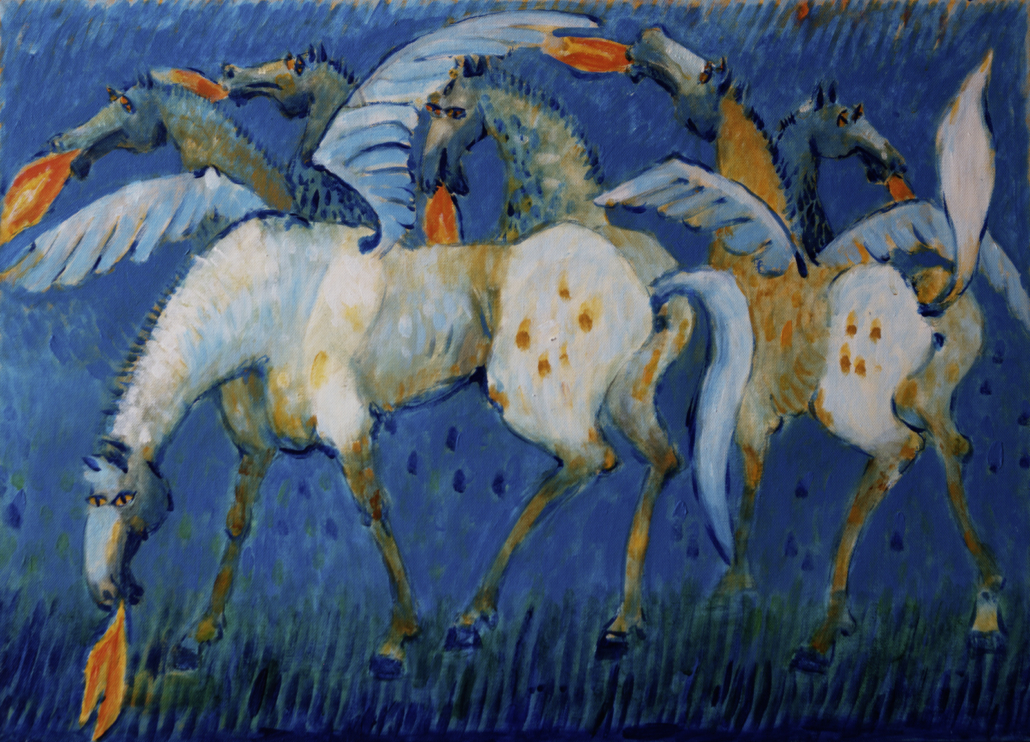


Systematic Overview of the “Mythology” Series (2007)
The entire series of canvases (all executed in a unified, deliberate 50×70 cm format) functions as a complete visual polyptych. Pristavec does not choose random ancient stories; his selection of motifs forms a carefully calibrated dramatic arc of human existence, suspended between the low (earthly/animalistic) and the high (spiritual/divine):
-
Primal Destruction and Conflict: The Battle of the Minotaurs (Boj minotavrov) – a clash with one’s own shadows and suppressed animal nature.
-
Passive Transformation and Erotic Mysticism: Danaë (Danaja) – the opening of the human body to an external, divine influence; the transformation of matter through light.
-
Escapism and Elevating the Spirit: The Rider of the Winged Horse (Jezdec krilatega konja) – Pegasus as a symbol of spiritual liberation, soaring above mundane reality and gravity.
-
Self-Reflection and the Demiurgic Space: The Studio (Atelje) – the bridge between the mythic world and the painter’s reality; the labyrinthine space where these myths actually come alive.
Together, these works form a closed system—a visual essay on the human condition.
Placement in the General and Spatial Context of European Culture
Pristavec’s work does not emerge in a vacuum; rather, it directly echoes European spiritual and art history.
General (Historical-Ideological) Context:
European culture has cyclically returned to antiquity since the Renaissance, but each epoch looks for something different in myth. In the early 21st century, Pristavec no longer uses myths romantically or neoclassically (as tales of external heroes). Instead, he approaches them through the lens of psychological archetypes (in the Jungian sense). For him, myth is a universal code for recurring internal human states—anxiety, passion, and the longing for the transcendental. This places him in line with great European modernists (like Pablo Picasso with his obsessive depictions of the Minotaur, or Francis Bacon), who saw in ancient allegories the cry of the modern, existentially fractured human.
Spatial (Geographical-Cultural) Context:
The Slovenian cultural space occupies a specific position at the crossroads of Central Europe (Mitteleuropa) and the Mediterranean. This duality is strongly felt in these canvases:
-
Central European Influence: Present through the dark, expressive drama, a sense of existential weight, anxiety (angst), and the fragmentation of the body. This is the heritage of Austrian and German Expressionism, where the canvas serves as a battlefield for the artist’s psyche.
-
Mediterranean Influence: Manifested in the choice of brighter, vital color accents and, of course, the themes themselves. Classical Greek myths introduce elements of light, vitalism, and fluidity that soften Central European rigidity.
Connecting this to European movements of the late 20th century, the Mythology series strongly echoes Italian Transavantgarde (Transavanguardia) and the German “New Wild Ones” (Neue Wilde). In the 1980s, these artists returned to figuration, myth, and wild, spontaneous brushwork as a rebellion against cold conceptualism. Pristavec replicates and builds upon this approach in 2007—structuring wild expressionism and keeping it in a tense equilibrium with pure abstraction.
Analysis of Motifs and Style
Motif Analysis: From Beast to Creator
The motifs in this series are defined by a continuous dualism between the physical and the spiritual:
-
The Body as a Battlefield: In both the Minotaur and Danaë, we encounter a radical physicality. The Minotaur’s body is trapped in destruction, while Danaë’s is caught in ecstasy. However, both states blur clear anatomical boundaries—the body becomes fluid.
-
The Spirit as Movement: The Winged Horse and The Studio represent a shift away from pure physics. The horse is a vector of upward movement (elevation), while the studio is a sacral space of creation where material objects transform into visual thoughts.
Stylistic Analysis: Controlled Chaos
Pristavec’s style in this phase is a masterclass in gestural expressionism balanced by a strong sense of structural order:
-
Brushstroke and Texture: The brushstrokes are fast, visible, and rhythmic. The painter does not smooth out the surface; the paint has a tactile, material presence (impasto), giving the works a raw, visceral energy. The surface feels alive, almost restless.
-
Color Palette: He utilizes a contrast between earthy, heavy tones (which anchor the figures in materiality) and flashes of pure, saturated light (the gold in Danaë, or the dynamic blue and red accents in the battles). Color does not describe the realistic state of objects but rather their energetic value.
-
Decomposition of Form: This is the key stylistic element. Figures are not confined by clear outlines (contours). The edges of bodies blend into the background. Pristavec uses a technique where space penetrates the figure and vice versa—ensuring the background is no longer just a backdrop but an active participant in the drama, transforming form into pure rhythm.
Through this methodology, we can see that the Mythology series is not merely an illustration of Greek fables, but a deeply considered cultural artifact. In it, Pristavec uses a synthesis of Central European expressionism and Mediterranean myth to explore the boundaries of human nature.


