Nudes on canvas

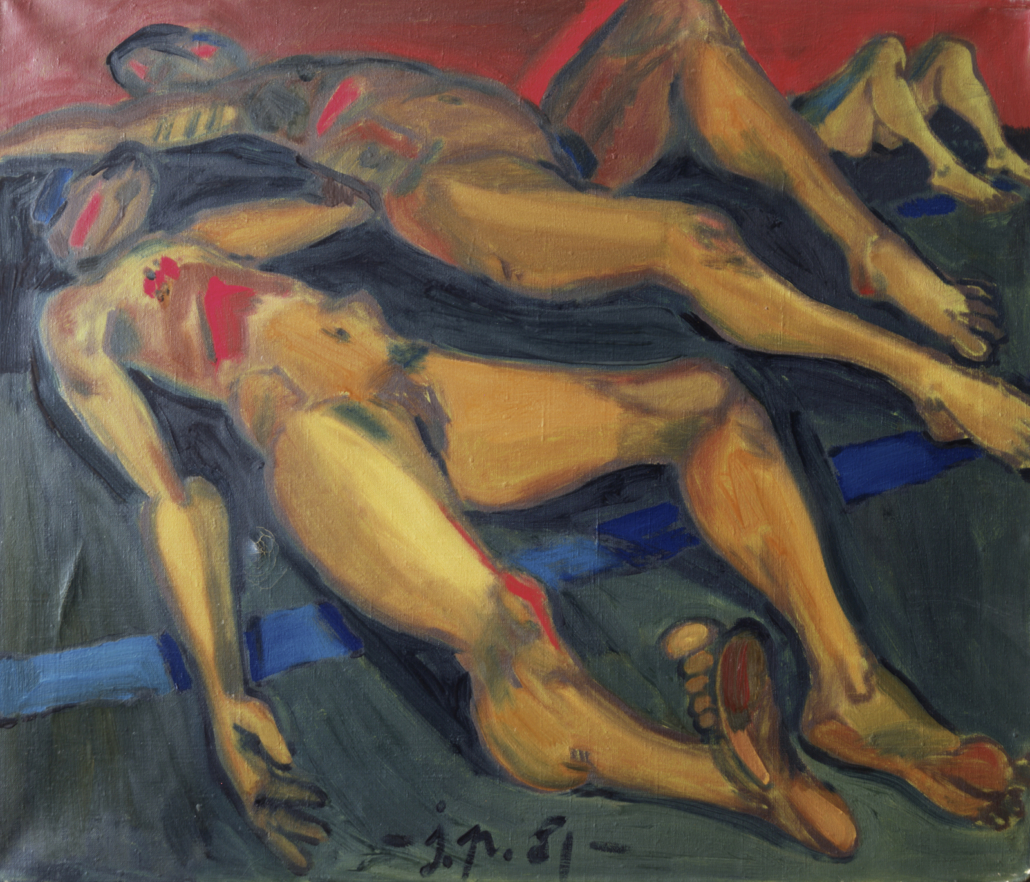
The Nudes on Canvas collection represents a foundational, raw, and deeply intimate chapter in Janez Pristavec’s career. By shifting from the theatrical concealment of the Harlequin cycle and the vast topographies of the Landscapes, this series strips away all performative elements to focus entirely on the human form as an absolute, existential monument.

1976 – 1979

Thematic & Iconographic Framework: The Body as an Absolute Entity

In the broader landscape of European post-war figural art, the nude has often vibrated between classical beauty and raw psychological exposure. Pristavec firmly aligns himself with the latter.

  • The Striped Armor: While his Harlequins use diamond grids as protective armor, his nudes are completely exposed, converting physical vulnerability into monumental strength. The figures in the core trilogy  are deeply introspective, rarely acknowledging the viewer. They sit, turn away, or recline in heavy, solemn poses that emphasize interiority over outward performance.

  • The Archetype of Earth and Flesh: There is an undeniable iconographic connection between his mid-1970s landscapes and these nudes. Pristavec treats the female anatomy like a natural terrain—shoulders, hips, and thighs are rendered with the same monumental permanence as rolling hills, effectively transforming the flesh into an organic landscape.

Stylistic and Formal Analysis: Expressionist Volumetrics and Chiseled Contours

Formally, this cycle displays an exceptional mastery of line and block structuralism:

  • The Structural Contour: Pristavec avoids delicate, academic blending. Instead, he bounds the anatomy with thick, dark, highly expressive contours. These chiseled lines break up the limbs and torso, creating a powerful, raw formal language that references the masterworks of German Expressionism (specifically Egon Schiele and the Die Brücke movement) and the structural gravity of Georges Rouault.

  • Flesh as Sculptural Mass: The volume of the figures is achieved through bold, visible patches of unblended color. The brushstrokes carry a high amount of texture and weight, sculpting the musculature and curves of the body into heavy, blocky planes that reject smooth realism in favor of pure expressive force.

Color Dramaturgy: Carnal Glow against Chromatic Recess

The emotional temperature of these canvases relies on a highly calculated, dramatic use of complementary color contrasts:

  • The Warm Interior Vitality: Skin tones are elevated into a vibrant, carnal spectrum. Pristavec utilizes rich layers of cadmium reds, earthy ochres, intense pinks, and glowing oranges. This choice makes the bodies appear as though they are radiating a high-temperature internal heat.

  • Recessive Cool Environments: To isolate this vitalistic glow, the backgrounds are pushed into flat, cold, or deeply shadowed color planes—recessive blues, dark teals, muted indigos, and forest greens. This deliberate color clash forces the warm figure to leap forward off the canvas, turning the human form into the primary source of light within the composition.

Spatial Arrangement: The Architecture of Isolation

In the later 1970s compositions, Pristavec aggressively compresses the pictorial space:

  • The environments are entirely stripped of narrative context—there are no domestic objects, beds, windows, or clear spatial depths. The figure exists in a vacuum of pure painterly atmosphere.

  • By contorting, folding, and packing the limbs closely together, the body expands to fill the entire frame. The figure itself becomes the architecture of the painting, trapping its own psychological energy within the hard borders of the canvas canvas board.

1980 – 1989

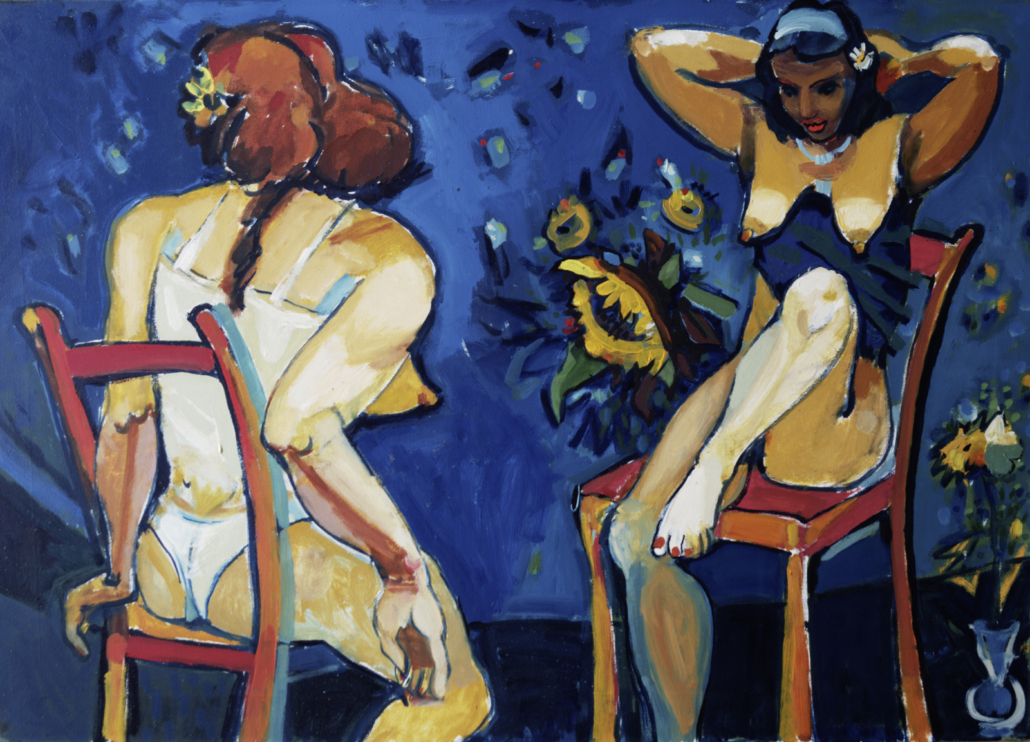
The Nudes on Canvas produced between 1980 and 1989 represent a radical, celebratory departure from the moody, introspective works of his early career. During this pivotal decade, Janez Pristavec moved away from dark, multi-layered oil mediums to embrace acrylics, transforming the human form into a landscape of radiant, vitalistic energy.

Based on the curatorial archives and historical records for this specific era, here is the formal macro-analysis for the 1980s works

Thematic & Iconographic Framework: The Anonymization and Universality of the Body

During the 1980s, Pristavec’s treatment of the nude undergoes a significant conceptual shift. Individualized psychological portraiture is systematically abandoned in favor of universal archetypes.

  • The Anonymous Form: In the vast majority of these 1980s works, the female figures lack distinct facial features. Faces are deliberately left unrendered, hidden by positioning, or omitted entirely. This abstraction ensures that the viewer’s focus remains locked onto the body as a pure motif rather than a portrait of a specific person.

  • The Ultimate Erotic Object: Stripped of facial narrative, the body becomes a playground for exploring pure volume, posture, and eroticsm. Influenced by his highly expressive 1981 cycles of distorted figures, the canvases of this decade constantly walk the line between playful allure, robust physical weight, and avant-garde anatomical configuration.

Stylistic and Formal Analysis: Linear Playfulness and Structural Simplification

Formally, the heavy, chiseled outlines of his late-1970s works open up into a much more fluid, energetic vocabulary.

  • Playful Draughtsmanship (Risarska igrivost): Transitioning primarily into acrylics on canvas, Pristavec’s style becomes noticeably light, spontaneous, and intuitive. He captures the essence of the form using simplified, elegant lines and basic organic shapes, creating a highly dynamic sense of movement across the canvas.

  • The Late-80s Synthesis: Toward the absolute close of the decade (spanning the late 1980s into the early 1990s), this playful simplification undergoes a secondary evolution. Pristavec begins to synthesize his decade-long abstract-color experiments back into a highly detailed, anatomically rich, and classical depiction of the nude.

Color Dramaturgy: Eruptive Purity and Chromatic Vibration

The most striking development of Pristavec’s 1980s output is the complete banishment of muddy, dark, and muted tones.

  • Radiant Pure Colors (Sijoče barve): Influenced by color theory and the broader Central European avant-garde currents, his canvases explode with pure, unblended pigments. Pristavec directly experiments with how raw primary and secondary tones—vibrant greens, blazing yellows, deep blues, and explosive reds—vibrate when placed side-by-side.

  • Eruptive Energy: The color is no longer just applied to the form; it is the form. The figures glow with a vitalistic, internal warmth that blends seamlessly with equally vibrant backgrounds, turning the entire canvas surface into a field of intense optical and emotional resonance.

Spatial Arrangement: The Autonomous Field of Color

Reflecting his concurrent mid-1980s masterpieces on experimental surfaces (such as his famous Crumpled Expressions series), Pristavec fundamentally alters the spatial dynamics of his canvas compositions.

  • The claustrophobic, flat backdrops of his academic years dissolve into floating, open planes of color energy.

  • The nudes are no longer rigidly anchored to the ground; they stretch, bend, and interact dynamically within a structured, almost architectural pictorial field where background and foreground share equal visual importance.

1990 – 2006

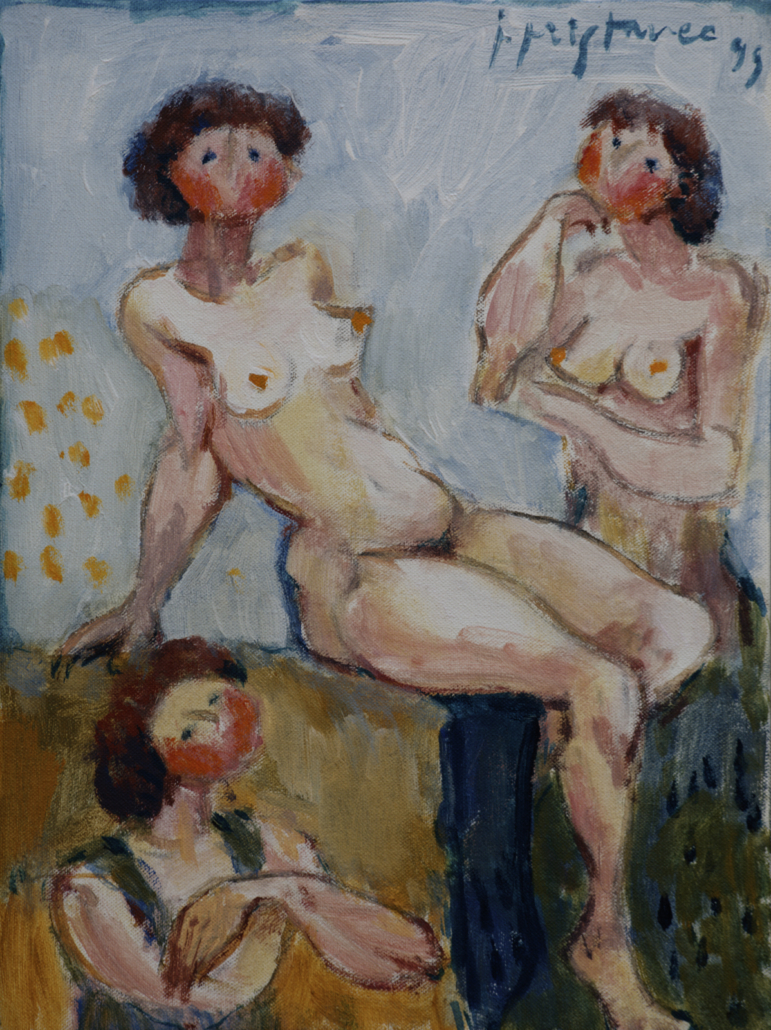
The Nudes on Canvas produced between 1990 and 2006 represent the grand finale and the ultimate mature phase of Janez Pristavec’s figural journey. If the 1970s were characterized by introspective weight and the 1980s by a playful explosion of pure color, this final era achieves a masterly Synthesized Expressionism. Here, Pristavec unites the psychological depth of his early career with the unrestricted, gestural freedom of his late years, creating bodies that stand as raw, existential monuments.

Thematic & Iconographic Framework: The Existential Body and Spiritual Synthesis

In this final timeline, Pristavec moves past both the strict concealment of his theatrical figures and the complete anonymity of his 1980s nudes.

  • The Psychological Return: The face and the gaze return to the canvas, but they are no longer purely academic. Features are frequently blurred, elongated, or mask-like, conveying a profound sense of universal human isolation, spiritual endurance, and wisdom.

  • The Body as Biography: The figures in this late period carry an undeniable gravity. Pristavec stops treating the nude as a purely aesthetic or erotic playground and begins treating it as an existential battlefield. The poses are heavy, deeply anchored, or grandly suspended, turning the human form into a timeless symbol of survival.

Stylistic and Formal Analysis: Calligraphic Gestures and Tactile Impasto

Formally, this era showcases a breathtakingly confident, late-career hand where line and matter fuse completely:

  • Calligraphic Expressionism: The clean, playful lines of the 1980s evolve into fierce, rapid, calligraphic brushstrokes. Pristavec uses the black or dark contour not just to enclose the form, but as an independent, dramatic force. Sudden paint splatters and bleeding lines echo East Asian ink traditions overlaid onto a European Expressionist framework.

  • Tactile Texturing (Impasto): The surface of the canvas becomes intensely physical. Pristavec applies the paint thickly, scoring, scraping, and layering the medium with palette knives and heavy brushes. The flesh of the nudes is no longer smooth; it is chiseled, scarred, and rich with texture, physically embodying the passage of time.

Color Dramaturgy: Sophisticated Deeps and Luminous Fractures

The raw, primary colors of the previous decade melt into a far more complex, deeply resonant, and atmospheric palette:

  • Resonant Twilight Tones: The background and shadow zones are dominated by sophisticated, deeply saturated mixtures—velvety indigos, midnight blues, deep violets, rich crimsons, and dark emeralds. This choices creates a twilight, spiritual world for the figures to inhabit.

  • The Luminous Fracture: To contrast these heavy, brooding depths, the contours of the bodies break open with sudden, shocking fractures of brilliant light. Streams of pure gold ochre, fiery cadmium orange, or stark titanium white cut through the skin tones, making the late-period nudes appear as if they are illuminated by a harsh internal or external spotlight.

Spatial Arrangement: The Integrated Painterly Vortex

Pristavec completely discards the concept of a figure resting against a background.

  • Foreground and background are sucked into a singular, vibrating painterly vortex. The heavy, gestural strokes that shape the background atmosphere match the emotional frequency and texture of the body itself.

  • The space surrounding the nude feels alive, thick with moving air and energy, mirroring the psychological and spiritual state of the subject. The architecture of the painting is entirely dictated by the raw energy of the brush.

No Date