


Colors
From Figural Residue to Chromatic Topography
When the face disappears, the crumpled paper retains its corporeality: the painting itself becomes skin, terrain and chromatic organism.


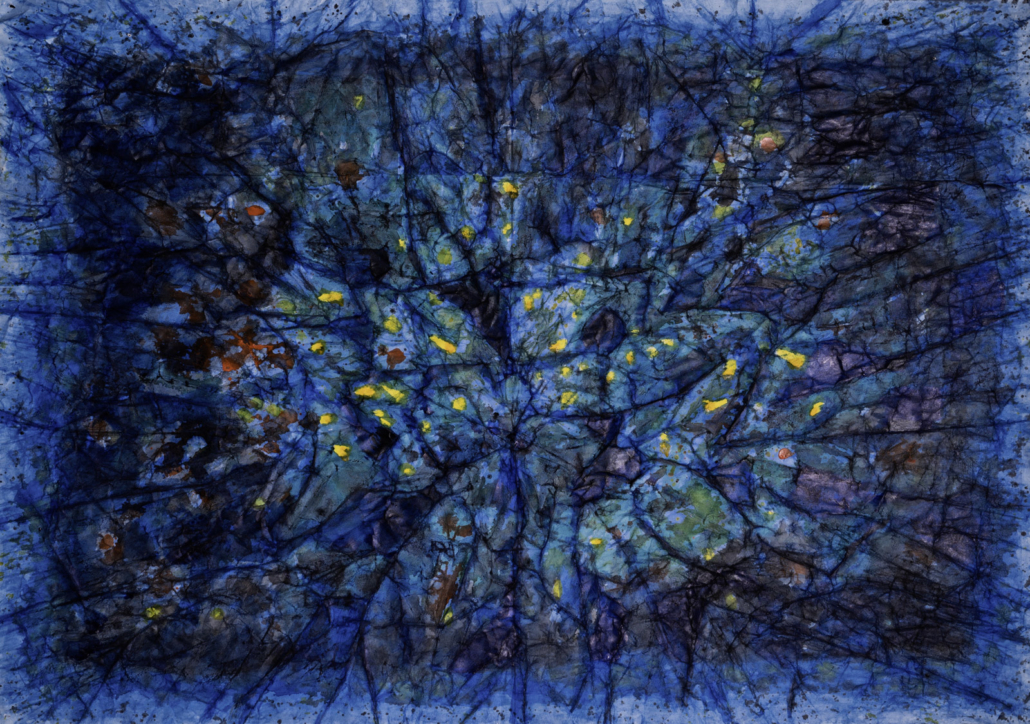


The shift from the neo-expressionist figuration of the Masks series to these purely abstract compositions marks a sophisticated evolution in Janez Pristavec’s handling of the crumpled paper matrix. The tactile fractures of the paper cease to define the boundaries of the body; instead, they dictate the flow, bleeding, and crystallization of raw color fields.
Crumpled Papers – Colours develops directly from the figurative works on the same support. In the faces, folds became furrows of forehead, cheek or neck; in the next step the motif disperses across the whole surface. The paper remains bodily but is no longer subordinated to a head or figure. The painting itself becomes skin.
Crumpling and unfolding the sheet creates a network of folds, intersections and depressions that functions as a preliminary drawing. The artist may emphasise it with dark paint, cover it with a translucent layer, or use it as the edge of a larger colour plane. A line may simultaneously be brushstroke, crack and shadow. Colour is never entirely uniform, because relief breaks and thickens it with every shift of light.
Most works are horizontal, and the gaze therefore travels without a single centre. It moves between dense cores, luminous openings and vertical tectonic bands. The compositions often evoke landscape – forest, rock, water or ravine – without describing a specific place. Their landscape quality is bodily and spatial. Pink and violet fields retain a memory of skin; blue-green areas suggest depth and cold. The cycle is Pristavec’s most sustained approach to abstraction, yet motif does not vanish: it disperses into material, rhythm and chromatic tension.
After the face withdraws, the material surface becomes autonomous. In Crumpled Papers – Colours, fold, crack and relief are no longer used to construct a figure but form the organising network of the entire image.
The passage from Crumpled Paper Faces to Crumpled Paper Colours may be understood as one of the most logical and, at the same time, most hazardous decisions in Pristavec’s development. In the faces, the material irregularity of the paper still served the figure: folds became furrows across the forehead, fractured the cheek, opened the neck, or determined the position of an eye. In the subsequent cycle, this supporting iconography recedes. The paper remains equally active, but it is no longer subordinated to a recognisable likeness. What had previously been the skin of the face becomes the skin of the entire picture.
This does not mean that the artist simply moves from figuration into pure abstraction. Such an account would be too linear and would overlook the persistence of earlier experience. Many works retain vertical masses, dark cavities, symmetrical tensions, and relations between centre and edge that continue to carry a memory of body or mask. The figure is not erased in a single step; it is decomposed into rhythms, planes, and fissures. The cycle is therefore better understood as a process in which the motif is dispersed rather than denied.
In these works it is necessary to distinguish between the drawing made by the artist and the drawing already contained by the support. Crushing and crumpling the paper produces a system of folds, intersections, depressions, and protrusions before the first application of paint. This system functions as a pre-existing drawing: it is not a neutral ground but a network of possibilities to which the artist responds. Some folds are reinforced with a dark application, others are veiled by translucent colour, while still others become the boundary of a larger chromatic plane. The image consequently emerges through a dialogue between found and added structure.
Such a procedure diminishes the conventional distinction between drawing and colour. A dark line visible on the surface may be a brushstroke, a shadow held within a depression, or a combination of both. Equally, a chromatic plane is never entirely flat, because it fractures, thickens, or thins across the creases. Colour becomes dependent upon micro-relief, while relief becomes visible only through colour. This reciprocity is the central formal property of the cycle.
Most of the works in the surviving body of work are presented in a markedly horizontal format. This choice is not merely technical; it substantially alters the conditions of viewing. The vertical sheets of the face cycle directed the spectator towards a frontal encounter with a single figure. The horizontal surface opens a wider and more dispersed field across which the eye travels without one stable centre. Composition extends, condenses, and branches.
Horizontality inevitably evokes the tradition of landscape, yet Pristavec does not construct a horizon in the conventional sense. Certain works suggest upper and lower zones, or a distinction between a dense dark area and a lighter margin, but space remains shallow. Instead of a view into distance, one encounters a surface behaving as terrain. The picture is simultaneously in front of and beneath the spectator: it may be read as wall, ground, crust, or map.
The crumpled papers create the impression of a dense calligraphy, yet this calligraphy is not composed solely of intentional strokes. Folds intersect at irregular angles, form nodes, and then disappear beneath layers of colour. Dark paint frequently reactivates them, giving them the character of a nervous, almost vegetative inscription. In some works they resemble branching growth; in others, fissures in rock, veins, currents of water, or a rapidly sketched urban network.
The line does not describe the external boundary of an object. Its function is internal: it divides the field, connects chromatic zones, and generates directions of movement. One may therefore speak of a material calligraphy in which the sign conveys no verbal meaning but transmits the energy of the surface. The line is simultaneously trace, incision, and shadow.
These works do not simply abandon the world of things. Body and landscape remain present as memories carried by relief, chromatic mass and the direction of the gaze. Pristavec’s abstraction is therefore physical, vulnerable and filled with the residue of motif.