


Janez Pristavec’s Academic Foundations – Descriptive Geometry and Biomechanical Anatomy (1974–1979)
I. The Mathematical Sublime: Geometric Distillation of Conchology
This exceptional body of academic drawings, executed during Pristavec’s tenure at the Academy of Fine Arts (ALU) in Ljubljana, uncovers the foundational, constructivist substructure of his entire artistic vocabulary. In the comprehensive conchology studies, Pristavec treats the organic architecture of snail and sea shells not as passive still-life subjects, but as complex equations of descriptive geometry.
Using precise graphite foundations augmented by sharp color-coded ink trajectories (vibrant reds, deep blues, and structural oranges), the artist maps out internal spatial pathways, cross-sections (prerez morskega polža), and cutting planes (presečnica). The internal helix or spiral core (hodnica v valovitem vrtnem polžu) is exposed like a mechanical blueprint. Formally, these sheets balance empirical naturalism with pure mathematical abstraction; the sweeping, outer contours of the shells are counterweighted by dotted projection lines and axial coordinates that demonstrate a profound understanding of logarithmic growth, structural volume, and three-dimensional rotation on a two-dimensional plane.
II. Biomechanical Deconstruction and Kinetic Vectorization
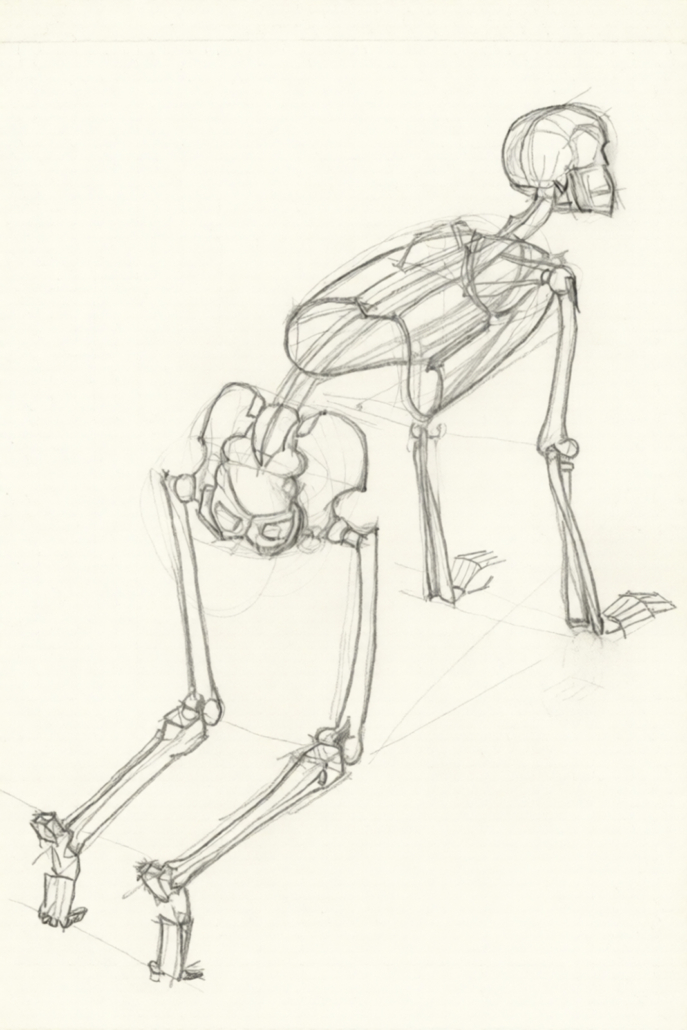
The rigorous analytical methodology shifts from architecture to kinetic life in the animal and primate anatomical sheets. In his highly analytical primate studies (gorile), Pristavec strips away the outer skin to expose a pure mechanical armature. The skeleton is reduced to a series of weight-bearing levers, volumetric cylinders, and focal joints linked by explicit structural axes that map out spatial perspective and center-of-gravity shifts.
This constructivist reduction is further synthesized in his amphibian and reptile studies:
-
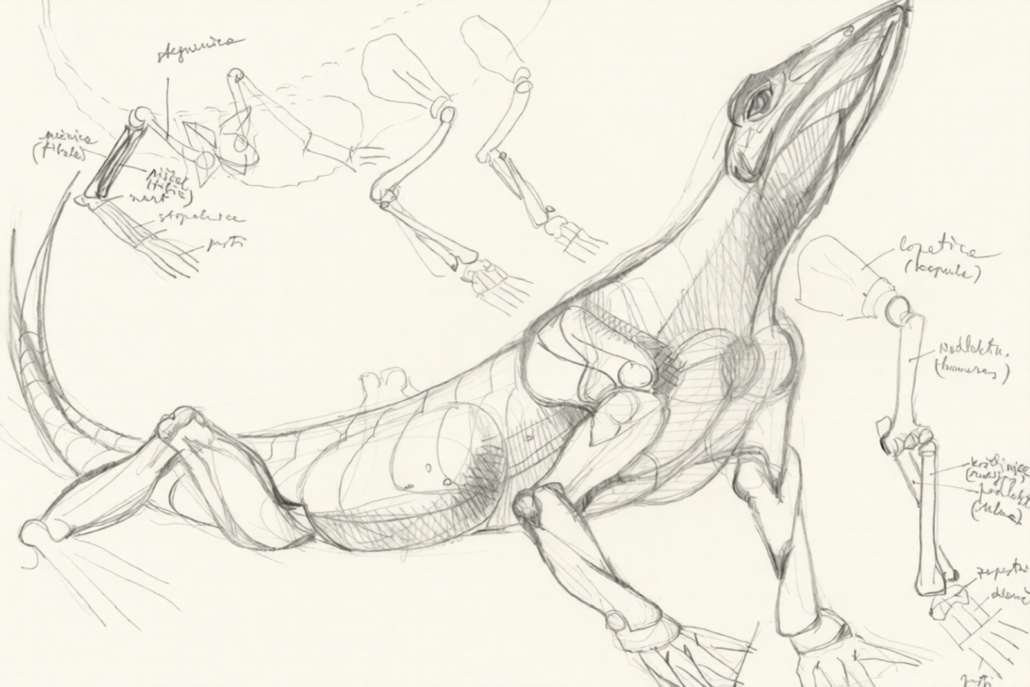
The meticulous graphite profile of an iguana is accompanied by geometric “stick-figure” schematics in the margins, mathematically plotting the mechanics of its walking gait and limb placement.
-
In the frog study, the artist documents locomotion by highlighting key muscle groups—explicitly labeling the deltoideus and deltridens—while overlaying a schematic trajectory that breaks down the physics of a jump into pure vectors of force.
Pristavec approaches the living creature as a beautiful, high-performance machine, tracking how bone levers and muscular contraction translate into physical space.
III. The Internal Blueprint of the Evolutionary Bridge
Phenomenologically, this academic phase is the indispensable catalyst for Pristavec’s evolutionary bridge. Before the artist could aggressively shatter anatomy in the 1992 Tuataromahija or dissolve form into color in the 2001 Asocijacije, he spent years mastering the absolute, structural grid of nature. The rotating, rhythmic bands of the snail shells are the direct conceptual ancestors of his late abstract modular color waves. The multi-directional linear vectors used here to mathematically chart a frog’s jump or a gorilla’s pelvis are the exact same graphic marks that would later liberate themselves from representation to become fields of pure kinetic energy. Ultimately, these ALU drawings prove that Pristavec’s abstraction was an act of profound structural distillation—a process of looking so deeply into the mathematical scaffolding of the universe that the illusion of surface reality simply dissolved.





IV. The Stereometric Reduction of Organic Volumetrics
This second installment of Janez Pristavec’s academic drawings from ALU Ljubljana represents a radical exercises in stereometry (the geometry of solid bodies), exposing the analytical scaffolding underneath human and animal anatomy. The absolute centerpiece of this sequence is the multi-sheet investigation of the human pelvis. Pristavec approaches this highly complex biological structure not through standard anatomical copying, but through a brilliant proto-cubist distillation.
As demonstrated across the sequence of stereometric studies, the pelvis is systematically reduced to a series of interlocking, pristine geometric volumes:
-
A truncated cone section clashing with a hollow cylinder cutting through its core.
-
A strict, blocky cube model that maps out the spatial orientation and tilt of the pelvic bowl.
-
A network of intersecting planes and dashed projection lines marked with spatial points (“A”) to track rotation across a three-dimensional grid.
This spatial reduction is perfectly summarized in the technical translations executed by the artist:
| Biological Form | Stereometric Substructure | Analytical Vector |
| Pelvic Basin | Truncated Cone / Cylinder Intersection | Spatial Tilt & Volumetric Depth |
| Femur / Joint Levers | Cylindrical Rods & Spherical Nodes | Kinetic Mechanics & Weight Distribution |
| Organic Hide / Muscle | Faceted Planes & Planar Cross-Hatching | Surface Tension & Mass Definition |
V. Orthographic Projections and Anatomical Nomenclature
In the masterfully executed multi-view sheet, Pristavec transitions from abstract stereometry into precise orthographic and medical mapping. The drawing presents the human pelvis from six distinct anatomical perspectives, including standard anterior views, profile alignments, and rare orthogonal views labeled as “Pogled od spodaj” (View from below) and “Pogled od zgoraj” (View from above).
The sheet is grounded by professional medical and anatomical nomenclature written in the artist’s own hand, pinpointing the structural composition of the bone matrix:
-
ILION (črevnica) defining the broad upper wings of the pelvis.
-
Os sacrum (križnica) and os coccygis (trtica) anchoring the central spinal column.
-
Pubis (sramnica) and ICHION (sednica), explicitly detailed down to the sub-components of the “sednični trn” (ischiatic spine) and “sednični lok” (ischiatic arch).
Using micro-interventions of yellow and red/orange colored pencils, Pristavec highlights the focal stress points and cartilaginous joint connections. This disciplined orthographic mapping proves that the artist possessed an empirical, near-surgical comprehension of human architecture before he began his journey toward the distortion of form.
VI. Faceted Zoomorphism and Kinetic Trajectories
The dialogue between mathematical grid lines and organic energy continues seamlessly into the amphibian and primate sheets. In the remarkable study of a crouched frog, Pristavec discards smooth organic rendering entirely, building the animal out of hard, faceted geometric planes defined by dense, uniform cross-hatching. The thighs and webbed feet are transformed into blocky, articulated polyhedrons, echoing the early cubist experiments of Georges Braque.
This is accompanied by rapid skeletal motion studies where primates and amphibians are stripped down to stick-figure kinetic armatures. Vertical axis lines capped with star-like directional vectors map out the exact paths of physical movement, leaping force, and skeletal leverage.


