

Abstract drawings
Formal Definition and Typological Expansion of the Opus
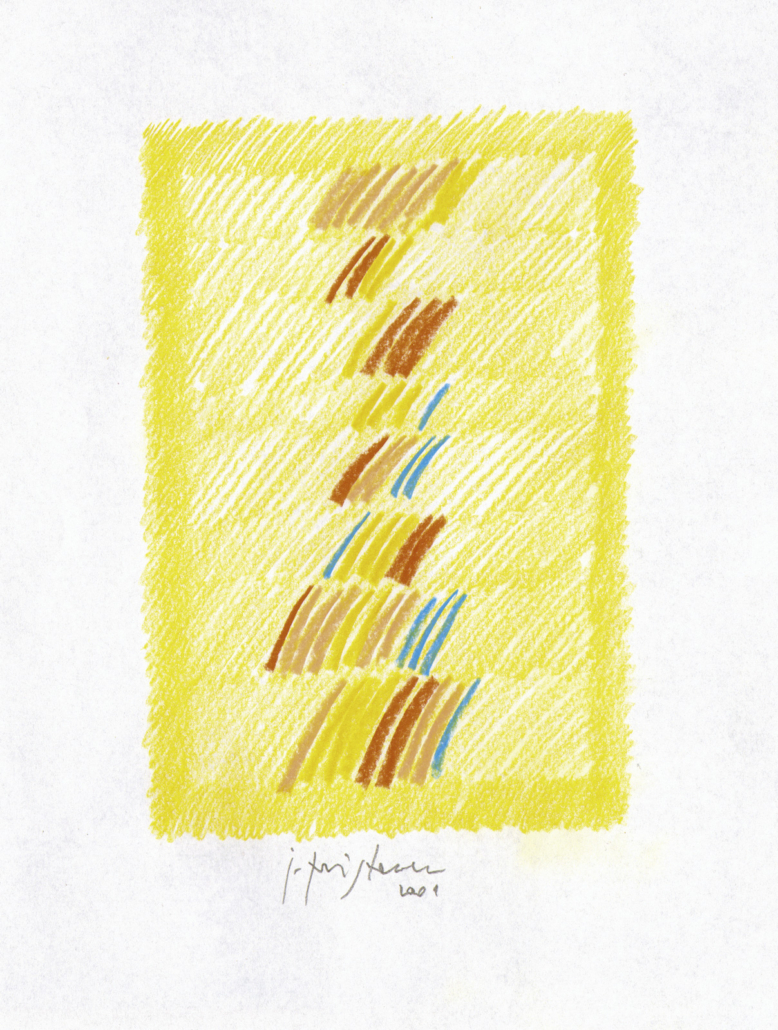
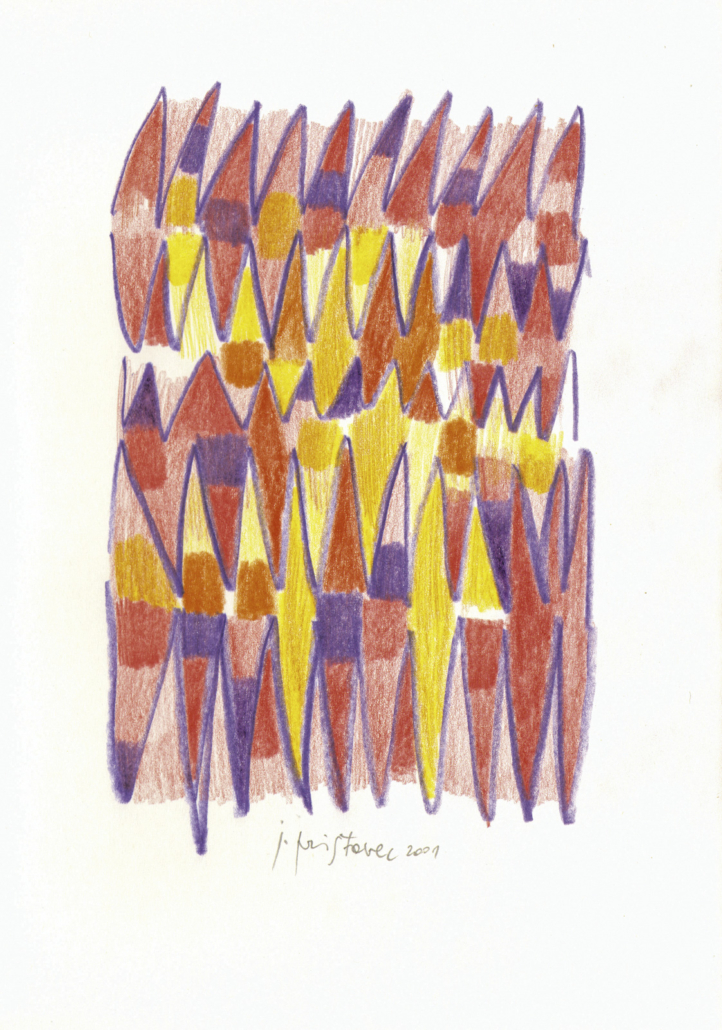
The expanded corpus of the 2001 colored pencil series, comprehensively titled “Abstraktne risbe” and explicitly sub-designated by the artist as “Asocijacije” (Associations), reveals a brilliant, multi-layered typological system far more complex than a singular stylistic exercise. Executed with a masterfully disciplined hand on paper, the collection unfolds into three distinct structural modalities. The first is a series of horizontal stratifications, where undulating, rhythmic bands of alternating warm and cool hatchings stack vertically, mimicking the compression of geological strata or the horizon lines of an abstracted landscape. The second modality introduces a profound spatial tension: a serene, monochromatic background matrix (often rendered in atmospheric blues or luminous yellows) sliced down the center by a concentrated, vertical “spine” of polychromatic, gestural vectors. The final modality encompasses geometric, vector-driven interventions where sharp, intersecting wedges and triangles clash with strict linear boundaries. Pristavec’s visible pencil strokes refuse static encapsulation; instead, they create an optical flicker where the raw, white grain of the paper acts as an internal light source, transforming these drawings from mere marks into self-sustaining phenomenological fields of energy and movement.
Structural Placement within Slovenian Modernism and the European Avant-Garde
To locate “Abstraktne risbe / Asocijacije” within the trajectory of Slovenian art history is to witness a profound sublimation of the lessons taught at the Ljubljana Academy of Fine Arts. While Pristavec’s mentors, Janez Bernik and Andrej Jemec, frequently channeled the heavy, existential weight of Art Informel or dark structuralism, Pristavec’s late-period work shifts toward an intimate, lyrical emancipation of color. The horizontal banding within this expanded series directly echoes his seminal mid-career Hrib (Hill) cycle, yet here, the topographic landscape is entirely dissolved into pure, meditative notation. In the broader European context, this work functions as a critical bridge between Central European Concrete Art (Konkrete Kunst) and Lyrical Abstraction. However, Pristavec completely bypasses the cold, mathematically computed mechanization of Western geometric abstraction. By keeping the organic tremor, pressure variations, and physical index of his hand visible, his seriality remains deeply human, diaristic, and rooted in an intimate, Central European poetic sensibility.
The Phenomenological Core: International Color Fields, Musicality, and Pure Association
In the global discourse of post-war abstraction, the “Asocijacije” series positions itself at the apex of Chromatic Abstraction and synesthetic art. The interplay between expansive color fields and condensed graphic notation channels the spiritual sublime of Mark Rothko, yet forces it into the rigorous, concentrated scale of an intimate drawing cabinet. The structural layout of these works operates on a profoundly musical axis: the horizontal stratifications read like contrapuntal musical staves, while the sharp, vertical polychromatic spines function as sudden visual crescendos or kinetic soundwaves. Pristavec’s hand-written title, Asocijacije, confirms that these drawings are not passive decorations but active cognitive maps—visual translations of interior states, classical music, and accumulated memories of light. Ultimately, this expanded series stands as a monument to the monumental potential of minimalist mediums, proving that within the humble boundaries of a colored pencil drawing, an artist can build infinite, transcendental architectures of light, sound, and space.
Material Pluralism, Contrast Dynamics, and Somatic Touch
Furthermore, the final evolution of the Asocijacije series exposes a compelling shift in material intensity and structural friction, characterized by an unprecedented graphic density. A radical tonal rupture occurs with the sudden introduction of heavy, opaque medium overlaying the delicate matrix of colored pencils. In these specific arrangements, Pristavec departs from the translucent, wax-based luminosity of his previous sheets, stamping a dark, monolithic network of thick, saturated strokes against a frail, vibrating sky-blue border. This creates an explicit dialogue between void and mass, a somatic weight that provides an earthy gravity to the otherwise ethereal collection. Simultaneously, the structural friction reaches its aesthetic zenith in the tightly woven, overlapping triangular grids. Here, the interlocking mesh of fiery reds, deep purples, and calculated greens forms a vibrating visual textile, demonstrating how effortlessly the artist could pivot from expansive, fluid atmospheres to high-velocity graphic tension. This textural pluralism underscores a complete mastery over the paper’s micro-topography, finalizing the entire opus not merely as a cerebral study of color relationships, but as a deeply visceral, tactile record of human pressure, cadence, and somatic rhythm.